


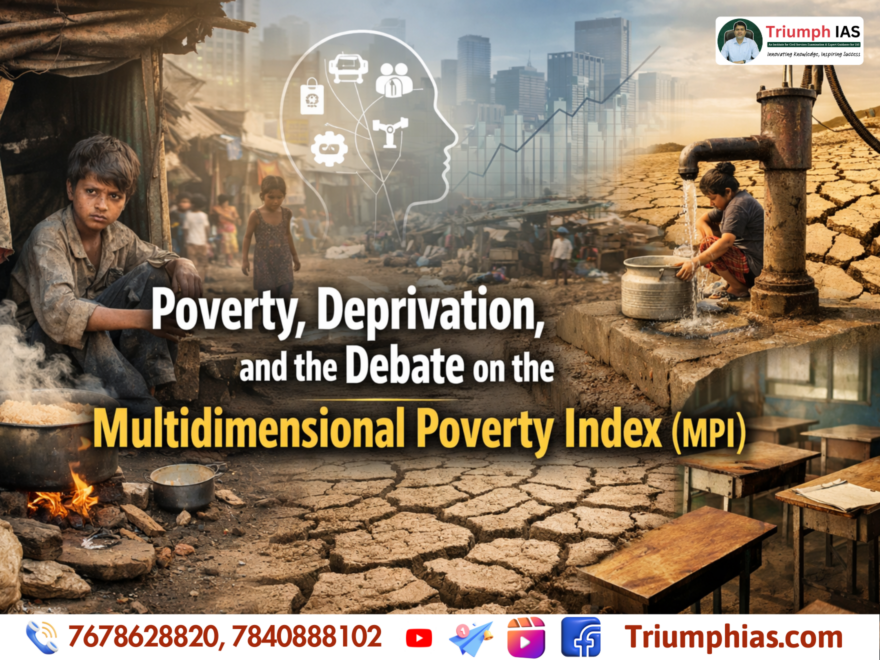
Poverty, Deprivation, and the Debate on the Multidimensional Poverty Index (MPI)
(Relevant for Sociology Optional Paper 1, Paper 2, and GS Paper I (Indian Society)
IntroductionPoverty has traditionally been measured through income or consumption expenditure. However, sociological inquiry has long argued that poverty is not merely the absence of income but a condition of structural deprivation embedded in social relations, institutional inequalities, and power hierarchies. The debate around the Multidimensional Poverty Index (MPI) emerges from this broader sociological understanding of poverty as capability deprivation rather than income deficiency alone. Dimension:From Income Poverty to Multidimensional Deprivation
Classical poverty measures, such as the poverty line approach, focus primarily on income thresholds. While useful for macroeconomic comparison, this approach fails to capture lived realities—malnutrition, lack of education, poor sanitation, limited access to healthcare, insecure housing, and social exclusion. The MPI attempts to bridge this gap by measuring deprivation across three core dimensions:
Each dimension includes multiple indicators such as years of schooling, child mortality, nutrition, sanitation, drinking water, electricity, housing, and assets. A household is considered multidimensionally poor if it is deprived in a specified proportion of these indicators. This shift reflects Amartya Sen’s capability approach, which argues that poverty should be understood as the deprivation of substantive freedoms rather than simply low income. Sociologically, this aligns with the idea that poverty is relational and structural, shaped by caste, gender, region, and class inequalities. Sociological Significance of MPIThe MPI broadens the analytical lens. It captures:
For instance, Scheduled Castes, Scheduled Tribes, and women often experience layered deprivation that income metrics alone cannot reveal. MPI thus provides a better diagnostic tool for targeted welfare policy. Moreover, the MPI allows policymakers to identify specific deprivations—such as lack of sanitation or school dropout—enabling more precise intervention rather than uniform cash transfers.
The Debate: Measurement vs RealityDespite its strengths, the MPI is not without criticism.
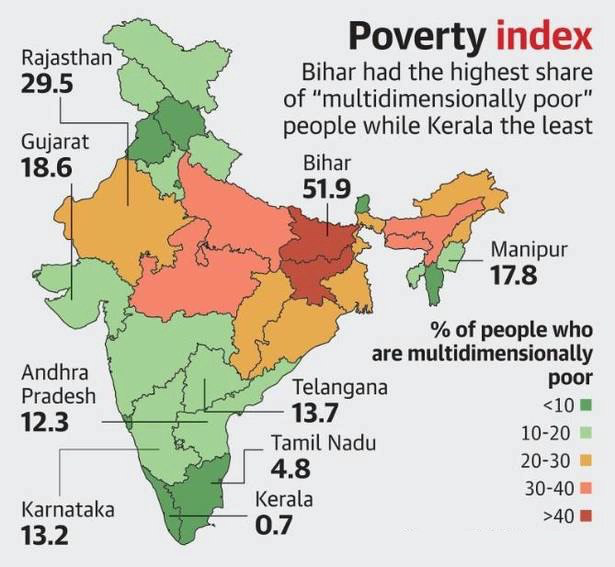
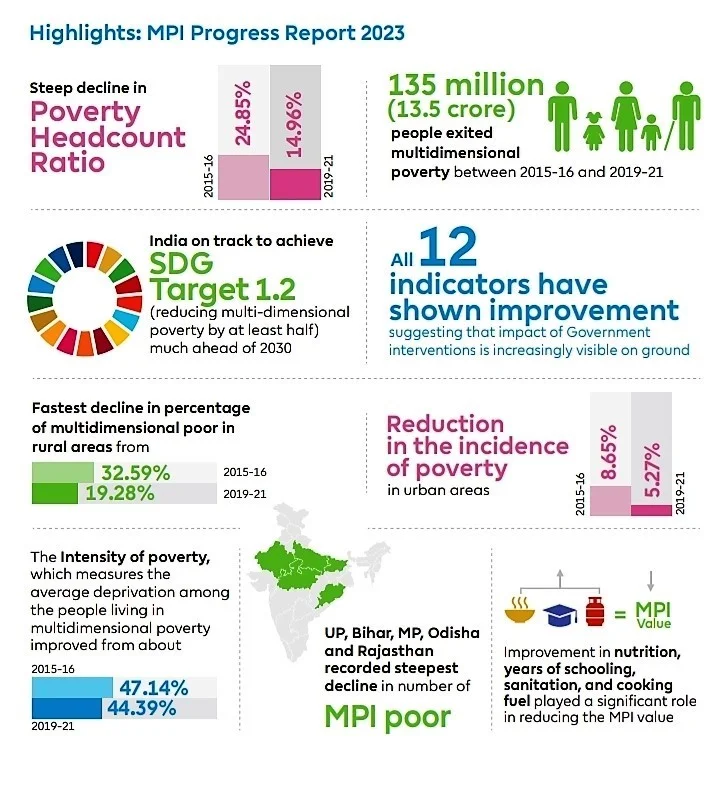
Critics argue that MPI may sometimes mask income distress or unemployment trends. Sociologically, poverty cannot be separated from labour market precarity, informalisation, and agrarian distress. MPI and Welfare State TransformationIndia’s recent policy discourse has emphasized improvements in multidimensional poverty indicators—expansion of toilets, electricity, housing, and direct benefit transfers. This signals a governance shift from income redistribution to asset and infrastructure provisioning. However, sociologists caution that welfare provisioning must be accompanied by structural reforms—quality public education, healthcare access, employment generation, and social security for informal workers. Otherwise, poverty alleviation risks becoming technocratic rather than transformative.
Conclusion:The MPI represents an important evolution in poverty measurement. It aligns closely with sociological understandings of deprivation as multidimensional and socially embedded. Yet, measurement alone cannot substitute for structural transformation. The core question remains: Are we merely counting fewer poor, or are we dismantling the structures that produce poverty? True poverty alleviation requires not only improved indicators but enhanced capabilities, dignity, and social mobility. |



UPSC Civil Services (Mains) Question
Poverty is not merely an economic condition but a multidimensional social phenomenon.” Critically examine this statement in the context of the Multidimensional Poverty Index (MPI).
To Read more topics, visit: www.triumphias.com/blogs
Read more Blogs:
Inequality in India: Wealth Concentration and Social Polarisation
5 comments