


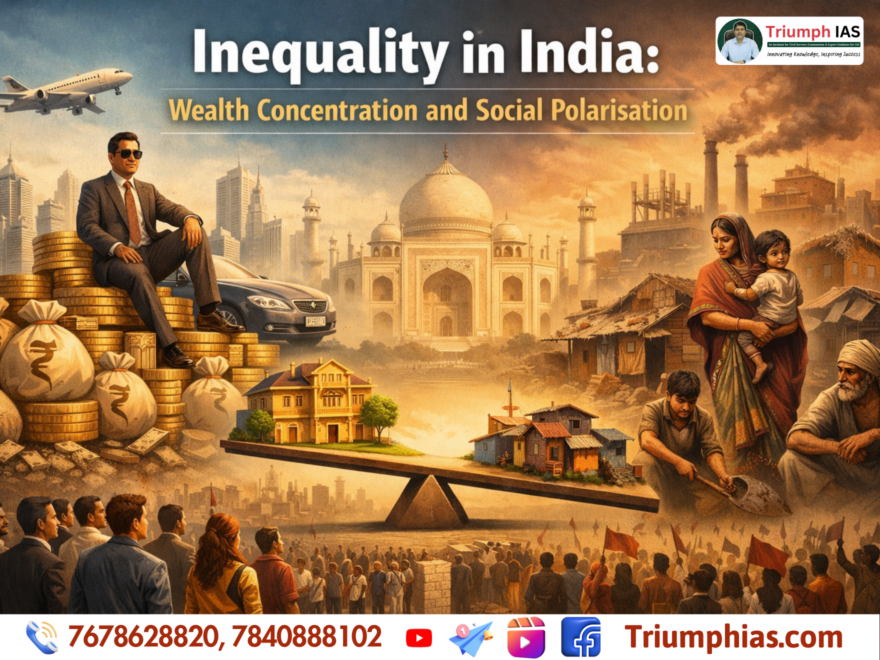
Inequality in India: Wealth Concentration and Social Polarisation
(Relevant for Sociology Optional Paper 1, Paper 2, and GS Paper I (Indian Society)
IntroductionInequality in India has emerged as one of the most defining sociological questions of contemporary times. While India has witnessed remarkable economic growth since the 1991 liberalisation reforms, the distributional consequences of this growth have generated intense debate. The paradox of “high growth with persistent inequality” invites a structural sociological analysis rather than a purely economic one.
Dimension:Structural Roots of InequalityFrom a sociological standpoint, inequality in India is not merely about income disparity; it is embedded in historically constituted structures of caste, class, gender, and region. The caste system institutionalised graded inequality, legitimising differential access to land, education, and occupations. Even with constitutional safeguards and affirmative action, caste continues to shape life chances through social networks, marriage patterns, and occupational clustering. Class stratification has deepened in the neoliberal era. Economic reforms expanded markets, encouraged private capital accumulation, and integrated India into global capitalism. However, this growth disproportionately benefited urban, skilled, and capital-owning groups. Informal workers, agrarian labourers, and marginal farmers remain vulnerable to market fluctuations and precarious employment. The sociological concept of “structural exclusion” becomes crucial here: participation in growth is mediated by access to education, capital, and social capital. Wealth Concentration and Capital Accumulation
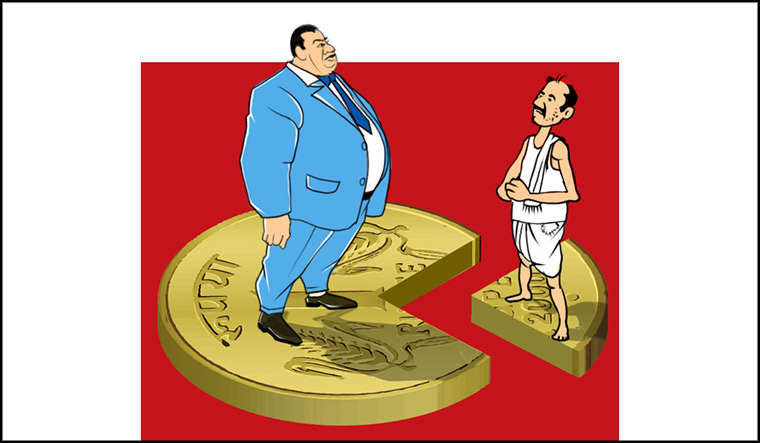
Wealth concentration in India reflects a pattern where a small elite controls a significant proportion of national wealth. This aligns with the broader global trend analysed by scholars like Thomas Piketty, who argue that returns on capital often exceed economic growth rates, leading to intensified concentration. In India, corporate consolidation, inheritance of wealth, and financialisation of the economy have further entrenched economic elites. From a Marxian perspective, this reflects the logic of capital accumulation and surplus extraction. The bourgeoisie consolidates ownership over productive assets, while the proletariat remains dependent on wage labour. Simultaneously, a Weberian lens highlights how status groups and bureaucratic power intersect with class to reproduce inequality. The digital economy has added a new dimension. While it generates opportunities for entrepreneurship and innovation, it also produces a digital divide. Access to technology, digital literacy, and online capital determine who benefits from platform-based economies. Thus, technological advancement may inadvertently widen structural disparities. Social Polarisation and Fragmented Public SphereWealth concentration is not only an economic issue; it produces social polarisation. Polarisation manifests in spatial segregation (gated communities versus informal settlements), differential access to health and education, and symbolic distinctions in lifestyle. Pierre Bourdieu’s idea of “cultural capital” is relevant here: elite groups convert economic capital into educational and cultural advantages, reproducing privilege across generations. Social polarisation also intersects with identity politics. Economic insecurities can be channelled into caste, religious, or regional mobilisation, intensifying social cleavages. The public sphere becomes fragmented, as different social groups inhabit distinct informational and experiential worlds. Urban-rural divides, regional disparities between developed and lagging states, and gendered labour force participation further complicate the landscape. State, Welfare, and RedistributionThe Indian state has historically attempted to address inequality through land reforms, reservations, public distribution systems, and welfare schemes such as MGNREGA and direct benefit transfers. These interventions aim at redistributive justice and social protection. However, sociological evaluation reveals both manifest and latent functions. While welfare programmes alleviate poverty, they may not fundamentally alter the structural basis of inequality, such as unequal ownership of productive assets or differential access to quality education. The challenge, therefore, lies in balancing growth with equity. Inclusive development requires investment in public education, universal healthcare, progressive taxation, and labour-intensive industrialisation. Equally important is social reform that dismantles entrenched hierarchies. Conclusion:Inequality in India is multidimensional—economic, social, cultural, and spatial. Wealth concentration intensifies social polarisation, weakening social cohesion and democratic equality. A sociological understanding reveals that inequality is not accidental but structurally produced and reproduced. Addressing it demands structural transformation, not merely incremental welfare measures. For a society aspiring toward substantive democracy, reducing inequality is not only an economic necessity but a moral and constitutional imperative. |


UPSC Civil Services (Mains) Question
“Economic growth in India has not translated into commensurate social equity.” Critically examine the structural causes of wealth concentration and its impact on social polarisation in India. (250 words)
To Read more topics, visit: www.triumphias.com/blogs
Read more Blogs:
Social Media, Self, Identity, and the Performance of the Digital Self
Latent Functions of Welfare Schemes and Unintended Consequences
4 comments