


Relevant for Sociology Optional Paper 1, Paper 2, and GS Paper I (Indian Society)
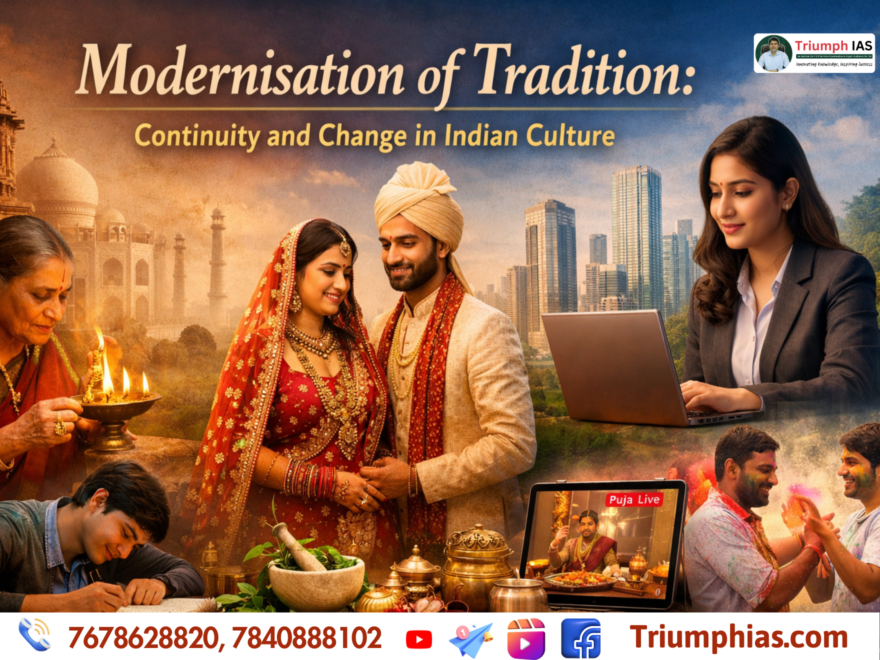
IntroductionIndia presents a fascinating sociological paradox where deep-rooted traditions coexist with rapid modernization. This phenomenon—often conceptualized as the modernisation of tradition—captures how traditional institutions, values, and practices are not simply replaced but are reinterpreted and adapted within a modern framework. Rather than a linear shift from “traditional” to “modern,” Indian society demonstrates a dynamic interplay between continuity and change. DimensionThe concept was notably articulated by sociologist Yogendra Singh, who argued that modernization in India does not entail the erosion of tradition but its transformation. Traditions are not static relics; they are flexible and capable of absorbing modern elements. This process ensures cultural resilience while enabling societal progress. One of the most visible examples of this synthesis is the transformation of the family system. The traditional joint family, once the dominant structure, has increasingly given way to nuclear families, particularly in urban areas. However, the underlying values of kinship, respect for elders, and familial obligations continue to persist. Even in nuclear setups, decisions such as marriage or career often involve extended family consultation, reflecting continuity within change. Similarly, the institution of caste, historically rigid and hierarchical, has undergone significant modification. While caste identities remain socially relevant, their functional role has shifted. In contemporary India, caste is often mobilized for political representation, affirmative action, and identity assertion rather than strictly governing occupation or social mobility. This illustrates how traditional structures adapt to democratic and modern political contexts. The sphere of religion and rituals also demonstrates this blend. Technological advancements have transformed religious practices—online पूजा services, digital donations, and virtual pilgrimages are now common. Yet, the essence of faith, ritual observance, and spiritual values remains intact. Festivals like Diwali and Holi are celebrated with modern aesthetics and global participation while retaining their symbolic meanings. Education and economic changes further highlight this process. The spread of formal education and market-oriented employment has altered occupational patterns, weakening hereditary professions. However, traditional knowledge systems, such as Ayurveda or classical arts, are being revived and institutionalized within modern frameworks, showing adaptation rather than disappearance. Urbanization and globalization have introduced new lifestyles, consumption patterns, and value systems. Western influences are evident in clothing, food habits, and individualistic aspirations. Yet, these are often selectively integrated. For instance, the celebration of Valentine’s Day coexists with traditional festivals, indicating cultural hybridity rather than cultural replacement. From a sociological perspective, this phenomenon challenges classical theories of modernization that predict a decline of tradition. Instead, India exemplifies a multiple modernities approach, where each society negotiates its own path to modernity based on historical and cultural contexts. The persistence of tradition within modern institutions reflects a process of structural adaptation rather than cultural rupture. However, this coexistence is not without tensions. Conflicts often arise between traditional norms and modern values, particularly in areas such as gender roles, marriage choices, and individual autonomy. Debates around issues like inter-caste marriages or women’s participation in the workforce highlight the ongoing negotiation between continuity and change. ConclusionIn conclusion, the modernisation of tradition in India is a complex, ongoing process characterized by adaptation, negotiation, and synthesis. It underscores the resilience of cultural systems and their ability to evolve without losing their core identity. Rather than viewing tradition and modernity as opposing forces, the Indian experience demonstrates that they can coexist and even reinforce each other in shaping a unique socio-cultural trajectory. |
UPSC Civil Services (Mains) Question
Q. Modernisation in India has not replaced tradition but transformed it.” Critically examine with suitable examples. (150 words)
To Read more topics, visit: www.triumphias.com/blogs
Read more Blogs:
Transformation of Indian Family Businesses: A Sociological Analysis


One comment