India added 55.3 GW of non-fossil fuel capacity during FY 2025–26.
Total installed non-fossil fuel capacity reached 283.46 GW as of 31 March 2026.
India is now the 3rd largest country globally in renewable energy installed capacity.
Statement highlighted by Union Minister Pralhad Joshi.
Break-up of Non-Fossil Sources (Indicative)
Solar Energy – Largest contributor (~dominant share)
Wind Energy – Second largest
Hydro Power – Established base
Nuclear Energy – Smaller but stable share
Biomass & others – Supplementary role
Conceptual Understanding
What is Non-Fossil Capacity?
Includes:
Renewable sources (Solar, Wind, Hydro, Biomass)
Nuclear energy
👉 It excludes coal, oil, and natural gas.
Why This Achievement Matters
1. Climate Commitments (Global Level)
Aligns with India’s Nationally Determined Contributions (NDCs) under the Paris Agreement
India aims for:
50% installed capacity from non-fossil sources by 2030
Net Zero by 2070
2. Energy Security
Reduces dependence on imported fossil fuels
Enhances strategic autonomy
Shields economy from global oil price shocks
3. Economic & Industrial Impact
Boosts sectors like:
Solar manufacturing (PLI schemes)
Green hydrogen ecosystem
Generates employment in:
Installation
Maintenance
Manufacturing
4. Leadership in Global Energy Transition
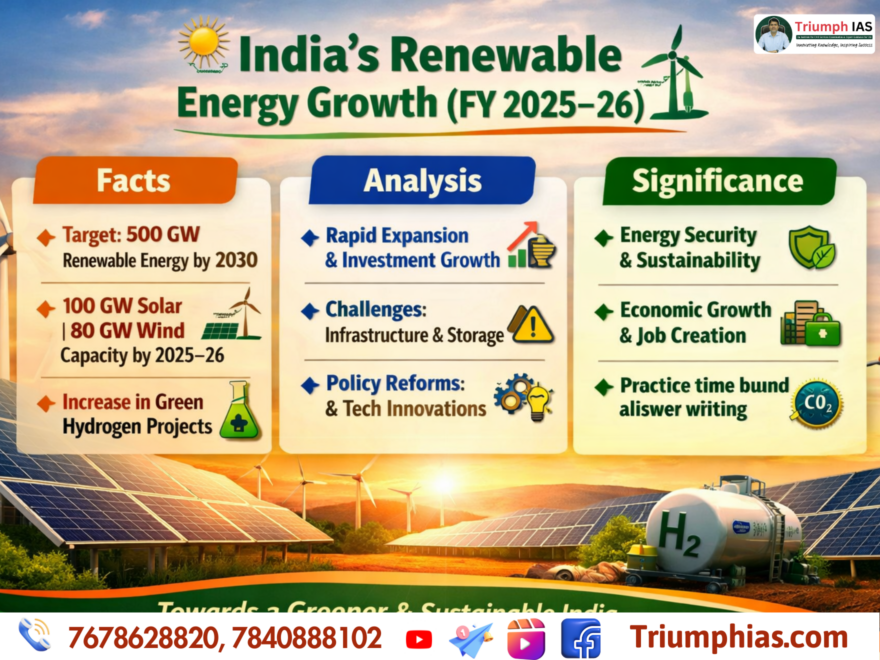
India emerges as a key clean energy player
Strengthens initiatives like:
International Solar Alliance
5. Environmental Benefits
Reduction in:
Carbon emissions
Air pollution
Supports sustainable development goals (SDGs)
Challenges Ahead
1. Intermittency & Grid Stability
Solar and wind are variable → need for energy storage systems
2. Land Acquisition Issues
Large solar parks require extensive land
3. Financial Stress
DISCOMs face:
Payment delays
Operational inefficiencies
4. Technology Dependence
Heavy reliance on imports (e.g., solar modules from China)
Government Initiatives Supporting Growth
National Solar Mission
PM-KUSUM Scheme
PLI Scheme for Solar Manufacturing
National Green Hydrogen Mission
Wind-Solar Hybrid Policy
Way Forward
Invest in battery storage & smart grids
Promote domestic manufacturing
Strengthen DISCOM reforms
Scale up green hydrogen exports
Encourage private sector participation
Answer Writing Value (UPSC Perspective)
Where to Use This Data
GS Paper 3:
Energy security
Climate change
Infrastructure
Sample Value Addition Line
“With 283.46 GW of non-fossil capacity and ranking 3rd globally, India is transitioning from an energy-deficit economy to a clean energy leader.”
Practice Questions
Mains (GS Paper 3)
India’s renewable energy growth reflects both opportunity and challenge. Discuss.
Examine the role of renewable energy in ensuring India’s energy security.
Critically analyze India’s progress towards its climate commitments.
Prelims-Oriented Fact
India ranks 3rd globally in renewable energy installed capacity (2026).
Conclusion
India’s rapid expansion in renewable energy marks a structural shift in its energy architecture. While achievements are substantial, sustaining this growth will require technological innovation, policy coherence, and institutional reforms.
Heartiest Congratulations to #Sandesh#Jain, #IPS. A student of the Sociology Foundation Course (Aug 2023 Batch) at #Triumph#IAS, Sandesh secured AIR 161 in UPSC CSE 2025 in his #First#Mains appearance.






One comment