


Relevant for Sociology Optional Paper 1, Paper 2, and GS Paper I (Indian Society)
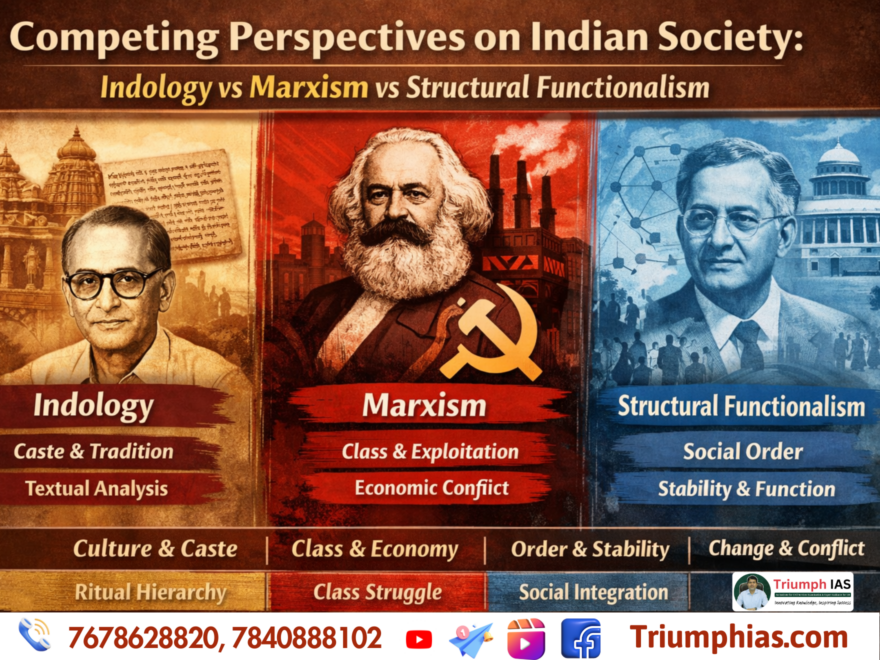
IntroductionUnderstanding Indian society requires navigating multiple theoretical lenses, each offering distinct epistemological foundations and methodological orientations. Among the most influential are the Indological, Marxist, and Structural Functionalist perspectives. These frameworks differ not only in their interpretive focus but also in their assumptions about social order, change, and hierarchy. Dimension1. Indological Perspective: Civilizational Continuity and Textual AuthorityThe Indological approach emphasizes the study of classical texts, traditions, and cultural symbols to understand Indian society. Scholars like G. S. Ghurye and Louis Dumont foreground the centrality of caste, dharma, and ritual hierarchy. Indology views Indian society as a historically continuous civilization rooted in sacred texts such as the Vedas and Dharmashastras. Dumont’s concept of homo hierarchicus highlights how hierarchy, rather than equality, structures social relations. Purity and pollution become organizing principles of caste stratification. Critique: 2. Marxist Perspective: Class, Exploitation, and Material ConditionsThe Marxist approach interprets Indian society through the lens of historical materialism, focusing on class relations, modes of production, and economic exploitation. Influenced by Karl Marx, Indian scholars like A. R. Desai applied this framework to colonial and post-colonial India. Marxist analysis highlights how economic structures shape social institutions. For instance, caste is often interpreted as a mechanism that reinforces class exploitation. Agrarian relations, land ownership patterns, and capitalist penetration into rural India are central concerns. Critique: 3. Structural Functionalism: Order, Integration, and Social StabilityStructural Functionalism, associated with thinkers like Talcott Parsons and M. N. Srinivas, examines how different parts of society contribute to overall stability and cohesion. In the Indian context, M. N. Srinivas introduced concepts like Sanskritization and the Dominant Caste to explain social mobility and local power structures. Functionalists view caste not merely as oppressive but also as a system that historically ensured division of labor and social order. Critique: Comparative Insights
ConclusionNo single perspective fully captures the complexity of Indian society. Indology provides depth in understanding cultural continuity, Marxism exposes structural inequalities, and Functionalism explains systemic stability. A synthetic approach—combining cultural, economic, and institutional analysis—is essential for a holistic understanding, especially in a society as layered as India. |
UPSC Civil Services (Mains) Question
Q. “Critically examine the relevance of Indological, Marxist, and Structural Functionalist perspectives in understanding contemporary Indian society.” (250 words)
To Read more topics, visit: www.triumphias.com/blogs
Read more Blogs:
Marxist Sociology and Neo-Colonialism: A. R. Desai Revisited



5 comments