


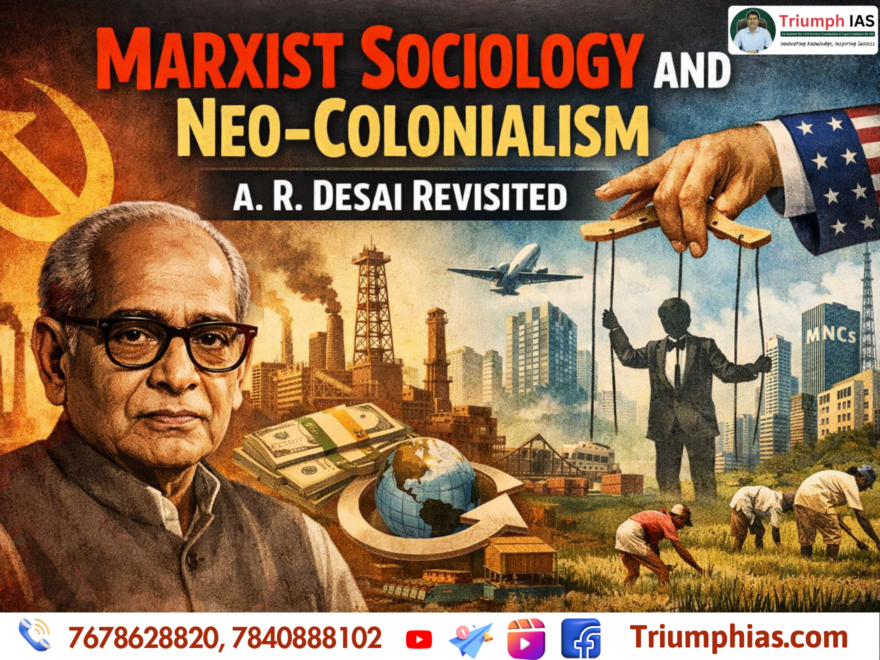
Relevant for Sociology Optional Paper 1, Paper 2, and GS Paper I (Indian Society)
IntroductionA. R. Desai remains one of the most influential Marxist sociologists in India, known for applying historical materialism to understand the structural dynamics of Indian society. Revisiting his framework in the context of neo-colonialism offers critical insights into contemporary patterns of economic dependency, class relations, and state power in post-liberalisation India. DimensionDesai’s central contribution lies in his analysis of the Indian state as a bourgeois state, which, despite achieving political independence, continues to serve the interests of dominant classes. He argued that the Indian ruling class, in alliance with global capitalist forces, perpetuates structures of exploitation. This perspective becomes particularly relevant when examined through the lens of neo-colonialism—a system where former colonies remain economically and politically dependent on developed nations despite formal sovereignty. Neo-colonialism manifests in India through global financial institutions, multinational corporations (MNCs), and unequal trade relations. Desai’s Marxist approach helps decode how these external forces align with internal class structures to sustain inequality. For instance, policies of liberalisation, privatisation, and globalisation (LPG reforms) have deepened capitalist penetration into agriculture, industry, and services. While these reforms have accelerated growth, they have also widened socio-economic disparities, marginalised small producers, and intensified labour precarity. Desai’s work on agrarian relations is particularly instructive. He highlighted how capitalist development in agriculture transforms peasants into wage labourers, thereby reinforcing class divisions. In the contemporary era, this can be linked to corporate control over agriculture, contract farming, and the commodification of land and labour. Neo-colonial economic arrangements further exacerbate this transformation by integrating local economies into global value chains, often on unequal terms. Another critical dimension of Desai’s thought is his emphasis on the role of the state. Contrary to the notion of a welfare-oriented state, he viewed it as an instrument of class domination. In the neo-colonial context, the state often facilitates foreign investment, deregulates markets, and prioritises capital accumulation over social welfare. This raises questions about sovereignty and democratic accountability, as policy decisions increasingly reflect global economic pressures rather than domestic needs. However, Desai’s framework is not without limitations. Critics argue that his approach tends to be economically deterministic, underestimating the role of culture, identity, and agency. In contemporary India, factors such as caste, religion, and regionalism intersect with class, complicating a purely Marxist analysis. Moreover, the rise of a new middle class and the expansion of digital capitalism require a more nuanced understanding beyond traditional class categories. Despite these critiques, Desai’s analysis remains highly relevant. His work provides a powerful lens to examine how global capitalism reshapes national economies and reinforces inequalities. In the era of neo-colonialism, where economic control often replaces direct political domination, his insights help uncover the underlying structures of power and exploitation. ConclusionIn conclusion, revisiting A. R. Desai in the context of neo-colonialism allows us to critically engage with contemporary socio-economic transformations in India. It highlights the استمرار (continuity) of dependency and class exploitation, while also underscoring the need for a multidimensional approach that integrates class with other axes of inequality. His work continues to be indispensable for understanding the political economy of modern India and for envisioning pathways toward a more equitable society. |
UPSC Civil Services (Mains) Question
Q. Critically examine A. R. Desai’s Marxist interpretation of the Indian state in the context of neo-colonialism and globalisation. (250 words)
To Read more topics, visit: www.triumphias.com/blogs
Read more Blogs:
Sanskritization to Social Media: Revisiting M. N. Srinivas in Contemporary India
The cost of being wrong is less than the cost of doing nothing – Triumph IAS & Vikash Ranjan Sir



2 comments