The Rise of Zombie Drug in India: Public Health Emergency & UPSC Analysis

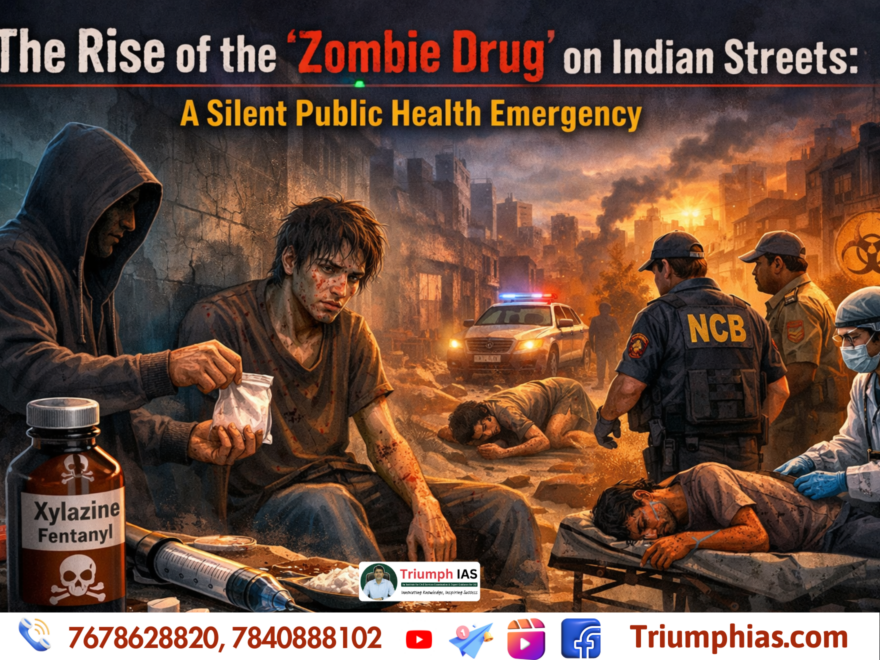
The Rise of the “Zombie Drug” on Indian Streets: A Silent Public Health Emergency

Relevant for UPSC CSE Examination

Introduction

What once sounded like dystopian fiction is now an emerging reality. A dangerous substance—Xylazine—popularly dubbed the “zombie drug”, is increasingly entering drug markets worldwide, and there are growing concerns about its potential spread in India.

Originally developed as a veterinary sedative, Xylazine was never meant for human consumption. Yet today, it is being misused in combination with potent opioids like fentanyl, creating a deadly cocktail that is cheap, addictive, and devastating in its effects.


⚠️ What is Xylazine and Why is it Dangerous?

Xylazine is used by veterinarians to sedate large animals. It works by depressing the central nervous system—essentially switching off alertness, reducing heart rate, and lowering blood pressure.

When used in humans illegally:

  • It induces a semi-conscious, trance-like state

  • Severely slows brain signals and breathing

  • Causes extreme sedation, making users appear “zombie-like”

But the real danger lies deeper.


☠️ The Deadly Combination: Xylazine + Fentanyl

Xylazine is now increasingly mixed with fentanyl, a synthetic opioid already responsible for a massive overdose crisis globally.

This combination is particularly alarming because:

  • It is cheaper to produce, increasing accessibility

  • It enhances addiction potential

  • It prolongs the sedative effect, making overdose more likely

Most concerning:
👉 Naloxone, the life-saving drug used to reverse opioid overdoses, does not work on Xylazine.

This makes treatment extremely difficult and often ineffective.


🧬 What Happens Inside the Body?

The physiological effects of Xylazine are catastrophic:

  • It disrupts blood circulation

  • Leads to oxygen deprivation (hypoxia)

  • Causes tissue death (necrosis)

Users often develop:

  • Deep, non-healing wounds

  • Severe skin ulcers

  • In extreme cases, amputations

This visible physical deterioration is why victims are often described as looking like “zombies.”


🌍 Global Alarm Bells

Countries like the United States are already facing a crisis due to widespread Xylazine abuse. Authorities have reported:

  • Rising overdose deaths

  • Increasing cases of severe tissue damage

  • Difficulty in detection and treatment

Governments are now:

  • Tightening regulations

  • Monitoring supply chains

  • Investing in research for antidotes


🇮🇳 Is India at Risk?

India is not yet at the epicenter of this crisis, but warning signs exist:

  • Growing synthetic drug networks

  • Weak enforcement in certain supply chains

  • Rising youth drug experimentation trends

Given these vulnerabilities, the entry of Xylazine into Indian drug markets could trigger a public health emergency.


⚖️ The Ethical Dilemma: Ban or Regulate?

Here lies the central question:

Should Xylazine be completely banned, even if it has legitimate veterinary uses?

Arguments for a Complete Ban:

  • Prevent misuse before it spreads widely

  • Reduce illegal drug combinations

  • Protect vulnerable populations

Arguments Against a Ban:

  • It has genuine medical utility in veterinary science

  • A ban may push the drug further into black markets

  • Enforcement challenges in a large country like India

A Balanced Approach:

Instead of an outright ban, policymakers could consider:

  • Strict regulation and licensing

  • Tracking and monitoring supply chains

  • Awareness campaigns among medical professionals

  • Early surveillance systems


🧠 The Way Forward

The Xylazine crisis is not just about one drug—it reflects a larger pattern:

  • Increasing synthetic drug innovation

  • Gaps in public health preparedness

  • Need for interdisciplinary policy responses

India must act proactively, not reactively.


🚨 Conclusion: A Crisis We Can Still Prevent

The “zombie drug” epidemic is a stark reminder of how quickly substance abuse patterns can evolve. What begins as a veterinary sedative can transform into a societal threat when combined with illegal drug networks.

India still has a window of opportunity.

The question is not just whether Xylazine should be banned—but whether we are prepared to anticipate and prevent the next drug crisis before it begins.


💬 What do you think?
Should drugs like Xylazine be completely banned, even if they have legitimate uses? Or should regulation be the way forward?

To Read more topicsvisit: www.triumphias.com/blogs

Read more Blogs:

Competing Perspectives on Indian Society: Indology vs Marxism vs Structural Functionalism

Girls are weighed down by restrictions, boys with demands- two equally harmful disciplines – Triumph IAS & Vikash Ranjan Sir


“𝟑𝟎𝟗 𝐌𝐚𝐫𝐤𝐬 𝐢𝐧 𝐒𝐨𝐜𝐢𝐨𝐥𝐨𝐠𝐲 𝐎𝐩𝐭𝐢𝐨𝐧𝐚𝐥 𝐰𝐢𝐭𝐡 𝐣𝐮𝐬𝐭 𝐎𝐍𝐄 𝐬𝐨𝐮𝐫𝐜𝐞!”SANDESH JAIN [B.Tech] SOCIOLOGY STRATEGY #UPSC CSE 2025
Heartiest Congratulations to #Sandesh #Jain, #IPS. A student of the Sociology Foundation Course (Aug 2023 Batch) at #Triumph #IAS, Sandesh secured AIR 161 in UPSC CSE 2025 in his #First #Mains appearance.
𝐖𝐡𝐚𝐭 𝐦𝐚𝐤𝐞𝐬 𝐭𝐡𝐢𝐬 𝐚𝐜𝐡𝐢𝐞𝐯𝐞𝐦𝐞𝐧𝐭 𝐞𝐱𝐭𝐫𝐚𝐨𝐫𝐝𝐢𝐧𝐚𝐫𝐲 𝐢𝐬 𝐡𝐢𝐬 𝐒𝐨𝐜𝐢𝐨𝐥𝐨𝐠𝐲 𝐎𝐩𝐭𝐢𝐨𝐧𝐚𝐥 𝐬𝐜𝐨𝐫𝐞:
𝐓𝐎𝐓𝐀𝐋 𝐒𝐎𝐂𝐈𝐎𝐋𝐎𝐆𝐘 𝐌𝐀𝐑𝐊𝐒: 𝟑𝟎𝟗
𝐏𝐚𝐩𝐞𝐫 𝟏 – 173 Marks
𝐏𝐚𝐩𝐞𝐫 𝟐 – 136 Marks
𝐒𝐚𝐧𝐝𝐞𝐬𝐡 𝐟𝐨𝐥𝐥𝐨𝐰𝐞𝐝 𝐚 𝐬𝐢𝐦𝐩𝐥𝐞 𝐛𝐮𝐭 𝐩𝐨𝐰𝐞𝐫𝐟𝐮𝐥 𝐬𝐭𝐫𝐚𝐭𝐞𝐠𝐲:
Single Source Preparation- Only #Vikash #Ranjan Sir’s Sociology Foundation Class Notes, Discussions, Application Strategies & Answer Writing Practice.
No multiple books or Scattered Materials, No PDFs, No Free YouTube Time Wastes, No other Essentials.
He focused on developing Sociological Wisdom — the ability to apply concepts, thinkers, and examples in answers.
Because UPSC preparation is not just about knowledge. It is about developing Sociological Wisdom.
#New #Sociology #Optional – Foundation to Final Course
#Batch for UPSC CSE 2027 -2028 | #Admissions #Open
Available for:
Offline Classroom Program
Live Online Classes
Tablet Course (Learn Anytime)

2 comments

Leave a Reply

Your email address will not be published. Required fields are marked *