


Relevant for UPSC CSE Examination
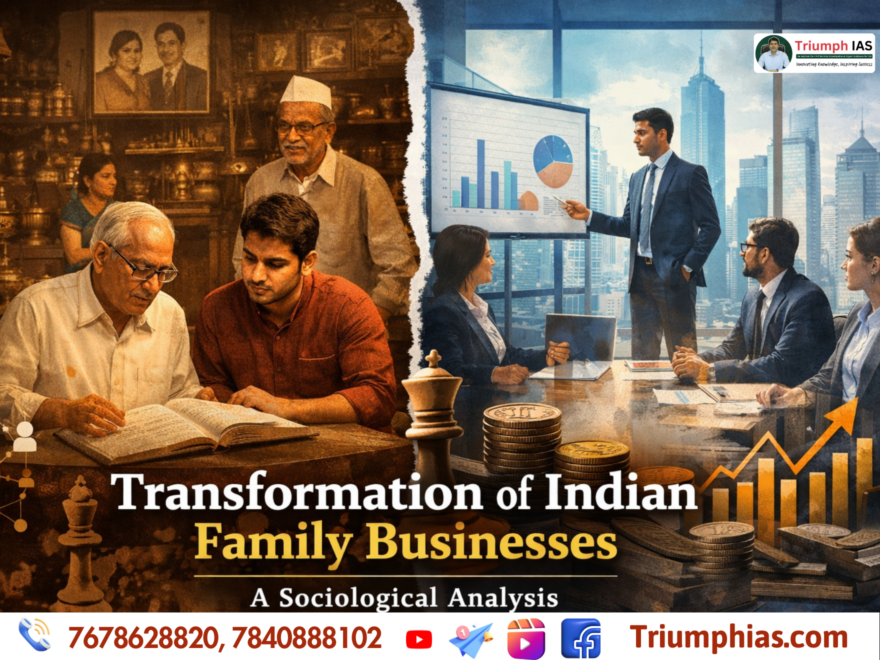
IntroductionIndian family businesses have historically been the backbone of the country’s economic and social structure. Rooted in kinship ties, trust, and intergenerational continuity, they represent not just economic enterprises but also social institutions embedded in family, caste, and community networks. However, recent trends indicate a shift—many such businesses are being sold, diluted, or professionally restructured. This transformation reflects deeper sociological changes in Indian society. Changing Nature of Family and EconomyTraditional Indian businesses were governed by the logic of the joint family system, where authority, ownership, and management were concentrated within the family. This aligns with structural-functionalism, where institutions like family and economy were interdependent and stable. However, with modernization, we observe:
The reluctance of the next generation to run family businesses reflects this shift. Economic roles are no longer inherited but chosen based on personal interest and global opportunities. Risk, Capital, and the Logic of De-riskingFrom a sociological perspective, wealth concentration in a single business reflects a traditional risk structure, where trust and familiarity override diversification. However, in a globalized economy:
Thus, selling stakes to Private Equity (PE) and diversifying assets is not just an economic act but a transition from traditional to modern rationality. Globalization and the Entry of Institutional CapitalThe increasing interest of global capital in Indian businesses reflects globalization of markets and financialization of the economy.
From a Marxist perspective, this can be seen as:
Cultural Shift: From “Family Control” to “Professional Management”Family businesses traditionally operated on:
However, modern business demands:
This reflects a movement toward bureaucratization (Weber) and rational-legal authority, replacing traditional authority structures. Structural Constraints of Family BusinessesMany family firms face a structural limitation:
This creates a paradox: 👉 “Great businesses, weak structures” From a sociological lens:
This mismatch leads to institutional lag. Rise of Family Offices and Wealth DiversificationThe rapid growth of family offices (from ~45 in 2018 to ~300 in 2024) indicates:
This aligns with:
It also reflects status reproduction strategies, where elite families aim to preserve and expand wealth across generations using modern financial tools. Private Equity as an Agent of Social ChangePrivate Equity firms act as agents of institutional transformation:
Their strategy:
Sociologically, this represents:
ConclusionThe dilution or sale of Indian family businesses is not merely an economic phenomenon but a reflection of deeper social transformation:
This transition highlights the dynamic interplay between economic structures and social institutions, demonstrating how globalization, changing family patterns, and rationalization are reshaping India’s business landscape. |
To Read more topics, visit: www.triumphias.com/blogs
Read more Blogs:
The Rise of the “Zombie Drug” on Indian Streets: A Silent Public Health Emergency
Mathematics is the music of reasons – Triumph IAS & Vikash Ranjan Sir



One comment