


Relevant for Sociology Optional Paper 1, Paper 2, and GS Paper I (Indian Society)
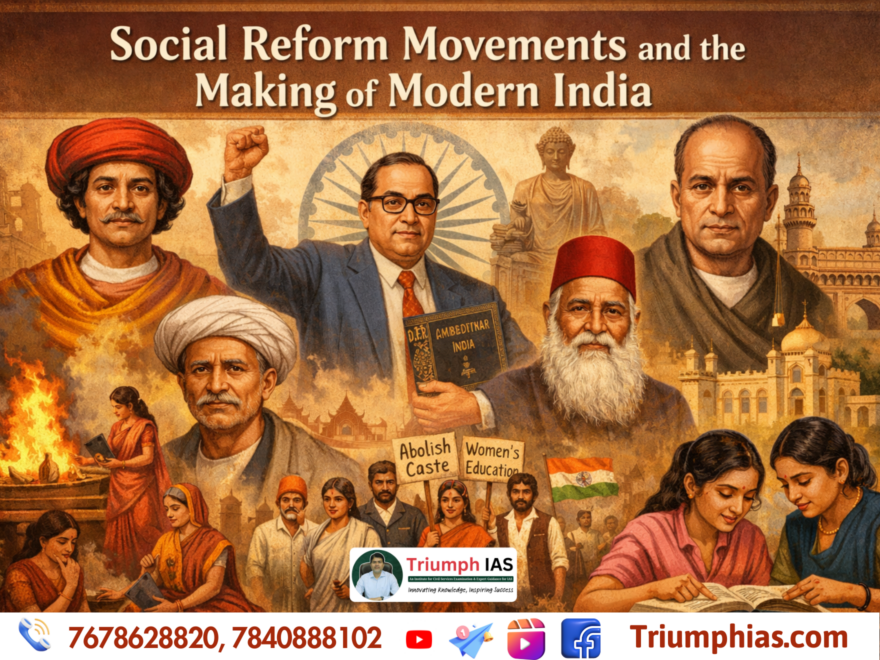
IntroductionThe emergence of modern India cannot be understood without examining the profound impact of social reform movements during the 19th and early 20th centuries. These movements were not merely isolated attempts at moral correction; rather, they constituted a structural transformation of Indian society by challenging entrenched hierarchies, redefining social norms, and facilitating the transition from a traditional to a modern social order. DimensionColonial rule acted as both a catalyst and a context for these reforms. The encounter with Western ideas such as rationalism, individualism, and humanism prompted Indian intellectuals to critically introspect indigenous social institutions. Reformers began to question practices like sati, child marriage, caste rigidity, and gender inequality, which were increasingly seen as impediments to social progress. One of the earliest reform initiatives was led by Raja Ram Mohan Roy through the Brahmo Samaj. His efforts against sati and advocacy for women’s rights marked the beginning of a new social consciousness. Similarly, Ishwar Chandra Vidyasagar’s campaign for widow remarriage and female education represented a direct challenge to patriarchal norms embedded in Hindu society. These reformers operated within a framework of “reinterpretation of tradition,” attempting to harmonize modern values with indigenous cultural foundations. In western India, Jyotiba Phule spearheaded a radical critique of caste oppression through the Satyashodhak Samaj. Unlike earlier reformers, Phule adopted a more confrontational stance, emphasizing social justice and the emancipation of lower castes. This trajectory later found a more structured and constitutional expression in the works of B.R. Ambedkar, who not only critiqued caste as a system of graded inequality but also institutionalized safeguards for social justice within the Indian Constitution. Parallel to these movements, Islamic and Sikh reform movements such as the Aligarh Movement led by Sir Syed Ahmed Khan and the Singh Sabha Movement sought to modernize their respective communities. These movements reflected a broader pattern: reform was not confined to a single religious group but was a pan-Indian phenomenon responding to the challenges of modernity. From a sociological perspective, these reform movements can be interpreted as processes of social change driven by both endogenous and exogenous factors. Endogenous factors included internal contradictions within traditional institutions, while exogenous influences stemmed from colonial modernity, missionary critique, and global intellectual currents. The movements also illustrate the dialectical relationship between tradition and modernity—rather than a complete rupture, there was selective adaptation and synthesis. Furthermore, these reforms contributed significantly to the development of a public sphere in India. Print media, vernacular literature, and voluntary associations enabled the dissemination of reformist ideas, fostering debate and collective consciousness. This emerging public domain laid the groundwork for nationalist mobilization, linking social reform with the broader struggle for independence. However, the reform movements were not without limitations. Many of them were urban-centric and led by upper-caste elites, often failing to penetrate rural society comprehensively. Additionally, while they challenged certain aspects of inequality, they sometimes reinforced other hierarchies, reflecting the complex and layered nature of Indian society. ConclusionIn conclusion, social reform movements played a foundational role in shaping modern India. They initiated critical transformations in social institutions, redefined normative frameworks, and contributed to the emergence of a democratic and egalitarian ethos. For sociology, these movements offer rich insights into the dynamics of social change, the negotiation between tradition and modernity, and the role of agency in restructuring society. |
UPSC Civil Services (Mains) Question
Q. “Social reform movements in India were both a product of colonial modernity and indigenous responses to social inequalities.” Discuss. (250 words)
To Read more topics, visit: www.triumphias.com/blogs
Read more Blogs:
“𝟑𝟎𝟗 𝐌𝐚𝐫𝐤𝐬 𝐢𝐧 𝐒𝐨𝐜𝐢𝐨𝐥𝐨𝐠𝐲 𝐎𝐩𝐭𝐢𝐨𝐧𝐚𝐥 𝐰𝐢𝐭𝐡 𝐣𝐮𝐬𝐭 𝐎𝐍𝐄 𝐬𝐨𝐮𝐫𝐜𝐞!”



4 comments