Relevant for Sociology Optional Paper 1, Paper 2, and GS Paper I (Indian Society)
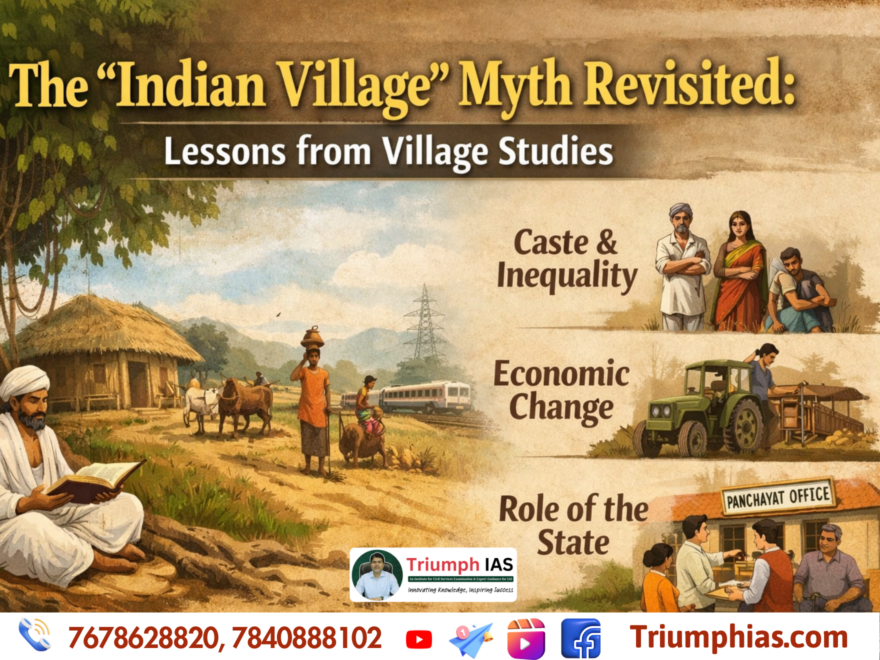
IntroductionThe idea of the Indian village has long occupied a central place in sociological imagination as well as in public discourse. Early colonial administrators and nationalist thinkers often portrayed the village as a self-sufficient, harmonious, and timeless unit—what came to be known as the “village republic.” However, post-independence sociological research, especially village studies conducted by scholars like M. N. Srinivas, S. C. Dube, and Andre Beteille, fundamentally challenged this romanticized notion and revealed a far more complex and dynamic reality. DimensionVillage studies emerged as a significant methodological and empirical shift in Indian sociology during the 1950s and 1960s. These studies emphasized intensive fieldwork and participant observation, thereby grounding sociological analysis in lived realities rather than abstract generalizations. The findings decisively dismantled the myth of the isolated and self-sufficient village. Instead, villages were shown to be deeply embedded in wider economic, political, and cultural networks. Markets, migration, state policies, and urban linkages played a crucial role in shaping village life. One of the most important insights from these studies was the recognition of internal differentiation and hierarchy within villages. Contrary to the image of social harmony, villages were marked by sharp inequalities based on caste, class, and gender. The caste system, far from being a static structure, was shown to be dynamic and context-specific. Srinivas introduced key concepts such as “Sanskritization” and “Dominant Caste” to explain social mobility and power relations in rural India. These concepts highlighted that change was occurring within the traditional framework, challenging the notion of villages as stagnant entities. Similarly, studies revealed that economic relations in villages were neither egalitarian nor self-contained. Land ownership patterns, tenancy arrangements, and labour relations exposed significant disparities. The Green Revolution further intensified these inequalities by benefiting certain sections while marginalizing others. Thus, the village was not an egalitarian moral community but a site of contestation and conflict. Another critical contribution of village studies was the understanding of the state’s role in rural transformation. Development programmes, Panchayati Raj institutions, and welfare schemes brought the state into the everyday life of villages. This contradicted the earlier perception of villages as autonomous units. Instead, the village emerged as an arena where state policies interacted with local power structures, often producing unintended consequences. Moreover, village studies highlighted the processes of change and continuity operating simultaneously. While traditional institutions such as caste and kinship persisted, they adapted to new economic and political contexts. Migration, education, and media exposure contributed to changing aspirations and lifestyles, further eroding the idea of the village as a closed and unchanging system. Revisiting the “Indian village” myth is particularly relevant in contemporary times, as rural India continues to undergo rapid transformation due to globalization, digitalization, and policy interventions. The insights from village studies remind us that simplistic and homogenized representations of rural life can lead to flawed policies and misinformed debates. Instead, a nuanced understanding that acknowledges diversity, inequality, and interconnectedness is essential. ConclusionIn conclusion, village studies have played a pivotal role in deconstructing the myth of the Indian village. They have demonstrated that villages are neither isolated nor harmonious but are dynamic spaces shaped by multiple forces. This shift from romanticism to realism remains one of the most significant contributions of Indian sociology. |
UPSC Civil Services (Mains) Question
Q. “The notion of the Indian village as a ‘self-sufficient republic’ is more a myth than reality.” Discuss with reference to findings from village studies in India. (250 words)
To Read more topics, visit: www.triumphias.com/blogs
Read more Blogs:
Not all who wander are lost – Triumph IAS & Vikash Ranjan Sir