Relevant for Sociology Optional Paper 1, Paper 2, and GS Paper I (Indian Society)
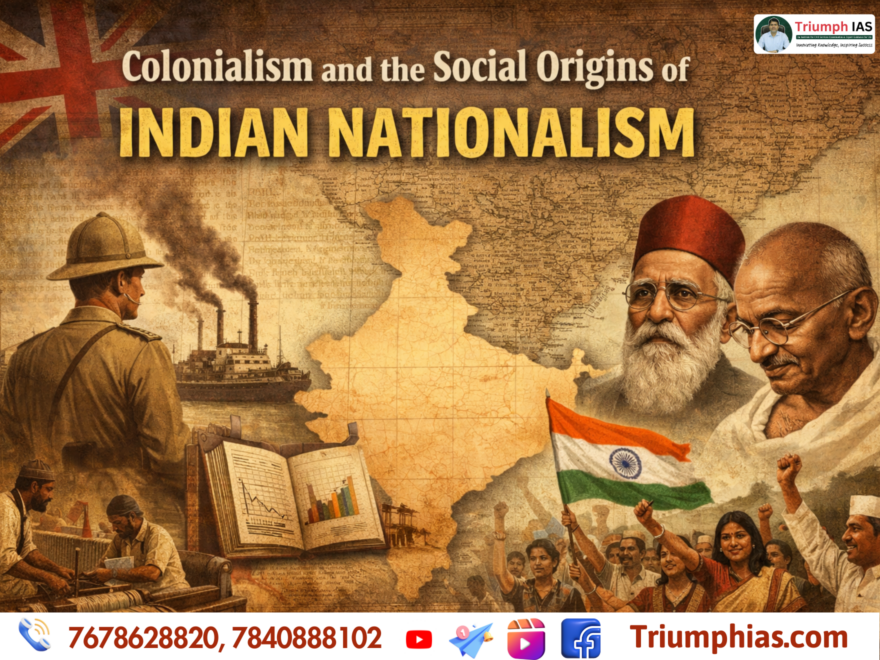
IntroductionThe rise of Indian nationalism cannot be understood merely as a political response to colonial rule; it must be situated within the broader sociological transformations triggered by colonialism. British colonialism fundamentally restructured India’s economic, social, and cultural institutions, creating the very conditions that fostered nationalist consciousness. Thus, Indian nationalism emerged not in isolation, but as a historically contingent outcome of colonial modernity. DimensionOne of the most significant impacts of colonialism was the transformation of India’s economic structure. The integration of the Indian economy into the global capitalist system led to deindustrialization, agrarian distress, and the emergence of new class relations. The destruction of traditional handicrafts and the commercialization of agriculture produced a class of dispossessed peasants and a nascent bourgeoisie. Thinkers like Dadabhai Naoroji articulated this exploitation through the “Drain of Wealth” theory, highlighting how colonial policies systematically impoverished India. This economic critique became a foundational pillar of nationalist discourse. Colonialism also introduced modern education, legal systems, and bureaucratic institutions, which played a paradoxical role. While these institutions were designed to consolidate colonial control, they inadvertently created a new middle class exposed to liberal, democratic, and nationalist ideas. Educated Indians began to question colonial authority using the very ideological tools introduced by the British. The emergence of print capitalism, vernacular press, and public sphere facilitated the spread of nationalist ideas across regions and communities. From a sociological perspective, colonialism disrupted traditional social structures, including caste and community relations. The census, codification of laws, and administrative categorization reified identities, often making them more rigid. However, these processes also enabled new forms of collective identity formation. Nationalism, in this sense, can be seen as a “constructed identity” that transcended local and regional affiliations. Scholars like Benedict Anderson conceptualized the nation as an “imagined community,” made possible through shared experiences and communication networks—many of which were products of colonial modernity. Moreover, colonial rule led to the politicization of various social groups. Peasant movements, tribal uprisings, and worker protests reflected growing resistance to colonial exploitation. These localized struggles gradually converged into a broader nationalist movement. Leaders like Mahatma Gandhi played a crucial role in mobilizing masses by linking everyday grievances with the larger goal of independence, thereby transforming nationalism into a mass movement. However, the social origins of Indian nationalism were not uniform. Different classes and communities engaged with nationalism in varied ways. The elite-led early nationalist movement often focused on constitutional reforms, while later phases witnessed mass participation with more radical demands. Additionally, issues of caste, religion, and regional disparities continued to shape the trajectory of nationalism, sometimes leading to tensions and contradictions within the movement. ConclusionIn conclusion, Indian nationalism was deeply rooted in the structural changes brought about by colonialism. It was not merely a reaction against foreign rule but a complex socio-historical process shaped by economic exploitation, cultural transformation, and the emergence of new social classes and identities. Understanding these social origins provides a nuanced perspective on nationalism as both a product and critique of colonial modernity. |
UPSC Civil Services (Mains) Question
Q. “Colonialism not only led to exploitation but also created the conditions for the rise of nationalism in India.” Critically examine this statement from a sociological perspective. (250 words)
To Read more topics, visit: www.triumphias.com/blogs
Read more Blogs:
Competing Perspectives on Indian Society: Indology vs Marxism vs Structural Functionalism