


Relevant for Sociology Optional Paper 1, Paper 2, and GS Paper I (Indian Society)
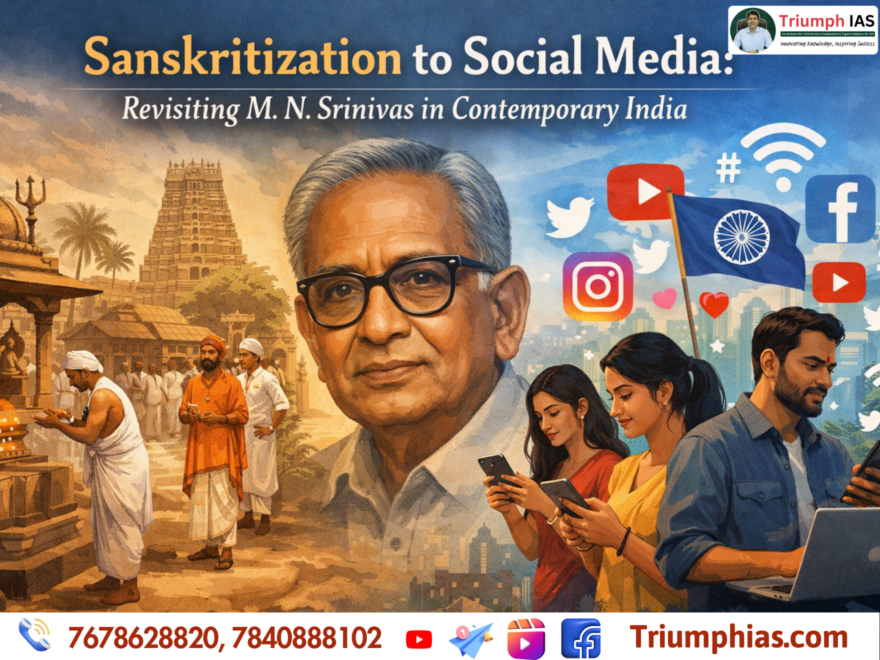
IntroductionIndian sociology owes a great deal to M. N. Srinivas, whose concepts such as Sanskritization, Dominant Caste, and Westernization provided a nuanced framework to understand social mobility and cultural change in India. Among these, Sanskritization—defined as the process by which lower castes adopt the rituals, practices, and lifestyles of upper castes to claim higher social status—remains one of the most debated and enduring ideas. However, in 21st-century India shaped by digital transformation, globalization, and identity politics, the relevance of Sanskritization invites critical re-examination. Traditionally, Sanskritization was rooted in rural, caste-bound social structures. It implied a unilinear movement towards upper-caste norms, often associated with purity, vegetarianism, and ritualistic practices. This process was slow, localized, and dependent on recognition by the dominant caste. However, contemporary India presents a far more complex social landscape where mobility is mediated not just by caste, but also by education, economy, and increasingly, digital visibility. DimensionThe rise of social media platforms such as Instagram, YouTube, and X (formerly Twitter) has introduced new avenues for identity construction and social assertion. In this context, the logic of Sanskritization appears to be undergoing a transformation. Instead of imitating upper-caste practices, marginalized groups are increasingly asserting their own identities, histories, and cultural symbols. This shift can be termed as “De-Sanskritization” or “Assertion Politics”, where dignity is derived not from imitation but from recognition. For instance, Dalit and OBC communities are actively using digital platforms to challenge caste hierarchies, document discrimination, and celebrate their cultural heritage. Hashtags, online campaigns, and digital storytelling have democratized voice and visibility. Unlike traditional Sanskritization, which required validation from dominant groups, social media enables autonomous identity formation and horizontal solidarity across regions. At the same time, elements of Sanskritization persist in subtle forms. The aspiration for upward mobility still often aligns with adopting dominant cultural capital—fluency in English, urban lifestyles, and consumption patterns associated with the middle class. However, these markers are no longer exclusively tied to caste but are increasingly linked to class and global exposure. Thus, the axis of mobility has partially shifted from ritual hierarchy to economic and symbolic capital. Another important dimension is the emergence of “Digital Dominant Castes”. Influencers, content creators, and opinion leaders wield significant power in shaping narratives and norms. This mirrors Srinivas’s idea of dominant caste, but in a virtual domain where influence is measured by followers rather than land ownership or numerical strength. Consequently, new hierarchies are emerging in the digital public sphere. Moreover, state policies, affirmative action, and urbanization have weakened the rigidity of caste in certain contexts, but they have not eliminated it. Instead, caste identities are being reconfigured and sometimes intensified in political mobilization and online discourse. Social media has become a site where caste both dissolves and reasserts itself, often simultaneously. ConclusionIn conclusion, while Sanskritization as originally conceptualized by M. N. Srinivas may not fully capture the dynamics of contemporary India, its core insight—social mobility through cultural change—remains relevant. However, the direction, agents, and mediums of this change have evolved significantly. From village-centric imitation to digital-era assertion, the trajectory reflects a shift from hierarchical emulation to pluralistic identity negotiation. Revisiting Srinivas in this context not only enriches sociological understanding but also highlights the need to adapt classical theories to contemporary realities. |
UPSC Civil Services (Mains) Question
Q. “Critically examine the relevance of M. N. Srinivas’ concept of Sanskritization in understanding social change in contemporary digital India.” (250 words)
To Read more topics, visit: www.triumphias.com/blogs
Read more Blogs:
Indology in the Age of Identity Politics: Relevance and Limits of G. S. Ghurye Today
All ideas having large consequences are always simple – Triumph IAS & Vikash Ranjan Sir


2 comments