


Relevant for Sociology Optional Paper 1, Paper 2, and GS Paper I (Indian Society)
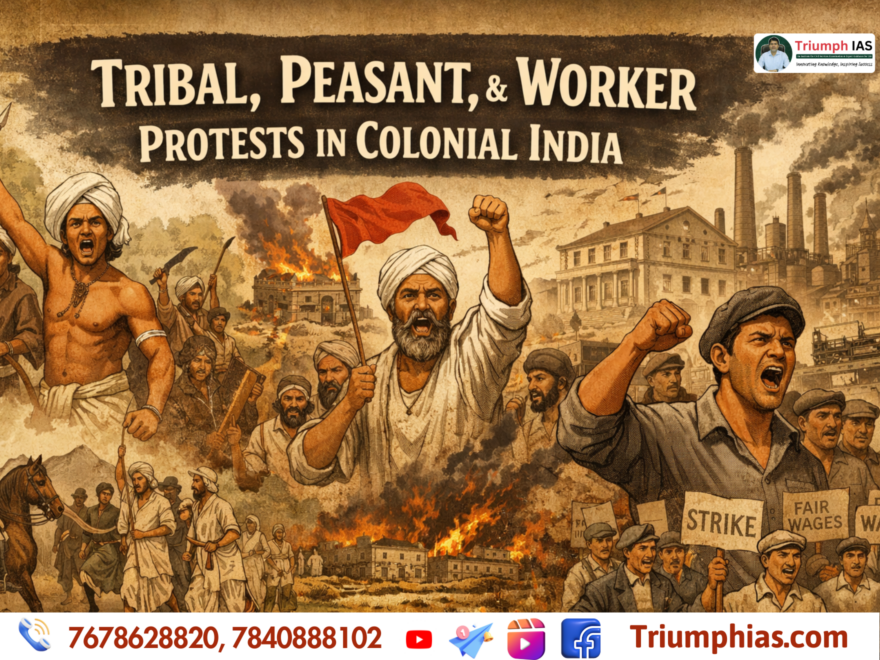
IntroductionColonial India witnessed a wide spectrum of protests by tribal communities, peasants, and workers, reflecting deep structural tensions produced by colonial exploitation. These movements were not merely sporadic outbursts but represented organized resistance rooted in socio-economic deprivation, cultural disruption, and political marginalization. From a sociological standpoint, they highlight the dynamics of power, class, identity, and resistance within a colonial framework. DimensionTribal uprisings were among the earliest forms of resistance against colonial intrusion. Communities such as the Santhals, Mundas, and Bhils revolted against the destruction of their traditional way of life. The imposition of private property, forest laws, and the entry of moneylenders disrupted their communitarian land systems. The Santhal Rebellion and the Munda Rebellion led by Birsa Munda illustrate how tribal protests combined economic grievances with cultural and religious revivalism. These movements can be interpreted through the lens of “relative deprivation” and “ethnic identity assertion,” where tribes resisted both economic exploitation and cultural assimilation. Peasant movements, on the other hand, were largely responses to oppressive land revenue systems and exploitative agrarian relations. The colonial state introduced zamindari and ryotwari systems that intensified extraction and indebtedness. The Indigo Revolt and the Deccan Riots were significant expressions of peasant unrest. These protests often targeted moneylenders, landlords, and colonial officials, revealing a layered structure of exploitation. From a Marxist perspective, these movements reflect class संघर्ष (class struggle), where peasants resisted surplus extraction by dominant classes backed by the colonial state. However, unlike industrial proletarian movements, peasant protests were often localized and lacked sustained organizational structure. The emergence of worker protests marked a new phase of resistance in colonial India, especially with the growth of industrialization in the late 19th and early 20th centuries. Workers in textile mills, plantations, and railways began to organize strikes demanding better wages, working conditions, and rights. The formation of trade unions and the involvement of nationalist leaders transformed these struggles into broader political movements. The Bombay Textile Strike and subsequent labor agitations indicate the rise of class consciousness among industrial workers. Sociologically, these movements align with theories of industrial conflict and collective bargaining, highlighting the transition from traditional to modern forms of protest. A comparative analysis reveals both commonalities and differences among these movements. While all three were responses to colonial exploitation, tribal protests were more identity-driven, peasant movements were agrarian and class-based, and worker protests reflected industrial class संघर्ष. Moreover, the degree of organization and political articulation increased from tribal to worker movements, indicating a shift towards modern forms of collective action. Importantly, these protests also contributed to the broader anti-colonial struggle. They exposed the exploitative nature of colonial policies and created a foundation for nationalist mobilization. However, their fragmented nature often limited their immediate impact, as they were region-specific and lacked unified leadership. ConclusionIn conclusion, tribal, peasant, and worker protests in colonial India were crucial expressions of resistance shaped by distinct socio-economic contexts. They offer valuable insights into the interplay of class, identity, and power in colonial society and remain significant for understanding contemporary social movements in India. |
UPSC Civil Services (Mains) Question
Q. Examine the nature and causes of tribal, peasant, and worker protests in colonial India. How do these movements reflect different forms of resistance within a colonial socio-economic structure?
To Read more topics, visit: www.triumphias.com/blogs
Read more Blogs:
Modernisation of Tradition: Continuity and Change in Indian Culture



One comment