Relevant for Sociology Optional Paper 1, Paper 2, and GS Paper I (Indian Society)
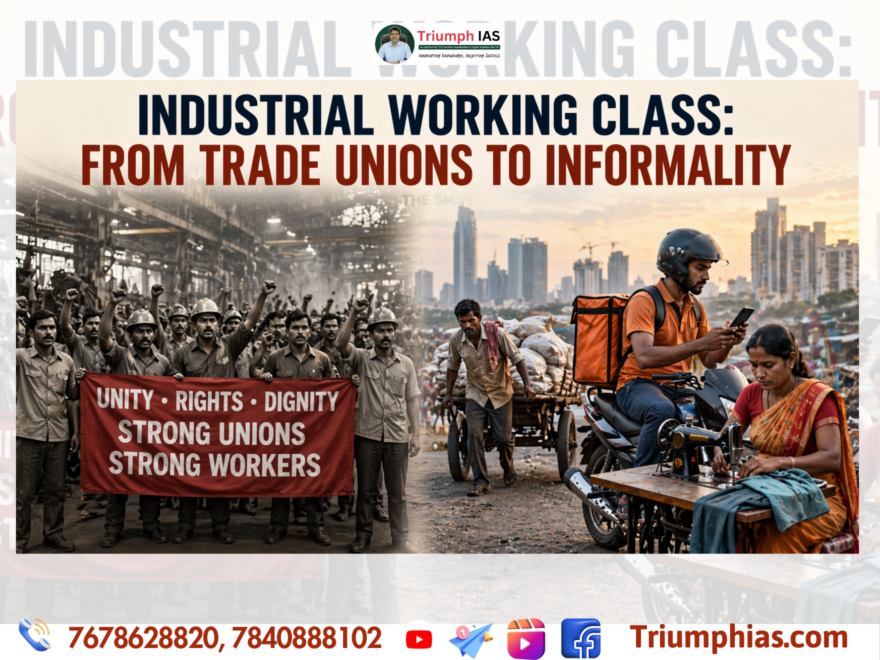
IntroductionThe trajectory of the industrial working class has undergone a profound transformation in the late 20th and early 21st centuries, moving from a relatively organized, unionized structure to a fragmented and informalized labour regime. Classical sociology, particularly Marxist and Weberian traditions, viewed the industrial working class as a cohesive entity central to capitalist production, capable of collective mobilization through trade unions. However, contemporary economic restructuring, globalization, and neoliberal policies have significantly altered this landscape. DimensionIn the early phase of industrial capitalism, especially during the Fordist era, labour was characterized by stable employment, standardized wages, and strong trade unions. Trade unions played a crucial role in negotiating wages, ensuring job security, and institutionalizing labour rights. They were not merely economic actors but also political agents influencing policy and welfare measures. This period saw the emergence of what is often termed the “organized working class,” particularly in industrial sectors such as manufacturing, mining, and heavy industries. However, the shift towards post-Fordism and neoliberal globalization has led to a systematic decline in the power and relevance of trade unions. Economic liberalization, technological advancements, and global competition have compelled firms to adopt flexible production strategies. This has resulted in contractualization, outsourcing, and the rise of the gig economy, all of which undermine traditional forms of labour organization. In India, post-1991 economic reforms accelerated this transition, leading to a dual labour market where a small segment remains formalized while a vast majority operates in the informal sector. Informality, in this context, refers to employment that is precarious, unregulated, and lacking social security. The informalization of labour is not confined to small-scale or rural industries but has penetrated large-scale industrial sectors as well. Workers are increasingly employed through contractors, deprived of benefits such as pensions, health insurance, and job security. This fragmentation weakens collective bargaining power and erodes class consciousness, making unionization difficult. Sociologically, this shift raises critical questions about class formation and labour identity. Scholars like Guy Standing have conceptualized the emerging “precariat” as a new class-in-the-making, characterized by insecurity and lack of occupational identity. In the Indian context, Jan Breman has highlighted the persistence of “footloose labour,” constantly migrating in search of livelihood without stable employment relations. These developments challenge the classical notion of a unified proletariat and call for rethinking labour politics in contemporary times. Moreover, the decline of trade unions has broader implications for democracy and social justice. Trade unions historically served as mediating institutions between the state and labour, ensuring representation and voice for workers. Their weakening leads to an imbalance of power in favour of capital, exacerbating inequality and marginalization. At the same time, new forms of worker mobilization are emerging, including informal workers’ collectives, self-help groups, and digital platforms, indicating a transformation rather than a complete disappearance of labour activism. ConclusionIn conclusion, the shift from organized trade unionism to widespread informality reflects deeper structural changes in capitalism. While it has increased economic flexibility, it has also intensified precarity and inequality. Addressing these challenges requires innovative policy interventions, stronger regulatory frameworks, and reimagined forms of collective action that can adapt to the realities of the informal economy. |
To Read more topics, visit: www.triumphias.com/blogs
Read more Blogs:
Agrarian Class Differentiation in Post-Green Revolution India
A ship in harbour is safe, but that is not what ship is for – Triumph IAS & Vikash Ranjan Sir