


Relevant for Sociology Optional Paper 1, Paper 2, and GS Paper I (Indian Society)
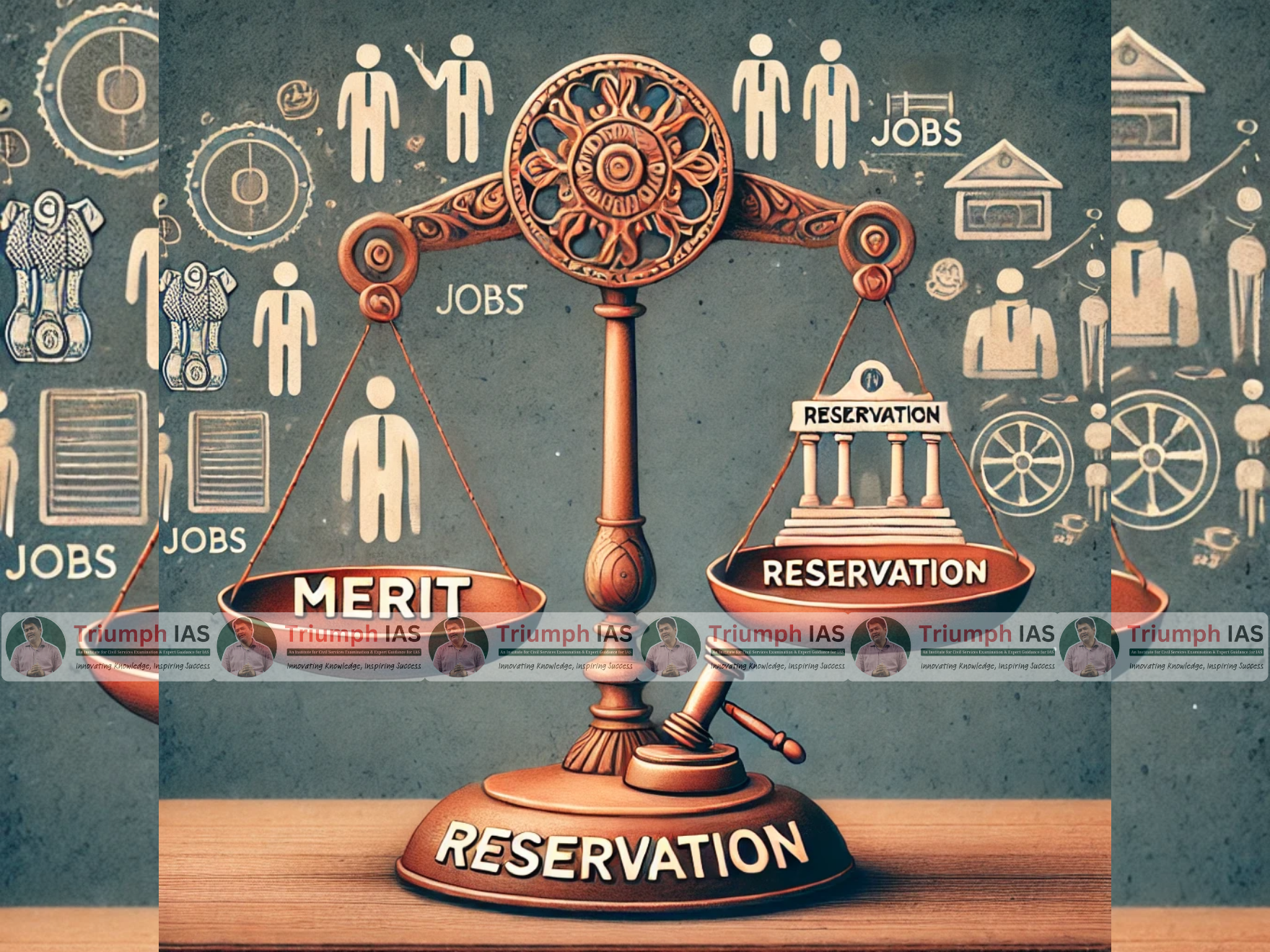

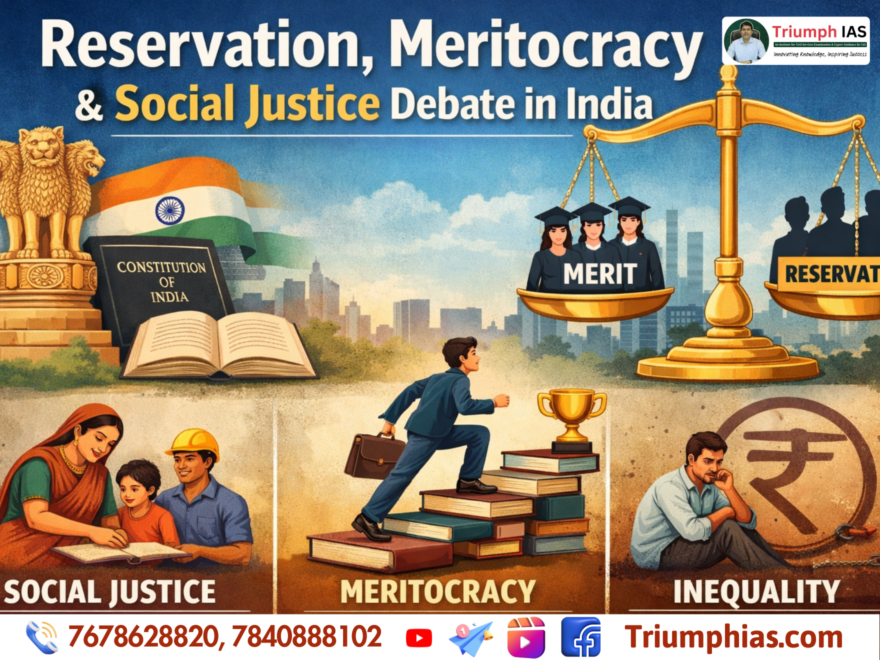
IntroductionThe debate surrounding reservation and meritocracy remains one of the most significant sociological discussions in contemporary India. It raises fundamental questions about equality, fairness, and the role of the state in addressing historical disadvantages. Reservation policies in India, primarily designed to uplift historically marginalized communities such as Scheduled Castes (SCs), Scheduled Tribes (STs), and Other Backward Classes (OBCs), are rooted in the constitutional vision of social justice. However, these policies often trigger debates over whether they undermine meritocracy or strengthen democratic equality. Dimension:Historical Roots of ReservationReservation in India emerged from the recognition that social inequality was deeply embedded in the caste system. For centuries, caste-based discrimination restricted access to education, economic opportunities, and political participation for large sections of society. The makers of the Constitution sought to correct these structural disadvantages through affirmative action policies. Articles 15(4), 16(4), and 46 of the Constitution empower the state to make special provisions for the advancement of socially and educationally backward classes. Reservation in education, employment, and political representation was therefore conceived as a corrective mechanism rather than a permanent entitlement. From a sociological perspective, reservation aims to promote substantive equality rather than merely formal equality. Meritocracy: Myth or Reality?Critics of reservation often argue that it compromises meritocracy. According to this perspective, opportunities should be allocated solely on the basis of individual talent, ability, and performance. However, sociologists challenge this notion by pointing out that merit is not produced in a social vacuum. Educational achievements and professional success are deeply shaped by social conditions such as family background, access to quality schooling, economic resources, and social capital. Individuals from historically privileged groups often benefit from better infrastructure, coaching facilities, and supportive networks. In contrast, marginalized communities face systemic barriers that limit their opportunities. Therefore, the idea of pure meritocracy can be misleading because it ignores unequal starting points. Sociologists argue that reservation does not undermine merit; rather, it attempts to level the playing field by compensating for structural inequalities.
Reservation as Social JusticeThe concept of social justice in India is closely linked with the goal of dismantling caste-based hierarchies. Reservation policies aim to ensure representation of marginalized communities in education, government services, and political institutions. Representation is sociologically significant because it increases the visibility and voice of historically excluded groups in decision-making processes. For example, the presence of individuals from marginalized communities in public institutions can challenge entrenched stereotypes and promote inclusivity. Furthermore, reservation policies contribute to social mobility by enabling individuals from disadvantaged backgrounds to access education and employment opportunities that were previously inaccessible. Over time, such policies can gradually reduce social inequalities and transform social structures. Emerging Challenges in the DebateDespite its achievements, the reservation system continues to face several challenges. One issue relates to the demand for inclusion by various communities seeking recognition as socially or educationally backward. This has led to debates about the criteria used to identify beneficiaries of reservation. Another challenge concerns the question of economic versus social criteria. Some argue that poverty should be the primary basis for affirmative action, while others maintain that caste-based discrimination remains a crucial determinant of inequality in India. There is also an ongoing debate about balancing efficiency with social justice. Policymakers must ensure that affirmative action policies promote both inclusivity and institutional effectiveness. Towards a Balanced PerspectiveFrom a sociological standpoint, the debate between reservation and meritocracy should not be framed as a simple opposition. Instead, it should be understood within the broader context of historical inequality and social stratification. Reservation is not merely a welfare measure but a tool for democratizing opportunities in a deeply unequal society. At the same time, continuous evaluation and policy refinement are necessary to ensure that affirmative action remains effective and responsive to changing social realities. Ultimately, the goal of public policy should be to create a society where structural inequalities no longer determine life chances. In such a society, meritocracy would become meaningful because individuals would truly begin from relatively equal starting points. |

To Read more topics, visit: www.triumphias.com/blogs
Read more Blogs:
Poverty, Deprivation, and the Debate on the Multidimensional Poverty Index (MPI)
One comment