


Relevant for Sociology Optional Paper 1, Paper 2, and GS Paper I (Indian Society)
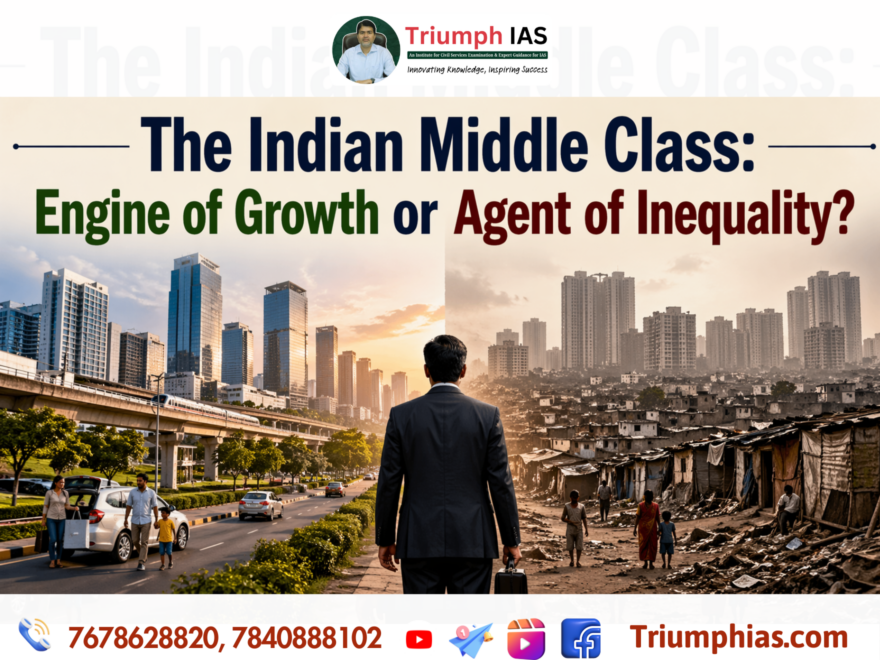
IntroductionThe rise of the Indian middle class has been one of the most defining features of post-liberalisation India. Often celebrated as the backbone of economic growth, this class has expanded rapidly since the 1991 reforms, driven by urbanisation, education, and the growth of the service sector. However, its role remains sociologically contested—does it act as an engine of inclusive development, or does it reinforce structural inequalities? DimensionFrom a developmental perspective, the middle class plays a crucial role in driving consumption, innovation, and entrepreneurship. It fuels demand for goods and services, supports the expansion of markets, and contributes significantly to GDP growth. The expansion of sectors like IT, education, healthcare, and finance has been largely sustained by middle-class participation. In this sense, the middle class aligns with modernization theories, which view it as a progressive force fostering rationality, meritocracy, and democratic values. However, a deeper sociological analysis complicates this narrative. Thinkers like Max Weber emphasized class, status, and power as overlapping dimensions of inequality, while Pierre Bourdieu highlighted how cultural capital reproduces social hierarchies. In India, the middle class often benefits from pre-existing advantages such as caste privilege, access to quality education, and urban location. Thus, rather than dismantling inequality, it may perpetuate it through mechanisms like elite schooling, English-language dominance, and professional networks. The Indian middle class is also marked by internal heterogeneity. It ranges from lower middle-class households struggling with job insecurity to an upper middle class enjoying global lifestyles. Yet, despite this diversity, there is a shared tendency toward “social closure”—a process where access to opportunities is restricted to maintain status advantages. For instance, private education and coaching industries, while enabling upward mobility for some, also deepen inequality by excluding those without financial means. Another critical dimension is the middle class’s relationship with the state. It often advocates for efficiency, governance reforms, and anti-corruption measures, which can strengthen democratic institutions. At the same time, it may resist redistributive policies such as subsidies or affirmative action, perceiving them as threats to meritocracy. This creates a paradox where the middle class supports growth but is ambivalent about equity. Moreover, the cultural influence of the middle class shapes aspirations and lifestyles across society. Through media, consumption patterns, and digital platforms, it sets norms that others seek to emulate. While this can drive social mobility, it also creates pressures and exclusions, particularly for marginalized groups who lack the resources to participate in this aspirational culture. ConclusionIn conclusion, the Indian middle class is both an engine of growth and a potential agent of inequality. Its economic contributions are undeniable, but its social role is ambivalent. The challenge lies in harnessing its developmental potential while ensuring that growth is inclusive and equitable. A more reflexive middle class—aware of its privileges and responsibilities—can play a transformative role in bridging, rather than widening, social divides. |
UPSC Civil Services (Mains) Question
Q. “The Indian middle class acts both as a driver of economic growth and a reproducer of social inequality.” Critically examine. (250 words)
To Read more topics, visit: www.triumphias.com/blogs
Read more Blogs:
Agrarian Class Differentiation in Post-Green Revolution India
A ship in harbour is safe, but that is not what ship is for – Triumph IAS & Vikash Ranjan Sir
Poets are the unacknowledged legislators of the world – Triumph IAS & Vikash Ranjan Sir



2 comments