


What's Inside this Blog!
Toggle
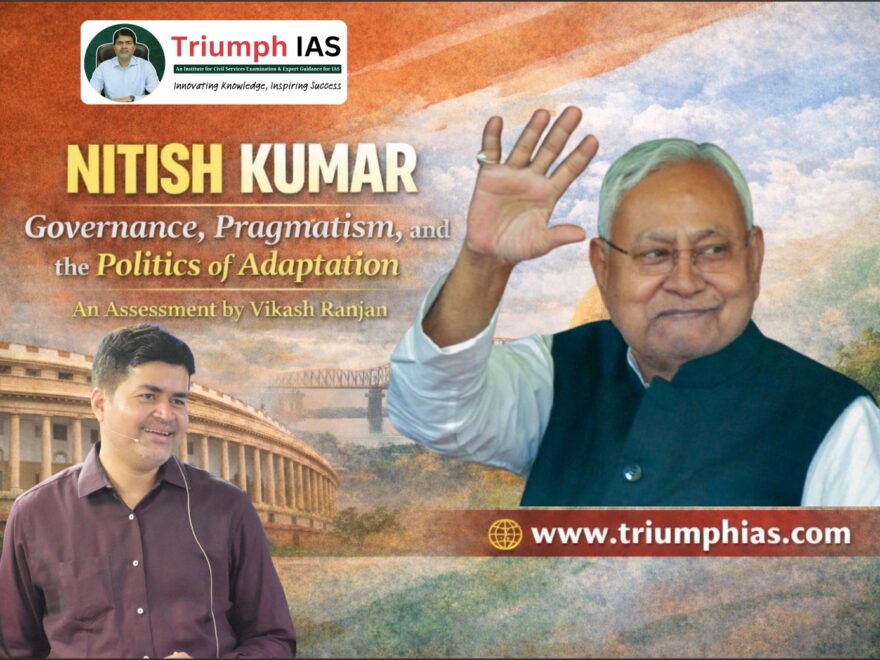
IntroductionIndian politics has produced many leaders whose careers reflect the dynamic and complex nature of democratic governance. Among them, Nitish Kumar stands as one of the most significant regional leaders of contemporary India. Over several decades, he has shaped the political and administrative trajectory of Bihar, transforming the discourse around governance, development, and social justice in a state that was once synonymous with administrative decline. Nitish Kumar’s political journey spans more than four decades, covering legislative, ministerial, and executive roles at both state and national levels. From his early days in socialist politics inspired by the ideas of Jayaprakash Narayan to his tenure as Chief Minister and Union Minister in multiple portfolios, Kumar’s career illustrates a blend of ideological flexibility, administrative focus, and political survival. At the same time, his political trajectory has also attracted criticism—especially over the last decade—regarding frequent political realignments, governance challenges, and the sustainability of his developmental legacy. An editorial assessment of Nitish Kumar must therefore balance two perspectives: his contributions to governance and social reform, and the controversies that have accompanied his later political career. EARLY POLITICAL JOURNEY AND IDEOLOGICAL FOUNDATIONSNitish Kumar’s political roots lie in the socialist movement that gained momentum in India during the 1970s. Born in 1951 in Bakhtiarpur, Bihar, he was educated as an engineer but gravitated toward politics during the turbulent years of the Emergency in India. The anti-Emergency movement, led by Jayaprakash Narayan, mobilized a generation of young activists who later shaped Indian politics. Nitish Kumar was among those who were deeply influenced by this political upheaval. His early association with socialist leaders like Ram Manohar Lohia and the ideological legacy of Karpoori Thakur shaped his emphasis on social justice and backward-class empowerment. The political environment of Bihar during the late twentieth century was characterized by intense caste mobilization, agrarian struggles, and the demand for representation of marginalized communities. Kumar first entered Parliament in 1989 as a member of the Janata Dal, representing the Barh constituency. His early parliamentary career established him as a serious and articulate politician who emphasized governance reforms and infrastructure development. RISE IN NATIONAL POLITICS: UNIONS MINISTERIAL ROLESNitish Kumar’s administrative credentials began to take shape when he served as a Union Minister in multiple portfolios during the coalition governments of the 1990s and early 2000s. MINISTER OF RAILWAYSOne of the most significant phases of his national political career came when he served as Railway Minister in the government led by Atal Bihari Vajpayee. During this tenure, Kumar introduced several initiatives aimed at improving passenger services, railway safety, and regional connectivity. His tenure saw the introduction of new trains, improved reservation systems, and modernization efforts aimed at enhancing the operational efficiency of Indian Railways. He also focused on expanding railway infrastructure in underdeveloped regions, particularly in eastern India. Nitish Kumar’s approach to railway administration reflected a technocratic orientation. Unlike many politicians who viewed the railways primarily through a populist lens, Kumar attempted to balance service expansion with institutional reform. MINISTER OF AGRICULTUREKumar also served briefly as Union Minister for Agriculture, where he advocated reforms aimed at improving agricultural productivity and rural infrastructure. His tenure emphasized irrigation development, rural credit accessibility, and farmer welfare. Although his period in this portfolio was relatively short, it reflected his broader commitment to rural development—an issue that would later become central to his governance agenda in Bihar. MINISTER OF SURFACE TRANSPORTIn the Ministry of Surface Transport, Kumar worked on strengthening highway connectivity and logistics infrastructure. His focus on transport networks foreshadowed the emphasis on roads and connectivity that later became a hallmark of his administration in Bihar. THE BIHAR TRANSFORMATION NARRATIVENitish Kumar’s most enduring political legacy is associated with his tenure as Chief Minister of Bihar. He first assumed office in 2005, at a time when the state was widely perceived as suffering from administrative collapse, weak infrastructure, and law-and-order challenges. The government he led under the banner of the Janata Dal (United), in alliance with the Bharatiya Janata Party, marked a turning point in Bihar’s governance narrative. LAW AND ORDER REFORMSOne of the earliest priorities of Nitish Kumar’s administration was restoring law and order. Bihar had long been associated with criminal politics and governance paralysis. Kumar introduced fast-track courts to expedite criminal trials and took a strong stance against organized crime. These measures resulted in a noticeable decline in kidnapping and violent crime, which had previously plagued the state. Improved security conditions created a more conducive environment for economic activity and social mobility. INFRASTRUCTURE DEVELOPMENTInfrastructure expansion became a central pillar of Kumar’s governance strategy. His government invested heavily in road construction, bridge development, and rural connectivity. Thousands of kilometers of rural roads were built or upgraded, improving connectivity between villages and markets. Improved infrastructure not only facilitated economic growth but also enhanced access to education and healthcare services. Electricity supply, which had been highly unreliable in the state, also saw gradual improvement during his tenure. EDUCATION INITIATIVESNitish Kumar launched several programs aimed at expanding educational access, particularly for marginalized groups. One of the most widely recognized initiatives was the bicycle scheme for girls, which provided bicycles to school-going girls to encourage secondary education. The program significantly increased female school enrollment and became an example of how targeted policy interventions could produce transformative social outcomes. The state also witnessed a rapid expansion in school infrastructure and teacher recruitment, although concerns about quality persisted. WOMEN ’s EMPOWERMENTKumar’s governance model placed considerable emphasis on gender empowerment. His government introduced 50 percent reservation for women in local self-government institutions, a landmark step in strengthening women’s political participation. Self-help groups were promoted under the Jeevika program, which aimed to empower rural women through microfinance and livelihood initiatives. These measures contributed to the emergence of women as significant stakeholders in Bihar’s development process. SOCIAL JUSTICE AND INCLUSIVE DEVELOPMENTNitish Kumar’s politics has consistently been rooted in the discourse of social justice. Unlike earlier caste-based mobilizations that focused primarily on political representation, Kumar attempted to combine identity politics with developmental governance. His policies targeted extremely backward classes (EBCs), Mahadalits, and other marginalized communities. Special welfare programs were designed to address the socio-economic disadvantages faced by these groups. This approach helped him build a broad social coalition that cut across caste lines, enabling his party to sustain electoral success for several years. ECONOMIC GROWTH AND DEVELOPMENT INDICATORSDuring the first decade of Nitish Kumar’s administration, Bihar recorded impressive economic growth rates. The state, once considered one of India’s most economically backward regions, began to show signs of improvement in sectors such as construction, services, and agriculture. Improved infrastructure, governance reforms, and increased public investment contributed to this growth trajectory. Bihar’s gross state domestic product (GSDP) growth during this period often exceeded the national average. However, critics have argued that much of this growth was driven by public spending and the construction sector, rather than sustainable industrialization. COALITION POLITICS AND POLITICAL ADAPTABILITYNitish Kumar’s career is also notable for his ability to navigate the complexities of coalition politics. Over the years, he has aligned with multiple political formations, including the BJP-led National Democratic Alliance and the opposition coalition led by the Indian National Congress. These shifts have often been justified by Kumar as necessary for maintaining governance stability and protecting secular values. However, critics argue that frequent political realignments have undermined ideological consistency. GOVERNANCE INNOVATIONSNitish Kumar introduced several governance innovations aimed at improving administrative accountability and citizen participation. Programs such as “Janata Darbar”, where citizens could directly present grievances to the Chief Minister, symbolized his emphasis on responsive governance. His administration also attempted to strengthen bureaucratic efficiency through monitoring mechanisms and performance evaluation. These initiatives helped create an image of Kumar as a governance-oriented leader focused on administrative reform rather than rhetorical politics. ENVIRONMENTAL AND SOCIAL INITIATIVESKumar also took initiatives in areas such as environmental protection and social reform. Campaigns against alcohol consumption led to the introduction of prohibition in Bihar in 2016. The policy was framed as a measure to protect families from the social and economic consequences of alcohol abuse. While it was welcomed by many women’s groups, the policy also generated debate regarding enforcement challenges and economic implications. CRITICISM AND CONTROVERSIES IN THE LAST DECADEDespite his earlier achievements, the last ten years of Nitish Kumar’s political career have been marked by increasing criticism. FREQUENT POLITICAL REALIGNMENTPerhaps the most prominent criticism relates to Kumar’s repeated changes in political alliances. Over the past decade, he has alternated between alliances with the BJP and opposition parties. These shifts have led critics to question his ideological commitment and political credibility. Opponents often describe him as a leader driven more by political survival than by consistent principles. GOVERNANCE FATIGUEAfter nearly two decades in power, some observers argue that Bihar’s governance model under Nitish Kumar has begun to show signs of fatigue. Issues such as unemployment, migration, and industrial stagnation continue to challenge the state. The COVID-19 pandemic exposed structural vulnerabilities in Bihar’s economy, particularly the heavy reliance on migrant labor. PROHIBITION POLICY CHALLENGESThe prohibition policy has been one of the most controversial aspects of Kumar’s governance. While intended as a social reform measure, it has faced criticism over implementation difficulties, black-market alcohol trade, and the burden on the criminal justice system. Thousands of arrests related to prohibition violations have raised questions about the policy’s effectiveness and fairness. ECONOMIC AND INDUSTRIAL LIMITATIONSAlthough Bihar achieved notable growth during the early years of Kumar’s administration, the state has struggled to attract large-scale industrial investment. Infrastructure improvements alone have not translated into significant industrialization. As a result, large numbers of young people continue to migrate to other states in search of employment opportunities. POLITICAL LEADERSHIP TRANSITIONAnother criticism concerns the lack of a clear leadership transition within Kumar’s political framework. As one of the longest-serving chief ministers in India, questions about succession and generational leadership change have become increasingly relevant. NITISH KUMAR ’s LEADERSHIP STYLENitish Kumar’s leadership style is often described as administrative, cautious, and pragmatic. Unlike many charismatic political leaders who rely heavily on mass mobilization, Kumar’s politics has focused on governance delivery. His emphasis on bureaucratic efficiency, development programs, and social welfare initiatives has distinguished him from traditional populist politics in Bihar. However, this technocratic approach has sometimes been criticized for lacking a broader ideological narrative. LEGACY AND HISTORICAL SIGNIFICANCEAssessing Nitish Kumar’s legacy requires situating his career within the broader context of Bihar’s political evolution. When he first assumed office in 2005, Bihar faced severe governance challenges. Over the following years, his administration succeeded in improving infrastructure, restoring law and order, and expanding educational opportunities. These achievements significantly altered national perceptions of Bihar and demonstrated the potential for governance reforms in historically marginalized regions. At the same time, the later phases of his political career have generated debates about ideological consistency, governance sustainability, and the limits of coalition politics. The political journey of Nitish Kumar reflects both the possibilities and contradictions of democratic leadership in India. His achievements in governance, infrastructure development, and social reform have left a lasting imprint on Bihar’s political landscape. Yet his career also illustrates the complexities of coalition politics, where pragmatism often intersects with ideological compromise. As Nitish Kumar now seeks a new chapter in parliamentary politics through the Rajya Sabha, his legacy remains a subject of intense debate. Supporters view him as the architect of Bihar’s governance revival, while critics see his recent political maneuvers as evidence of strategic adaptability bordering on opportunism. Ultimately, Nitish Kumar’s place in Indian political history will depend on how future generations evaluate the balance between his administrative achievements and the controversies of his later years. His career serves as a reminder that political leadership in a democracy is rarely defined by a single narrative. Instead, it is shaped by a continuous negotiation between ideals, governance challenges, and the shifting currents of electoral politics. |
To Read more topics, visit: www.triumphias.com/blogs
Read more Blogs:
Inequality in India: Wealth Concentration and Social Polarisation