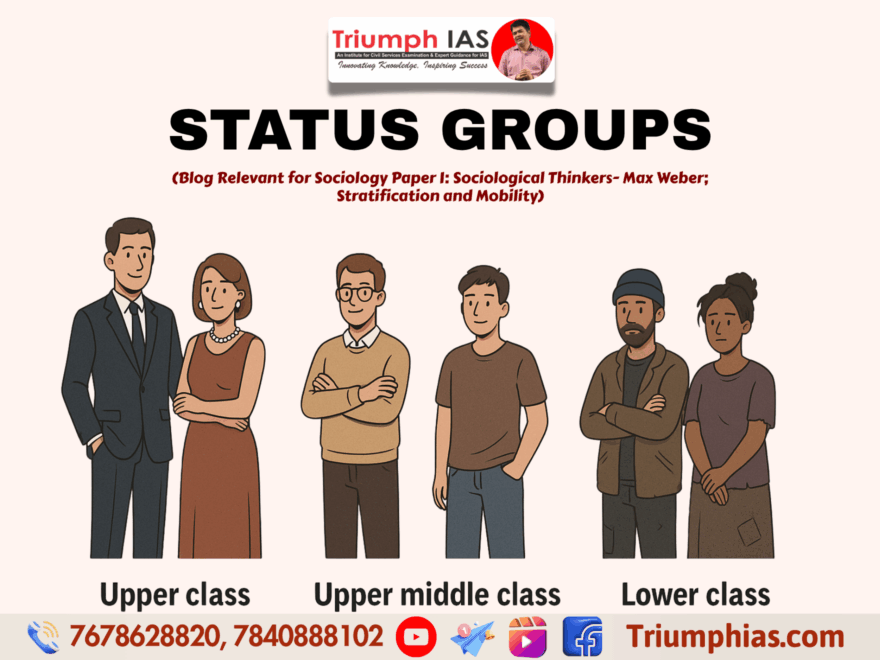
In the study of social stratification, Max Weber’s concept of status groups holds a critical place. While Karl Marx focused on economic class and means of production, Weber added the dimension of social prestige, thereby introducing a more nuanced understanding of hierarchy. It is essential to grasp how status groups function, interact with caste, and influence social mobility and inequality in contemporary India.
What Are Status Groups?
Status groups refer to social collectives distinguished by lifestyle, prestige, honour, or social esteem, rather than material wealth or political power. This concept is a pillar of Weber’s threefold model of social stratification:
Class = Economic position
Status = Prestige and honour
Party = Political power and influence
Status groups gain their social privilege through cultural and symbolic markers such as religion, caste, race, or ethnicity. Importantly, these groups practice social closure—restricting entry and maintaining exclusivity.
Status Groups vs Class:
Unlike class, which can be changed through upward mobility, status groups are often rigid, inherited, and culturally sanctioned. For instance:
A Dalit individual may acquire economic wealth (class mobility), but may still face social exclusion due to their status group identity.
A Brahmin priest may lack wealth but hold a high status due to ritual purity and religious function.
Status Groups in Traditional Indian Society:
In India, caste system is the most prominent historical example of a closed status group. According to Weber, caste embodies:
Ascribed status (by birth)
Social closure (e.g., endogamy)
Occupational specialization
Ritual status (purity and pollution)
Each jati (sub-caste) forms a status group, reinforced through cultural practices like marriage restrictions, food taboos, and religious hierarchies. This makes status groups in India uniquely complex, combining both economic inequality (like class) and symbolic exclusion.
Mechanisms of Social Closure in Status Groups
Weber used the term“social closure” to describe the strategies employed by status groups to maintain their position. Common techniques include:
Endogamy: Marriage within the group
Occupational monopoly: Reserving professions (e.g., Brahmins as priests)
Cultural symbols: Language, dress, lifestyle choices
Exclusionary practices: Denial of entry to temples, wells, or housing
In contemporary society, these mechanisms persist in more subtle ways, including urban housing discrimination, elite school admissions, and glass ceilings in jobs.
Status Groups and Social Mobility:
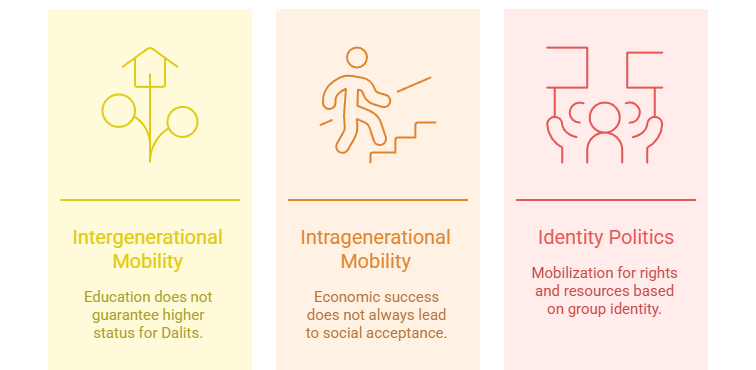
Although India’s constitutional vision promotes equality and mobility, status groups continue to affect:
Intergenerational mobility: Despite education, Dalits may remain in lower-status occupations
Intragenerational mobility: Economic gains may not translate to social acceptance
Identity politics: Group-based mobilization for rights and resources (e.g., SC/ST/OBC reservations)
The 2024 NSSO data revealed that SCs and STs still lag in job mobility, reinforcing Weber’s idea that status barriers remain strong even in capitalist economies.
Status Group Politics:
Status group identities are also politically mobilized. The Mandal Commission Report (1980) identified backward castes not only by economic deprivation but by lack of status and social discrimination.
In recent years, political parties have leveraged status group identities:
Dalit assertion movements (e.g., Bhim Army)
Jat and Patidar agitations demanding OBC status
Sub-categorization within Scheduled Castes to ensure equitable representation
These examples show that status group identity is not static but politically potent.
Contemporary Status Group Trends in India
Digital Divide and Caste Status: Recent studies (like by Azim Premji University and Oxford) show that caste-based digital exclusion mirrors the status group hierarchy. SCs and STs have less access to digital infrastructure, further impacting education and employment.
Social Media and Status Group Identity: Social media platforms have become a space for status assertion (e.g., online Dalit activism) but also for hate speech and reinforcement of status hierarchies.
Urbanization and Status Fluidity: In cities, class mobility may blur status boundaries, yet gated communities, caste-based matrimonials, and elite clubs continue to reflect status-based segregation.
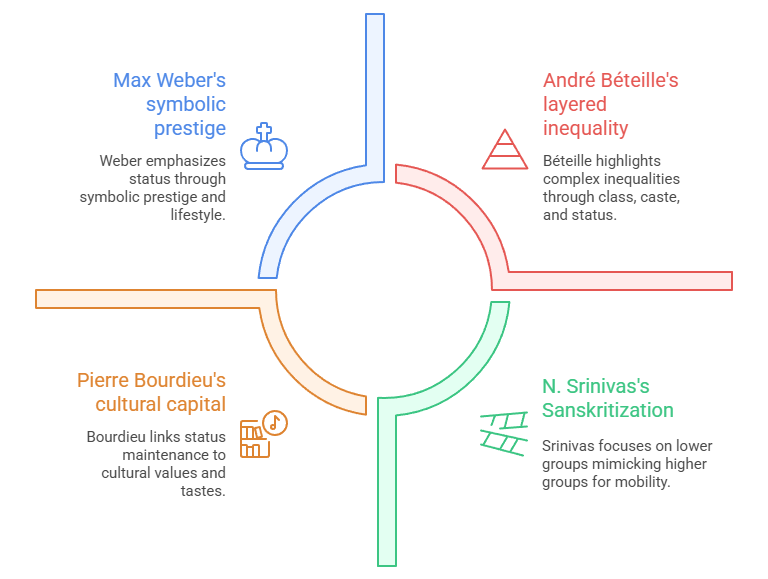
Sociological Thinkers on Status Groups
Max Weber: Developed the idea of status group; emphasized symbolic prestige and lifestyle
Pierre Bourdieu: His concept of cultural capital complements Weber—status groups maintain their position through values and tastes
N. Srinivas: Concepts like Sanskritization reflect the aspiration of lower status groups to mimic higher groups for upward mobility
André Béteille: Differentiated between class, caste, and status as layered forms of inequality in India
Status Groups in Global Context
While caste dominates the Indian context, status groups globally include:
Racial hierarchies in the US(e.g., segregation of African-Americans)
Ethnic minorities in Europe (g., Roma people in Eastern Europe)
Tribal marginalization in Latin America
This makes status group theory universal in its application and relevance for global sociology comparative analysis.
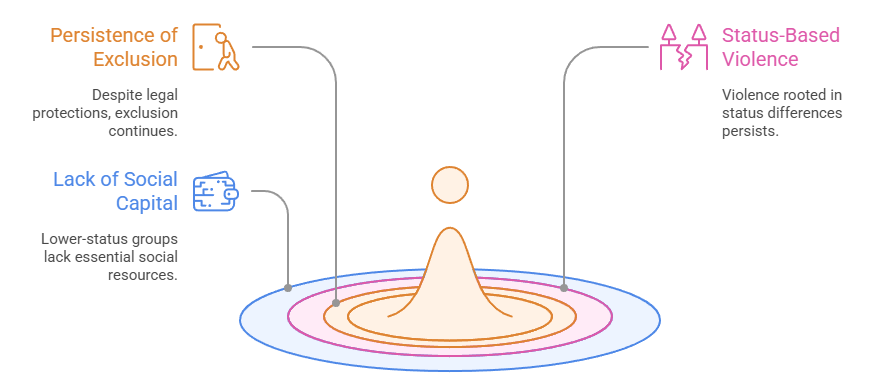
Challenges for India
Persistence of exclusion despite legal safeguards
Status-based violence (honour killings, caste lynchings)
Lack of social capital for lower-status groups
Opportunities for India
Affirmative action policies
Social movements for dignity and equality
Digital empowerment for marginalized status groups
Conclusion
Understanding status groups helps us decode the symbolic and cultural dimensions of inequality that persist despite economic progress. Weber’s insights remain strikingly relevant in the Indian context, where birth-based social honour still governs social behaviour, access to resources, and patterns of exclusion. Hence, addressing status-based discrimination requires more than economic growth—it demands sociocultural transformation.
Paper 1
What is social closure? How do status groups maintain their privileges in a closed stratification system? (2016)
How does Weber conceptualize the relationship among class, status, and party? Explain with suitable examples. (2017)
Explain the relationship between social stratification and social mobility in open and closed systems. (2018)
Differentiate between life chances and lifestyles. Explain how status groups influence lifestyle. (2019)
What are the basic tenets of Weber’s theory of social stratification? How does it differ from Marx’s theory? (2019)
Distinguish between class and status. How does Weber use these concepts in understanding social stratification? (2020)
How does stratification contribute to social stability and social change? Illustrate with reference to class and status. (2021)
What is the significance of status inconsistency in stratified societies? Discuss with sociological examples. (2022)
Examine the role of cultural and symbolic capital in maintaining the hierarchy of status groups. (2023)
How do Weber and Bourdieu differ in their approach to status, prestige, and social hierarchy? (2023)
Paper 2
How has the role of caste as a status group changed in modern India? Illustrate with examples. (2015)
Discuss the concept of Sanskritization. How does it reflect efforts by lower status groups to claim higher prestige? (2016)
Discuss the features of caste as a system of social stratification. Do you agree with the view that caste is a status group? (2017)
Critically examine the Mandal Commission Report and its implications for status group politics in India. (2019)
How far is caste a basis for social stratification in India? Discuss with suitable examples. (2021)
Discuss the impact of reservation policy on the status mobility of Scheduled Castes and Other Backward Classes. (2021)
To what extent has the process of urbanization affected the traditional status hierarchy based on caste? (2022)
Is caste still an important factor in social mobility and status identity in India today? Give sociological reasons. (2023)







2 comments