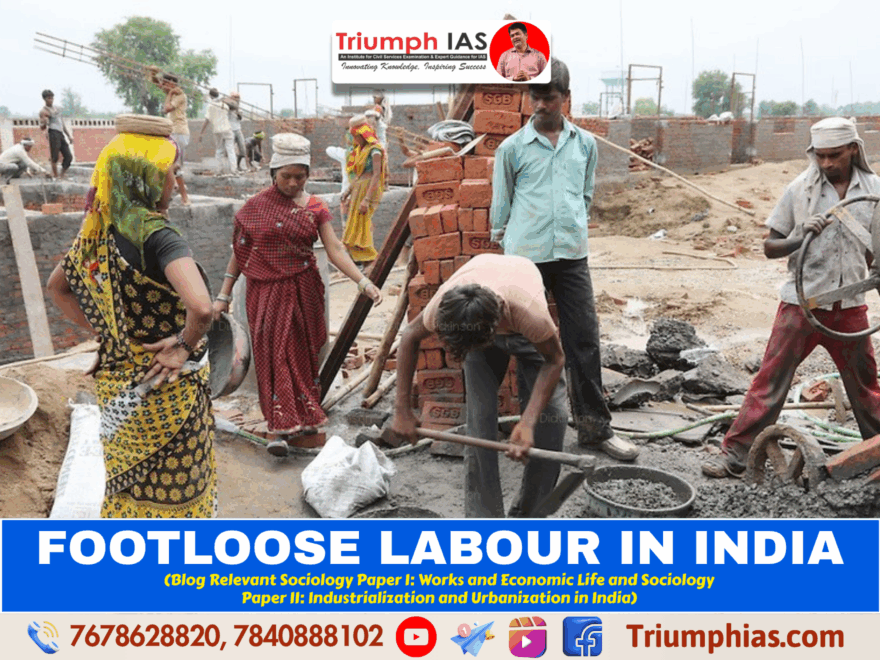
India’s labour market has witnessed profound structural changes in recent decades, most notably through the rise of footloose labour. This term, popularised by sociologist Jan Breman, refers to workers who are casually employed, lack job security, and constantly shift locations in search of livelihood. They represent the marginal and mobile workforce navigating the vulnerabilities of the informal economy. In the backdrop of agrarian crisis, urban informalization, and globalization, footloose labourers are fast becoming a defining feature of India’s socio-economic landscape.
Understanding footloose labour is crucial to grasp the changing nature of work, inequality, class structures, and labour rights in contemporary India. This blog delves into the meaning, causes, sociological implications, and policy relevance of footloose labour.
What is Footloose Labour?
Footloose labour refers to non-permanent, circular, and migratory workers who shift between informal jobs and lack stable income, employment contracts, or social security.
Key Features:
No fixed employer or workplace
Migratory in nature, moving across states and regions
Work in informal sectors such as construction, brick kilns, agriculture, loading/unloading, and domestic work
Low wages and high exploitation
Social insecurity and exclusion from labour laws
Sociological Analysis
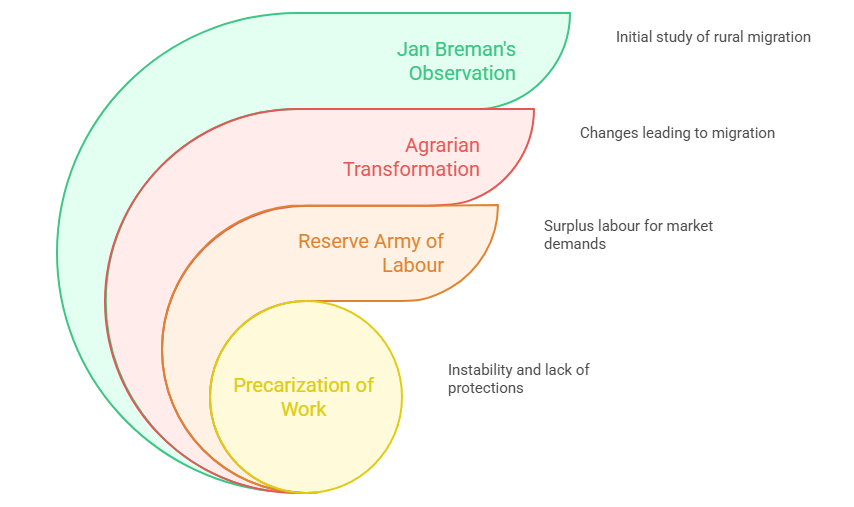
Jan Breman introduced the term while studying rural Gujarat. He observed that agrarian transformation and decline in rural employment pushed landless labourers into seasonal migration, especially from Dalit and Adivasi backgrounds.
From a Marxist perspective, footloose labour reflects the “reserve army of labour”, as theorised by Karl Marx. It highlights how capitalism generates surplus labour, using it as a buffer for fluctuating market demands and suppressing wage growth.
The rise of footloose labour signifies the precarization of work, a concept explored by sociologists like Guy Standing (precariat class) and Arne Kalleberg, who highlight unstable employment, lack of worker rights, and erosion of traditional labour protections.
Sociological Causes of Footloose Labour in India
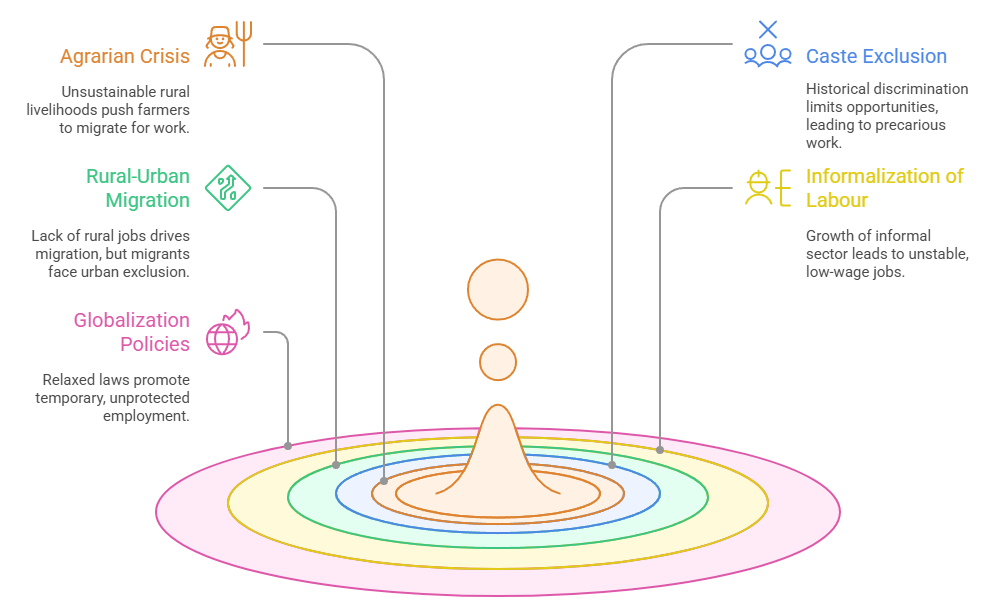
Agrarian Crisis: The decline in agricultural profitability due to land fragmentation, rising input costs, and climate uncertainties has made rural livelihoods unsustainable. This pushes marginal farmers and landless labourers—especially Dalits and Adivasis—toward seasonal migration and precarious urban work.
Caste and Labour Segmentation: Historical patterns of caste-based exclusion have confined Dalits and Adivasis to low-paid, menial work. Their limited access to land, education, and formal employment opportunities has led to overrepresentation in footloose labour, reinforcing caste-class intersectionality.
Rural-Urban Migration: Lack of employment in rural areas and the lure of daily wage work in cities have driven circular and seasonal migration. However, migrants remain socially and legally excluded in cities, often lacking documentation and access to services, resulting in a vulnerable existence.
Informalization of Labour: A growing informal sector with minimal job security and lack of contracts has led to increasing casualisation of the workforce. Even formal enterprises increasingly outsource work to informal contractors, leading to unstable, low-wage, and mobile employment for millions.
Globalisation and Neoliberal Policies: Post-liberalisation, labour laws were relaxed to promote economic flexibility. This shift encouraged industries to rely on temporary and mobile labour, eroding job permanency and encouraging contractual, footloose employment models without protections or benefits.
Implications of Footloose Labour in India
Class Formation and Fragmentation: Footloose labourers represent a fragmented class lacking cohesion or collective bargaining power. Due to their mobile and scattered nature, they are unable to develop strong class consciousness, making it difficult for them to organise or resist exploitation effectively. This limits their political visibility and representation.
Gendered Nature of Labour: A significant portion of footloose labour consists of women, especially in domestic work, textiles, and care sectors. These women face double marginalisation—first as informal workers and second due to patriarchal norms. They often endure wage discrimination, unsafe work conditions, and social invisibility.
Family and Social Life Disruption: The migratory nature of footloose labour leads to long periods of family separation. Children may be left behind in villages or move frequently, resulting in disrupted schooling, inadequate healthcare, and emotional distress. The lack of stability affects family bonding and long-term community integration.
Urban Exclusion: Despite their contribution to the urban economy, footloose migrants often remain excluded from city planning and services. Without valid IDs or documents, they are denied housing, health care, banking, and welfare schemes, reinforcing their status as “urban outsiders” or invisible citizens.
COVID-19 and Migrant Crisis: The COVID-19 lockdown starkly revealed the systemic neglect of footloose labourers. With no job security, savings, or transportation, millions were left stranded, forced to walk hundreds of kilometres. The crisis exposed deep flaws in the welfare architecture and the urgent need for inclusive labour policies.
Current affairs linkage
NITI Aayog’s reports on migrant workers and portability of entitlements
e-Shram portal: A recent initiative to register informal and footloose labourers
Code on Social Security, 2020: Potential to bring them under legal safety nets
Kerala’s Inter-State Migrant Workers Welfare Scheme as a model
Policy Challenges and Recommendations
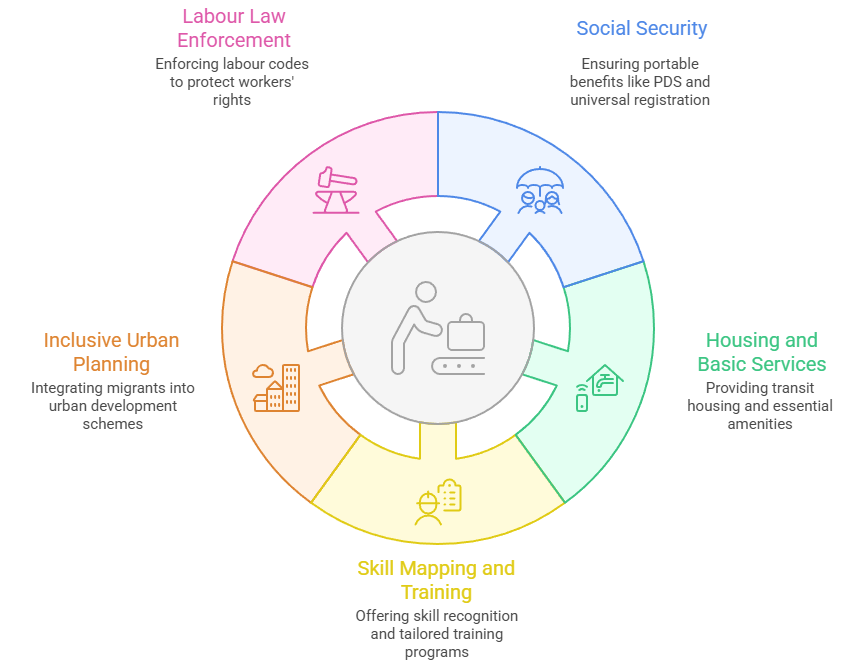
Social Security and Portability: Footloose labourers lack stable access to social welfare due to their mobility. Ensuring portability of benefits such as PDS through schemes like ‘One Nation One Ration Card’ and universal registration under e-Shram is vital for improving their security and access.
Housing and Basic Services: Migrants often live in overcrowded and informal settlements without basic amenities. Urban planning should include transit housing, clean water, toilets, and primary healthcare to ensure dignity and better living conditions for footloose workers.
Skill Mapping and Training: Many footloose labourers work in low-skill jobs despite having better potential. Government interventions must include skill recognition and training programs tailored to their mobility, enabling them to move into more secure and better-paid occupations.
Inclusive Urban Planning: City administrations often exclude migrants in planning. Integrating them into urban development schemes like Smart Cities and PM SVANidhi (for street vendors) can help improve their access to services, rights, and livelihoods in urban areas.
Labour Law Enforcement: Footloose workers face wage theft, long hours, and unsafe conditions. Effective enforcement of new Labour Codes, especially those related to minimum wages, workplace safety, and dispute redressal, is essential to protect their rights.
Conclusion
Footloose labour is not just an economic category—it reflects deep-rooted social inequalities, institutional neglect, and the failures of both rural and urban policy frameworks. Understanding this phenomenon requires a multidimensional approach that combines economic, social, and political analysis.
Paper I:
Critically examine the functional and dysfunctions of the informal sector in the economy. – (2013)
What do you understand by the informal sector? Examine the role of the informal sector in the Indian economy. – (2014)
Discuss the significance of informal networks in the organization of work. – (2015)
Explain the Marxian concept of surplus value. Is it relevant in the present-day capitalist society? – (2016)
Discuss the relevance of Marx’s theory of class struggle in understanding labour exploitation in the unorganised sector. – (2021)
What is meant by precarious work? Discuss its emergence in the context of globalization. – (2023)
Paper II:
Write a note on labour migration and its impact on social structure in India. – (2013)
Examine the changing labour relations in the emerging agrarian economy in India. – (2015)
Explain the growth of informal sector in urban India and its implications for social mobility. – (2017)
Discuss the challenges faced by internal migrants in India during the COVID-19 pandemic. – (2021)
How has the informalisation of labour affected the economic security of rural households? – (2022)
Critically examine the sociological consequences of inter-state labour migration in India. – (2023)