(Relevant for Sociology Paper I: Works and Economic Life; Social Change in Modern Society and Sociology Paper II: Rural and Agrarian Transformation in India; Challenges of Social Transformation)
The Mahatma Gandhi National Rural Employment Guarantee Act (MNREGA) is hailed as one of the most ambitious public works programmes in the world, aimed at reducing poverty and ensuring rural livelihood security in India. Launched in 2005, it guarantees 100 days of wage employment per household in rural areas. While the programme has succeeded in enhancing economic stability and reducing rural distress, recent research highlights a troubling paradox: MNREGA may have inadvertently reduced women labour force participation and weakened their bargaining power within households. This raises crucial questions about the gendered effects of welfare schemes and the importance of designing employment policies that foster both economic security and women’s empowerment.
Gender Roles and Labour
From a sociological standpoint, female labour force participation (FLFP) is closely tied to gender norms, class structures, and the socio-economic organization of households. Functionalists like Talcott Parsons viewed the division of labour by gender as a functional necessity, where women manage the expressive roles (household, caregiving) and men take on instrumental roles (breadwinning). However, feminist sociologists argue that such divisions are historically constructed and perpetuate women’s subordination.
In the context of rural India, the “added worker effect” explains women’s entry into the labour market primarily as a coping mechanism in times of male unemployment or income instability. MNREGA’shousehold-level guarantee seems to have substituted this buffer role, reducing the need for women to engage in paid work.
MNREGA: Objectives and Achievements
MNREGA was envisioned as a rights-based employment scheme, with its objectives including:
Alleviation of rural poverty
Creation of durable assets in villages
Strengthening of livelihood security
Promotion of women’s employment (minimum one-third of the beneficiaries to be women)
Achievements:
Increase in household income and consumption by 5–7%
Employment provision to over 270 million rural households
54% of MNREGA job-days between 2012–2021 went to women
Yet, these figures do not reflect an actual increase in net female labour force participation, as many women may have merely shifted from other informal jobs to MNREGA.
The Paradox: Declining Women Labour Force Participation
Despite MNREGA’s legal provisions for women’s participation, rural married women were found to be 4 percentage points less likely to work outside the home after its implementation. According to García (2025), MNREGA explains up to 30% of the nationwide decline in rural FLFP from 2005 to 2012.
Why did this happen?
Household-Level Targeting: MNREGA guarantees employment per household, not per individual. Once the male member secures the job, there’s reduced necessity for the woman to work.
Women as Insurance Workers: In rural India, women are often secondary earners. When male earnings become stable (thanks to MNREGA), women retreat from the labour force.
Gender Norms: Social expectations that women should work only when absolutely necessary discourage their participation when basic income is secured.
Empirical Evidence
Based on National Sample Survey (1999–2012) and Indian Human Development Survey (2005, 2012), García (2025) observed:
FLFP dropped significantly in districts where MNREGA was implemented earlier.
Men’s participation remained steady, but they reduced the number of days worked.
Household consumption increased, yet asset ownership declined, indicating less need for precautionary savings.
Women’s share in household resources fell by 9%, reducing their decision-making power.
Women’s BMI dropped, suggesting negative health and well-being outcomes due to reduced economic autonomy.
Impact on Household Bargaining Power
Amartya Sen (1990) have shown that economic independence enhances women’s agency in household decision-making. MNREGA’s household-centric model inadvertently:
Undermined women’s bargaining power by reinforcing dependence on male income.
Reduced financial autonomy, affecting their say in matters like children’s education, healthcare, and daily expenditures.
A domestic independence index from IHDS data declined by one-third of a standard deviation for women in MNREGA-implemented regions.
Sociological Analysis
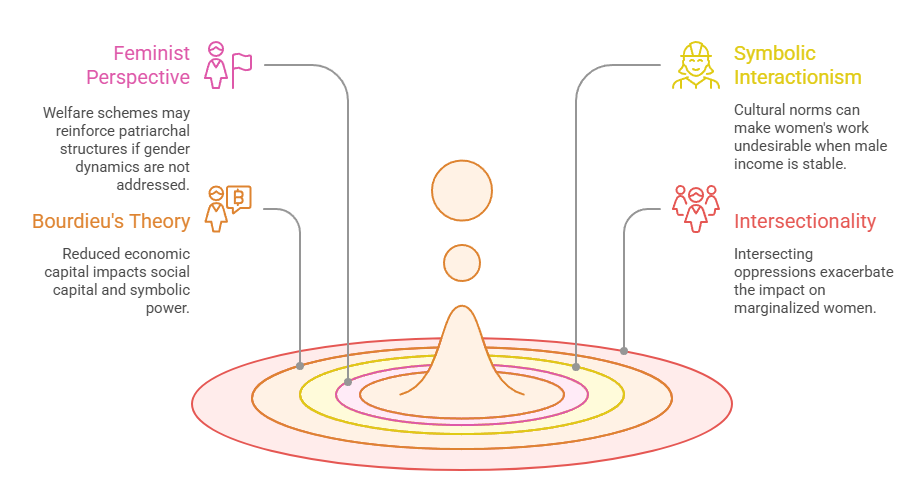
Feminist: Argues that welfare schemes often reproduce patriarchal structures if they do not explicitly address gendered power relations.
Symbolic Interactionism: Norms surrounding “respectable femininity” in rural India associate wage work with necessity, not choice. When MNREGA provides male income stability, women’s work becomes symbolically undesirable.
Pierre Bourdieu’s Theory of Habitus and Capital: Women’s retreat from paid work reduces their economic capital, impacting their social capital and symbolic power within the household.
Intersectionality (Crenshaw): The decline in FLFP must be understood in light of intersecting oppressions—caste, class, and gender. Dalit and Adivasi women, who may rely more on labour work, face more significant setbacks when such employment avenues shrink.
Policy Implications
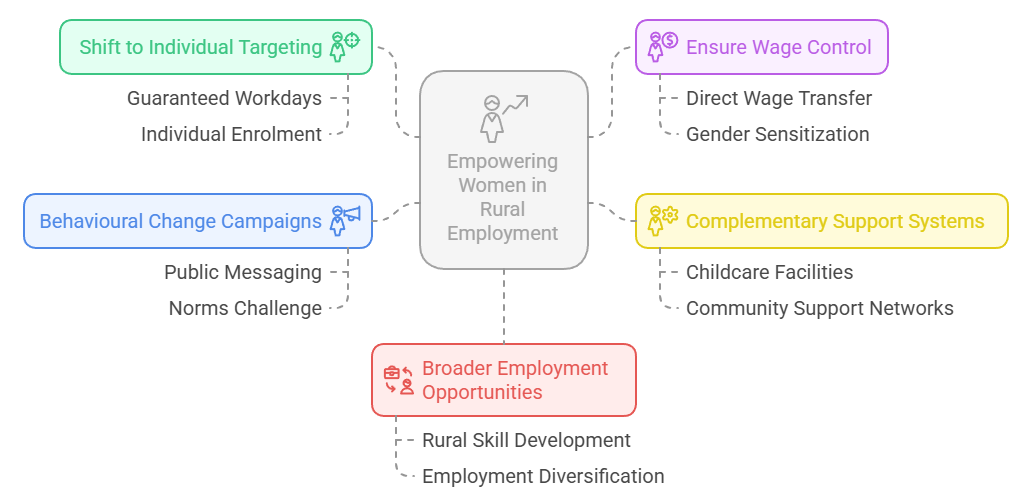
MNREGA, while effective in poverty alleviation, must evolve to promote gender-equitable outcomes. Key recommendations:
Shift from Household to Individual Targeting
Assign guaranteed workdays per adult, not per household.
Create quotas or incentives for women’s individual enrolment and wage disbursal.
Ensure Women’s Wage Control
Direct transfer of wages to women’s bank accounts.
Introduce gender-sensitization among field functionaries and local administrators.
Complementary Support Systems
Provide childcare facilities, safe transportation, and sanitation at worksites.
Build community support networks that encourage women’s employment as a norm.
Behavioural Change Campaigns
Public messaging campaigns to challenge gender norms that link women’s work with economic desperation.
Broader Employment Opportunities
Promote rural skill development and employment diversification for women beyond MNREGA.
Conclusion
MNREGA offers a compelling example of a well-intentioned policy with unintended gender consequences. While it has enhanced rural economic stability, it has simultaneously reduced rural women labour force participation, weakened their bargaining position, and compromised their well-being. These findings underscore the importance of designing welfare schemes through a gender lens, ensuring that empowerment and equity are embedded in policy frameworks.
In the broader context of sociology of gender and development, MNREGA reflects the complex interplay between state intervention, household dynamics, and entrenched social norms. As India reimagines its social protection systems, a critical rethinking of gender-responsive design is essential to transform women from secondary earners into empowered economic agents.
PYQs
Paper 1:
Critically examine the relationship between gender, labour, and social stratification.(2014)
Discuss the interplay between economic development and gender inequality.(2015)
Discuss how patriarchy shapes women’s access to employment and economic resources in Indian society.(2016)
Examine the changing nature of work and labour in the informal sector in India.(2017)
Critically evaluate the role of the State in transforming gender relations in society.(2018)
How does the concept of ‘bargaining power’ apply to gender relations within households?(2019)
Evaluate the impact of economic policies and employment programmes on women’s empowerment.(2020)
How do gender roles influence women’s participation in the labour force? Illustrate with examples.(2021)
Explain the concept of ‘feminization of poverty’ with reference to rural labour.(2022)
Examine the role of social norms and cultural practices in determining women’s work participation in rural areas.(2023)
Paper 2:
Discuss the role of social norms in limiting the effectiveness of poverty alleviation programmes for women.(2015)
How far has the rural employment guarantee scheme succeeded in transforming agrarian society in India?(2016)
Explain how state policies can perpetuate or challenge gender inequality. Use relevant examples.(2017)
Assess the effectiveness of welfare policies in promoting inclusive development in India.(2018)
Discuss the factors responsible for the declining female labour force participation rate in rural India.(2019)
Evaluate the role of MNREGA in addressing rural poverty and women’s empowerment.(2020)
Critically analyse the unintended consequences of rural development programmes on gender roles in India.(2021)
Examine how government employment schemes like MNREGA impact the socio-economic position of rural women.(2023)
Analyse the sociological impact of MNREGA on rural labour structure and household decision-making.(2024)






2 comments