Waves of Change in India-Maldives Partnership

Waves of Change in India-Maldives Partnership

Waves of Change in India-Maldives Partnership

(Relevant for GS paper-2, International Relation)

Introduction: India-Maldives Partnership

India-Maldives relations have witnessed a dramatic evolution in recent years. Once mired in tension following the 2023 election of Maldives’ President Mohamed Muizzu on an “India‑Out” plank, bilateral relations have undergone a marked reset as India emerges again as the Maldives’ anchor partner in diplomacy, development, and security. Prime Minister Narendra Modi’s two-day state visit to the Maldives in July 2025 symbolized this strategic realignment and underscored India’s continuing primacy in its maritime neighbourhood.

From Strain to Strategic Reset

Muizzu’s call for the withdrawal of Indian military personnel—who had been deployed for search, rescue, and medical aid missions—triggered a low in relations. India complied by replacing troops with civilian technical staff to operate gifted aircraft, diffusing sovereignty concerns while ensuring continuity of services.

Political missteps such as Maldivian ministers’ derogatory online remarks about India contributed to a tourism boycott and heightened diplomatic friction.

The Diplomatic Turnaround

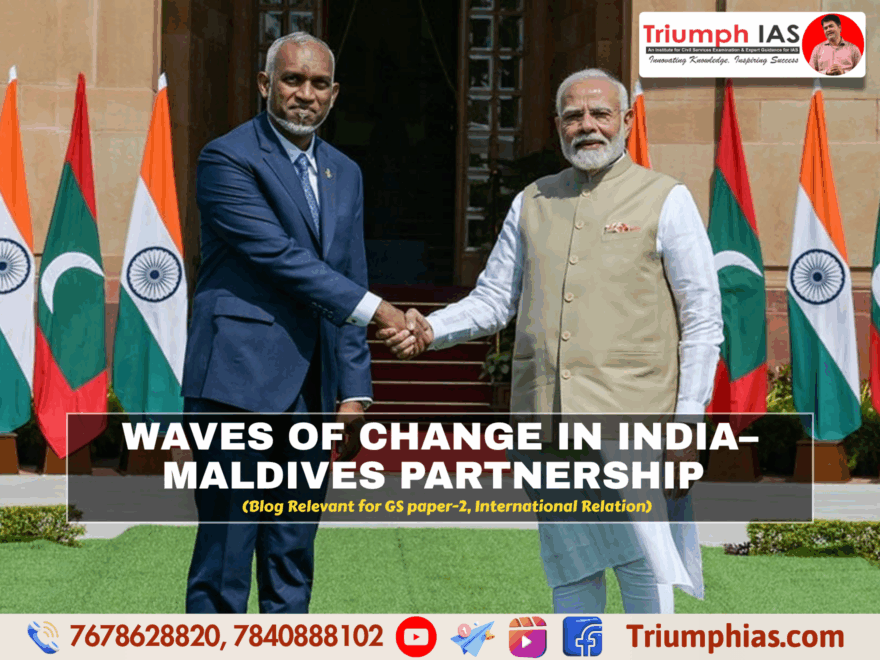
PM Modi’s invitation as the guest of honour at Maldives’ 60th Independence Day was both symbolic and substantive. He presided over multiple high-profile engagements, reaffirming shared sovereignty, regional stability, and mutual respect between the leaders of both nations.

Key highlights included six memoranda of understanding (MoUs) spanning areas like fisheries, meteorology, digital public infrastructure, and the integration of UPI and RuPay into Maldives’ digital economy. A new Line of Credit worth ₹4,850 crore (~US $565 million) was extended, alongside a 40% reduction in Maldives’ annual debt repayment obligations from roughly US $51 million to US $29 million. Modi also inaugurated infrastructure and community projects, including road and drainage systems in Addu City, and handed over 3,300 social housing units and defence vehicles.

Deepening Cooperation: Key Deliverables

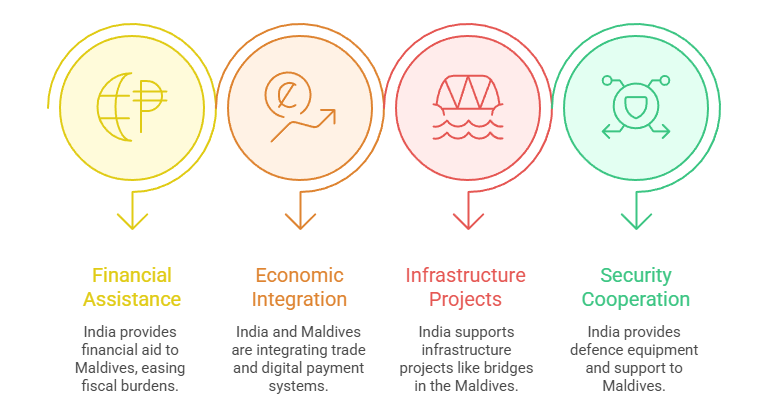
  • Line of Credit & Debt Relief: The ₹4,850 crore LoC funding remotely supports Maldives’ infrastructure and development ambitions, with the amendatory agreement easing its fiscal burden significantly.
  • Trade & Digital Connectivity: Launch of free trade agreement and investment treaty talks signalled a push toward economic integration. Integration of India’s UPI and RuPay systems into Maldives’ digital payment framework underscores growing cross-border digital synergy.
  • Infrastructure Collaboration: India’s support continues across flagship projects—the Greater Malé Connectivity Project (Thilamalé Bridge, 6.74 km) is now over 50% complete, with planned delivery by September 2026. India also recently inaugurated the Hankede Bridge in Addu City under its LoC funding.
  • Defence & Security Support: India gifted 72 vehicles and defence equipment to Maldives National Defence Force, reinstating its role as the Indian Ocean’s trusted security partner. Additionally, Maldives is seeking India’s support in countering drug trafficking linked to cross-border terrorism, reflecting converging security interests in the region.

Strategic Rationale & Regional Implications

Under its “Neighbourhood First” and SAGAR policy frameworks, India views Maldives as a strategic partner pivotal to ensuring maritime security and influence in the Indian Ocean region.

The resetting of relations also reflects a strategic contest with China, whose growing presence via the Belt and Road Initiative and earlier high-level agreements prompted India’s diplomatic and financial outreach.

Successful Indian engagement has ranged from crisis response—most famously Operation Cactus in 1988—to development aid during the 2004 tsunami, 2014 water crisis, COVID‑19, and recent financial bailouts. That historical goodwill has re‑emerged as a powerful tool in rebuilding trust.

Challenges & Risks Ahead

Despite renewed warmth, challenges persist in sustaining stability:

  • Political Volatility in Maldives: Coalition politics and shifting leadership continue to influence foreign policy direction—India must guard against another resurgence of anti-India sentiment or a repeat of “India Out” campaigns.
  • Chinese Economic Influence: China’s substantial investment footprint in Maldives remains formidable; India must offer competitive, people-centric alternatives to preserve influence.
  • Public Sentiment & Soft Power: India’s continued soft power appeal—in education, healthcare, migration, and diplomatic goodwill—remains a potent strategic resource to reinforce long-term partnership.

Policy Imperatives for Bilateral Growth

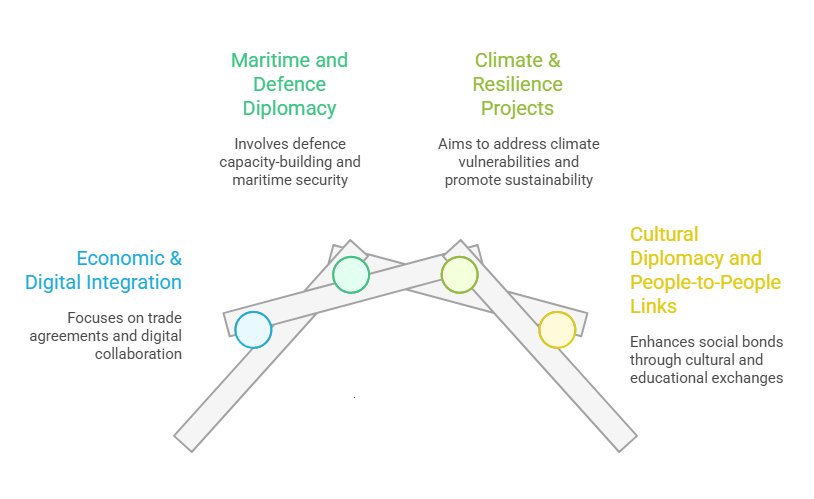
  • Economic & Digital Integration: Fast-track negotiations on the Free Trade Agreement and investment treaty while deepening digital public goods cooperation—UPI, RuPay, fintech collaboration.
  • Maritime and Defence Diplomacy: Continue defence capacity-building via infrastructure projects like Uthuru Thila Falhu naval harbour and joint maritime exercises; scale up collaboration on piracy, drug trafficking, and maritime surveillance.
  • Climate & Resilience Projects: Expand cooperation in water, sanitation, renewable energy, and climate adaptation to address Maldives’ vulnerability to sea-level rise and extreme weather shocks
  • Cultural Diplomacy and People-to-People Links: Promote scholarships, tourism exchanges, diaspora outreach, and education partnerships to strengthen lasting social bonds.

Significance for UPSC Aspirants

This diplomatic reset offers rich insights across UPSC themes:

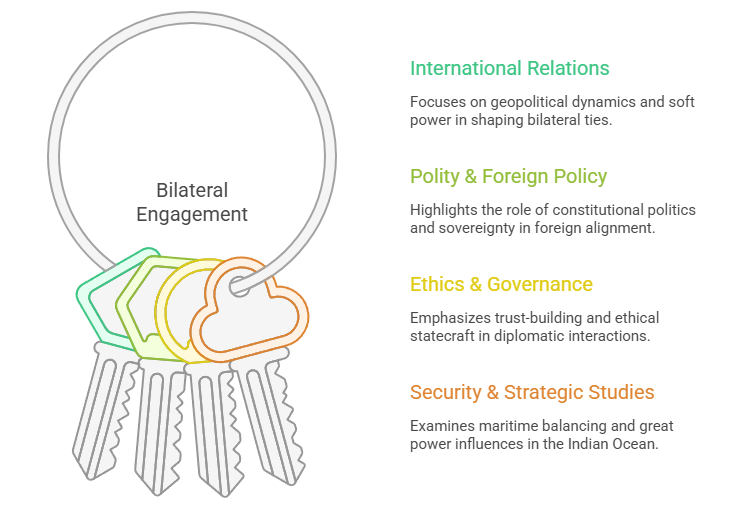
  • International Relations: Illustrates how geopolitics and small state dynamics shape bilateral engagement—through aid, strategic outreach, and soft power.
  • Polity & Foreign Policy: Highlights the role of constitutional politics, sovereignty sensitivity, and external actors in foreign alignment.
  • Ethics & Governance: Underscores principles of trust-building, diplomacy, and development assistance as instruments of ethical statecraft.
  • Security & Strategic Studies: Examines maritime balancing in the Indian Ocean against competing great power influences.

Conclusion

The recasting of India–Maldives diplomacy represents not only a restoration of ties but a deeper strategic realignment. India’s fine balance of firm diplomatic outreach, development cooperation, and maritime engagement is realigning its position as the Maldives’ preferred partner amid global power shifts. The bilateral journey now hinges on sustainable cooperation in trade, climate resilience, and trust-based partnerships that go beyond transient political landscapes.

To Read more topicsvisit: www.triumphias.com/blogs

Read more Blogs:

The idea of Development Planning and Mixed Economy | Sociology Optional Coaching | Vikash Ranjan Classes | Triumph IAS | UPSC Sociology Optional

Lineage and descent in India | Sociology Optional Coaching | Vikash Ranjan Classes | Triumph IAS | UPSC Sociology Optional

2 comments

Leave a Reply

Your email address will not be published. Required fields are marked *