India stands at a critical juncture where economic growth must translate into quality employment for its young workforce. With global uncertainty and a volatile external sector affecting demand-driven growth, the Prime Minister’s Independence Day address emphasised reforms to stimulate investment and employment. While tax reforms such as GST recalibration may spur consumption, a deeper challenge lies in restructuring India’s education and skilling ecosystem. Our traditional academic, rote-based education system is insufficient to prepare youth for the future of work. Vocational Education and Training (VET) holds the key, but India’s system requires fundamental reinvention to improve both uptake and employability outcomes.
Current State of Vocational Training in India
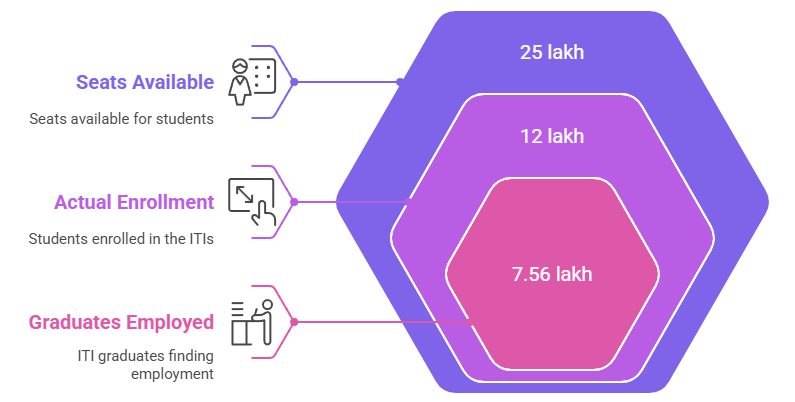
India has an extensive VET network with 14,000 Industrial Training Institutes (ITIs) and 25 lakh sanctioned seats, yet actual enrolment in 2022 stood at just 12 lakh (48% seat utilisation).
Only 4% of India’s workforce is formally trained, compared to much higher proportions in developed countries.
Employment outcomes remain modest: 63% of ITI graduates found jobs in 2018, while countries with robust VET systems such as Germany, Singapore, and Canada reported employment rates between 80–90%.
This mismatch reveals structural weaknesses in India’s VET ecosystem.
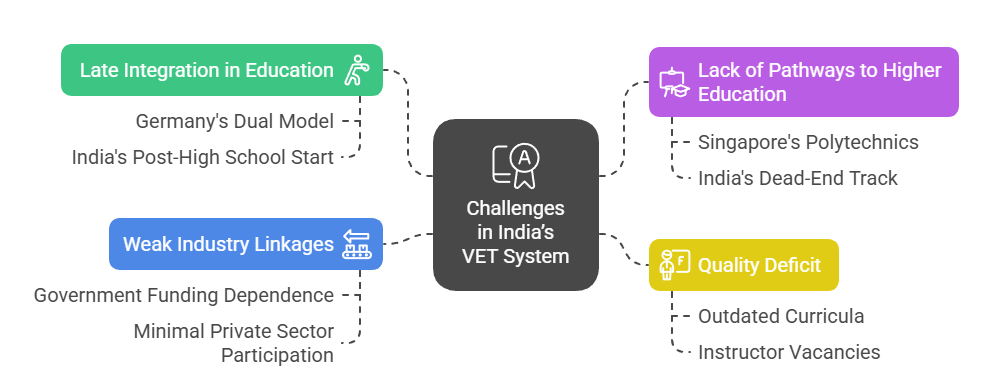
Challenges in India’s VET System
Late Integration in Education
In Germany, VET is embedded at the upper secondary level through a dual model (school + apprenticeship).
In India, VET begins only after high school, limiting exposure to practical skills and delaying orientation toward employability.
Lack of Pathways to Higher Education
Singapore provides clear academic progression from vocational to higher education via polytechnics and universities.
In India, VET is a dead-end track with no defined credit transfers or academic mobility, discouraging aspirants who want flexibility.
Quality Deficit
Outdated curricula, weak industry alignment, and vacancies in one-third of instructor posts undermine training quality.
Feedback loops with industry and trainees are missing; audits and grading of ITIs are irregular.
Weak Industry Linkages
Internationally, employers co-finance training, design curricula, and offer apprenticeships.
In India, ITIs depend mainly on government funding, with minimal private sector or MSME participation.
Sector Skill Councils lack strong state-level presence, further weakening industry integration.
Lessons from International Models
Germany: Dual VET system, early integration, and strong apprenticeship culture.
Singapore: Industry-led curricula, SkillsFuture Programme for lifelong learning, defined academic pathways.
Canada: Public-private partnerships, strong employer participation in apprenticeships.
These models highlight three pillars of success: early integration, quality assurance, and industry collaboration.
Way Forward for India
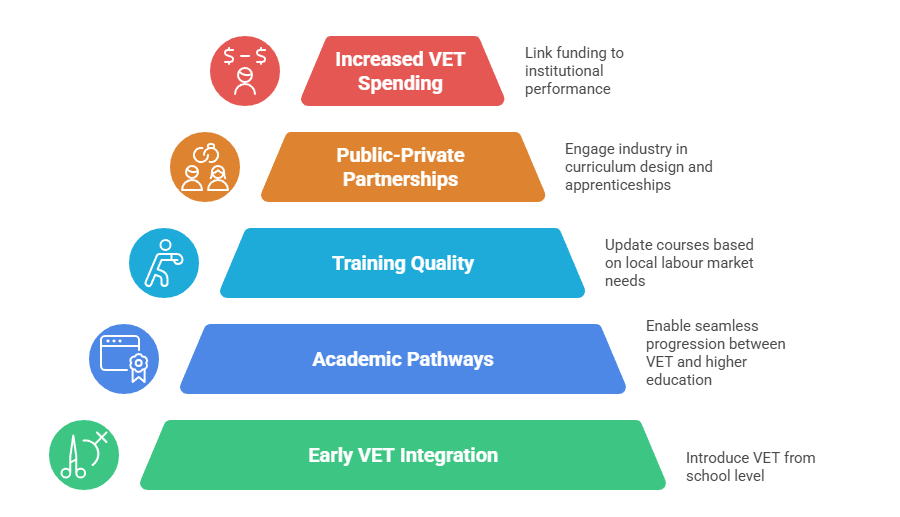
Integrate VET Early in Schooling
Implement NEP 2020’s recommendation of introducing VET from school level.
Promote vocational subjects alongside mainstream academics to normalise skill orientation.
Create Academic Pathways
Fast-track the National Credit Framework to enable seamless progression between VET and higher education.
Establish nationally recognised certifications to enhance credibility.
Improve Quality of Training
Regularly update courses based on local labour market needs.
Expand National Skill Training Institutes (NSTIs) and fill instructor vacancies.
Institutionalise ITI grading and incorporate feedback from trainees and employers.
Strengthen Public–Private Partnerships
Engage industry in curriculum design, training delivery, and apprenticeships.
Involve MSMEs through incentives and CSR-based models.
Scale the “Private Training Partner” approach by combining public infrastructure with private expertise.
Increase Public Spending on VET
India spends only 3% of total education expenditure on VET, compared to 10–13% in Germany, Singapore, and Canada.
Link funding to institutional performance while granting ITIs greater autonomy for resource mobilisation.
Recent Government Initiatives
Employment Linked Incentive (ELI) Scheme – Promotes formalisation of jobs but lacks a skilling component.
PM Internship Scheme – Provides one-year placements in top firms but with limited long-term absorption.
ITI Upgradation Initiative – Modernises infrastructure in 1,000 ITIs, though quality of instruction remains a concern.
While these schemes are steps forward, they remain piecemeal and insufficient for systemic transformation.
Conclusion
For India’s demographic dividend to translate into a Viksit Bharat, vocational education must move from the margins to the mainstream of policy priorities. A comprehensive overhaul is necessary — early integration in schools, flexible academic pathways, high-quality instruction, industry collaboration, and higher investment. Without such reforms, India risks producing a workforce underprepared for a rapidly evolving global economy. Skilling must become not just a welfare measure but a strategic investment in human capital and national competitiveness.







One comment