Role of State in Labour-Capital Relations in the Neoliberal Era | Sociology Optional Coaching | Vikash Ranjan Classes | Triumph IAS 2025 | UPSC Sociology Optional
The relationship between labour and capital has always been central to sociological analysis and political economy. Traditionally, the state played the role of mediator between the two, ensuring industrial peace, regulating wages, and safeguarding social security. However, in the neoliberal era, marked by globalization, privatization, and liberalization, the role of the state has undergone significant transformation. The state no longer appears as a neutral arbiter but increasingly as a facilitator of capital accumulation, often at the cost of labour rights. Understanding the role of the state in labour-capital relations is crucial, as it connects to themes of state, economy, labour reforms, globalization, and class struggle, all of which feature prominently in the sociology.
From Welfare State to Neoliberal State
During the post-independence period, India followed a socialist-inspired model, where the state acted as the main regulator of industries and protector of workers through labour laws like the Factories Act, Industrial Disputes Act, and Minimum Wages Act. The welfare state approach ensured job security, collective bargaining, and trade union rights.
With the 1991 New Economic Policy (NEP), the paradigm shifted. Under neoliberalism, the state began to withdraw from welfare responsibilities and encouraged market mechanisms. This transition reflected broader global trends shaped by the Washington Consensus, emphasizing deregulation, privatization, and free markets.
Features of Neoliberal Labour-Capital Relations
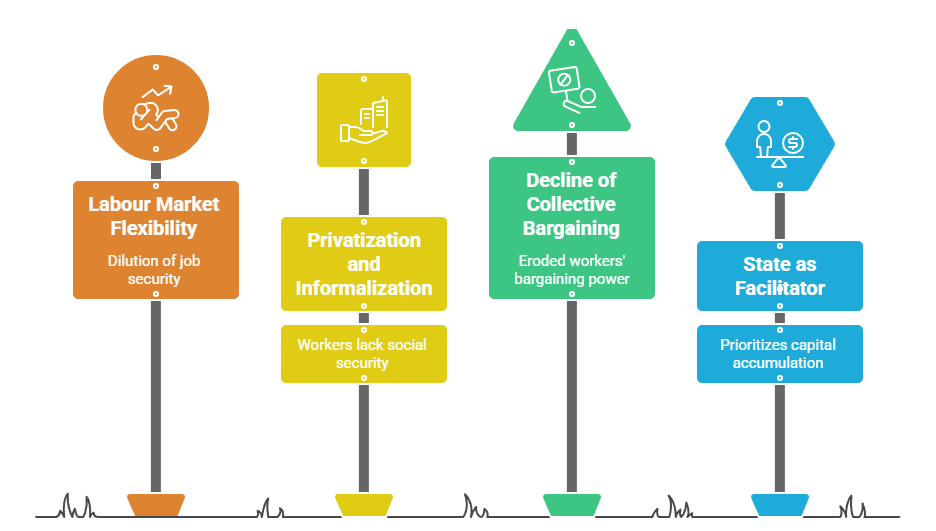
Labour Market Flexibility: The neoliberal state promotes flexible labour laws to attract foreign direct investment (FDI). This often means dilution of job security, weakening of trade unions, and ease of hiring and firing. The Four Labour Codes introduced in India exemplify this push towards flexibility.
Privatization and Informalization: Privatization of public sector units has created precarious employment conditions. Informalization of labour is a hallmark of neoliberalism, where a large proportion of workers remain outside the ambit of social security. According to the Periodic Labour Force Survey (PLFS), over 80% of India’s workforce is informal.
Decline of Collective Bargaining: Trade unions, once powerful mediators, have weakened due to state policies favouring capital. Union-busting, restrictions on strikes and the promotion of contract labour have eroded workers’ bargaining power.
State as Facilitator of Capital: Instead of balancing labour and capital, the state increasingly acts as an agent of capital. Through tax concessions, land acquisition laws, and easing of environmental regulations, the state prioritizes capital accumulation.
Sociological Analysis
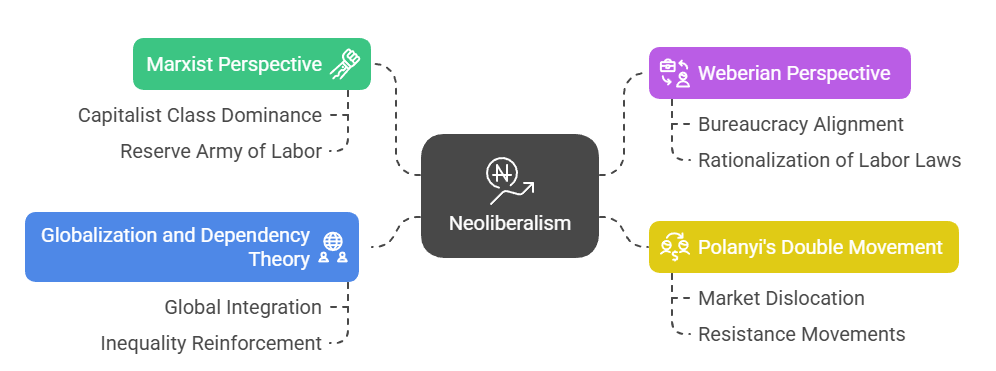
Marxist Perspective: From a Marxist lens, the neoliberal state represents the dominance of the capitalist class. The state is not neutral but an instrument of the bourgeoisie, ensuring the reproduction of capitalist relations. Precarious work and erosion of job security expand the reserve army of labour, keeping wages low and profits high.
Weberian Perspective: Weber highlights the role of bureaucracy and legal-rational authority. In the neoliberal context, bureaucracy is increasingly aligned with global capital and transnational corporations. The rationalization of labour laws is justified under efficiency but often undermines workers’ rights.
Polanyi’s Double Movement: Karl Polanyi argued that markets, when left unchecked, create social dislocation, prompting society to demand protective measures. The neoliberal era reflects this tension: while the state dismantles labour protections, resistance movements such as workers’ strikes, farmers’ protests, and informal sector mobilization represent society’s pushback.
Globalization and Dependency Theory: Neoliberal reforms deepen India’s integration with global capitalism, making domestic labour policies subordinate to global economic trends. Dependency theorists argue that this reinforces inequality between developed and developing nations, as cheap labour in the Global South sustains capital accumulation in the Global North.
Case Studies
Maruti Suzuki Manesar Plant Strike (2012) – Demonstrated how the state sided with corporate interests, cracking down on workers’ protests instead of addressing labour grievances.
Gig Economy Workers (Swiggy, Zomato, Uber) – Highlight how neoliberal policies have given rise to platform-based informal work, where workers lack basic rights and social security.
Farm Laws and Labour Codes (2020) – Both sets of reforms were criticized for prioritizing capital and corporate interests over workers’ and farmers’ livelihoods.
Impact on Indian Society
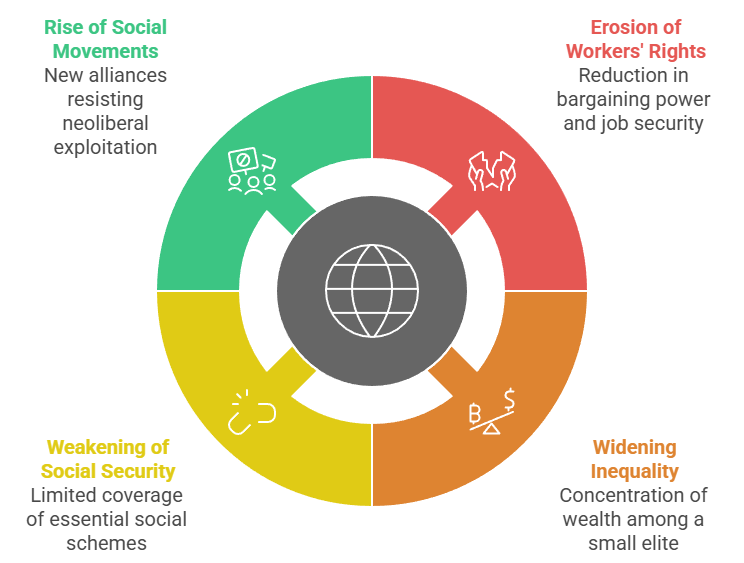
Erosion of Workers’ Rights – Reduction in bargaining power and increase in precarious jobs.
Widening Inequality – Capital gains are concentrated among a small elite, while workers face declining real wages.
Weakening of Social Security – Limited coverage of schemes like ESI, EPFO, and MGNREGA in the neoliberal framework.
Rise of Social Movements – Labour unions, farmers, and gig workers are forming new alliances to resist neoliberal exploitation.
Way Forward
Strengthening Labour Rights – Ensuring universal social security, fair wages, and protection against arbitrary dismissals.
Balancing Growth and Justice – Development strategies must integrate inclusive policies instead of focusing solely on capital.
Collective Bargaining Revitalization – Encouraging democratic trade unions and worker participation in decision-making.
Global Labour Standards – Adopting ILO conventions and aligning national policies with international norms.
Conclusion
In the neoliberal era, the state’s role in labour-capital relations has shifted from being a protector of labour to a facilitator of capital. This has deepened inequalities, eroded workers’ rights, and created precarious employment. From a sociological standpoint, it reflects the dominance of global capitalism and the reconfiguration of class relations. For India, the challenge lies in balancing economic growth with social justice—a theme that resonates strongly with Sociology and the broader debates on development and democracy.
Previous Year Questions
Paper 1
Discuss Marx’s concept of alienation in the context of modern industrial society. (2016)
What do you understand by labour market? Discuss its social dimensions. (2017)
Examine the impact of globalization on labour and work in modern society. (2018)
Critically analyse the concept of “informal sector” in developing societies. (2019)
How has the emergence of the gig economy transformed labour relations? (2021)
Paper 2
Trace the changing nature of labour relations in the post-liberalization era in India. (2014)
Discuss the impact of economic reforms of 1991 on the working class in India. (2016)
How has globalization affected labour-capital relations in India? (2017)
Examine the relevance of Karl Polanyi’s “double movement” in understanding neoliberal reforms in India. (2019)
Critically discuss the impact of the new Labour Codes on industrial relations in India. (2022)
Assess the role of the Indian state in balancing growth with labour welfare in the neoliberal era. (2023)






One comment