(Relevant for Sociology Paper I: Systems of Kinship; Social Change in Modern Society and Sociology Paper II: Systems of Kinship in India; Social Changes in India)
The family, as one of the most fundamental social institutions, has undergone significant transformations across the globe and in India. Traditionally, the family in India was seen through the lens of the joint family system, rooted in kinship, caste, and patriarchal norms. However, processes like industrialization, urbanization, globalization, and social change have led to the emergence of new family forms that challenge conventional definitions.
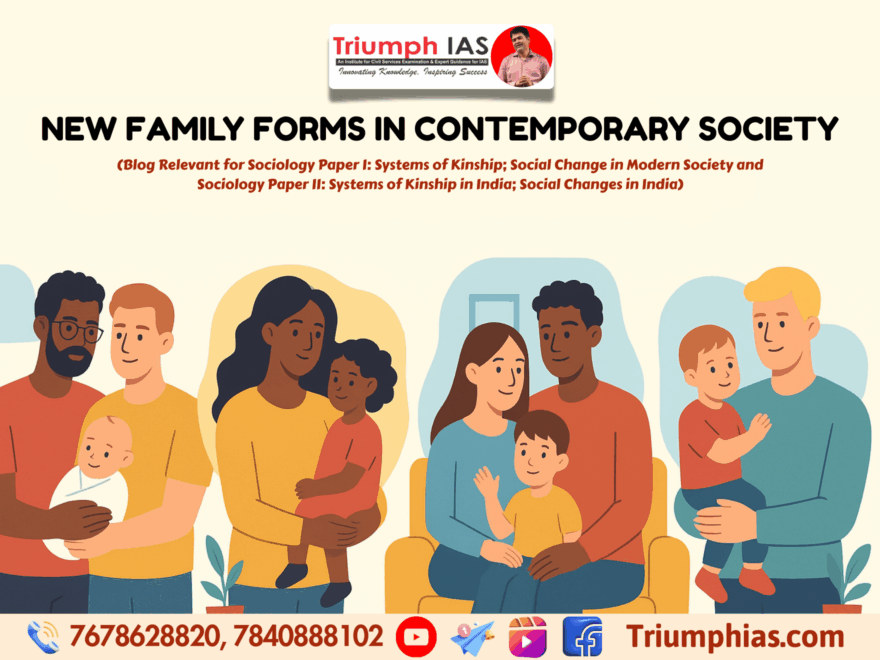
In the context of sociology and UPSC Sociology syllabus, the study of family includes changes in structure, authority, functions, and relationships. The emergence of alternative family forms such as nuclear families, single-parent families, live-in relationships, same-sex families, child-free families, and transnational families reflects broader societal transformations.
Traditional vs. New Family Forms in India
Traditional Family: The joint family, characterized by collective living, shared property, patriarchal authority, and extended kinship ties.
Modern Trends: Shift towards nuclear families, due to economic independence, mobility, and urban lifestyles.
New Family Forms: Growing visibility of single-parent households, inter-caste and inter-religious marriages, LGBTQ+ families, live-in partnerships, commuter marriages, and chosen families.
This transition mirrors wider sociological themes of modernization, individualism, gender roles, and social mobility.
Types of New Family Forms
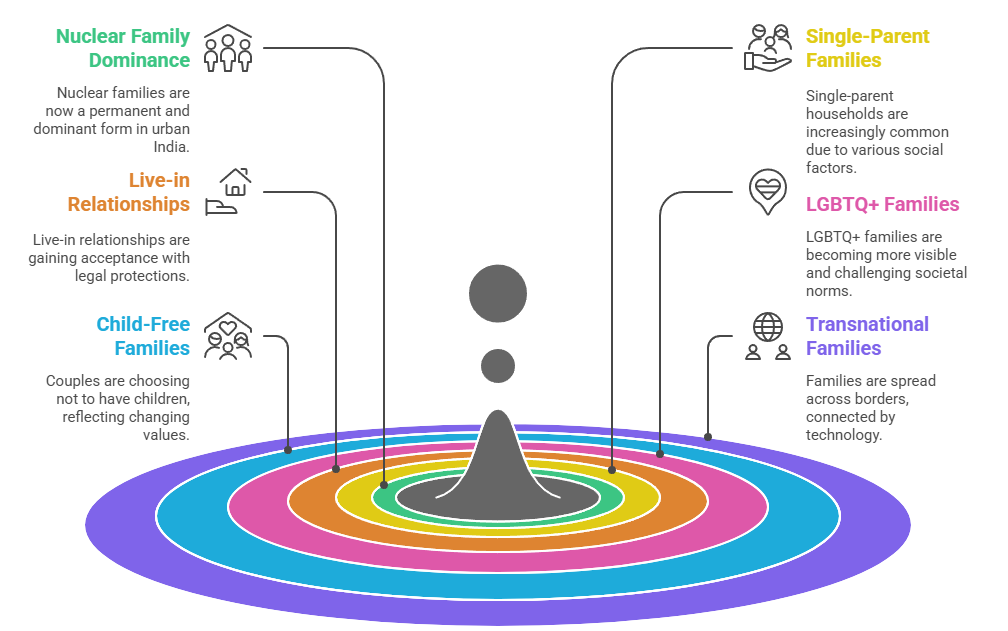
Nuclear Family Expansion: Though not new, nuclear families have become the dominant form in urban India. Unlike earlier, where they were seen as transitional, today they are a permanent reality.
Single-Parent Families: Due to divorce, widowhood, or choice, many households are headed by single parents. Urbanization and changing gender roles, especially women’s empowerment, have normalized this form.
Live-in Relationships: Courts in India have provided legitimacy to live-in couples under the Protection of Women from Domestic Violence Act, 2005. While still contested socially, it represents a shift towards individual autonomy.
Same-Sex Families and LGBTQ+ Households: Although same-sex marriage is not legally recognized in India, the decriminalization of Section 377 in 2018 has brought visibility to LGBTQ+ partnerships. Such families represent a challenge to heteronormativity.
Child-Free Families: Couples increasingly choose not to have children due to financial, career, or lifestyle choices. This reflects changing values around parenthood and individual self-fulfillment.
Transnational Families: With migration, families are increasingly spread across borders, maintaining ties through technology. This form highlights the role of globalization and digital sociology.
Factors behind Emergence of New Family Forms
Urbanization and Industrialization – Job opportunities in cities weaken joint family ties.
Women’s Education and Employment – Economic independence challenges patriarchal norms.
Legal Reforms – Laws on divorce, inheritance, adoption, and domestic violence.
Globalization and Media – Exposure to new lifestyles and family models.
Changing Values – Shift towards individualism, freedom of choice, and self-expression.
Technology and Migration – Transnational and digital families maintained via communication tools.
Sociological Analysis
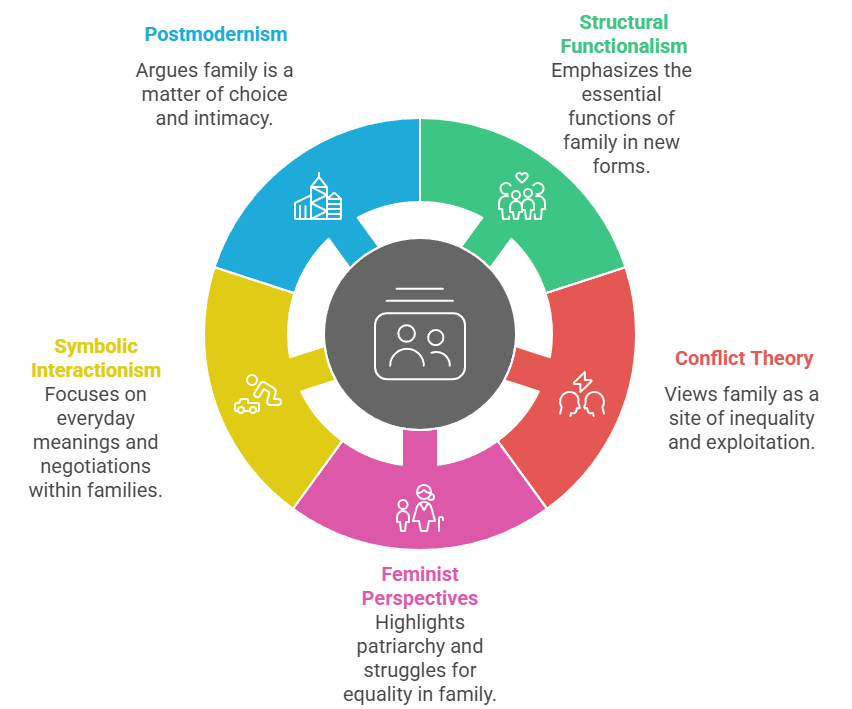
Structural Functionalism (Talcott Parsons): According to functionalists, family continues to perform essential functions even in new forms. Nuclear families, single-parent families, or live-in households still provide primary socialization, emotional support, and regulation of sexual behavior, though in specialized ways compared to joint families.
Conflict Theory (Karl Marx, Engels, and A.R. Desai): Conflict theorists see family as a site of inequality and exploitation. Engels argued that the monogamous family was linked to private property and control over women. New family forms challenge these hierarchies, as women’s economic independence, live-in partnerships, and same-sex families resist traditional power structures.
Feminist Perspectives (Ann Oakley, Sylvia Walby): Feminists highlight how the traditional family perpetuates patriarchy by controlling women’s labor and sexuality. New family forms reflect struggles for equality and autonomy, as seen in the rise of single-parent female-headed households, dual-earner families, and queer families.
Symbolic Interactionism (Erving Goffman, Herbert Blumer): Interactionists focus on everyday meanings and negotiations within families. New family forms show how partners and children constantly construct and redefine roles, responsibilities, and identities through interaction rather than fixed traditions.
Postmodernism (Anthony Giddens, Ulrich Beck): Postmodernists argue that family is no longer a rigid institution but a matter of choice. Giddens’ concept of the “pure relationship” highlights how families today are based on intimacy, negotiation, and personal satisfaction, visible in live-in relationships, same-sex partnerships, and child-free families.
Challenges and Criticisms
Cultural Resistance: Traditional norms often stigmatize new families (e.g., live-in couples, LGBTQ+ families).
Legal Gaps: Lack of legal recognition for certain forms, such as same-sex marriage.
Economic Pressures: Single-parent and nuclear families face greater financial strain compared to joint families.
Emotional and Social Costs: Child-free families and transnational families may face loneliness, weak support systems, and identity crises.
Indian Context:
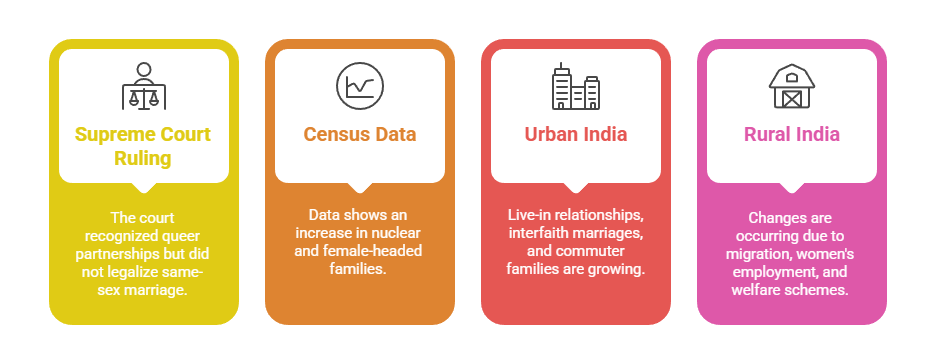
Supreme Court on Same-Sex Marriage (2023): Court upheld the right to queer partnerships but stopped short of legalizing marriage.
Census Data and NSSO Surveys: Indicate rising nuclear households and female-headed families in India.
Urban India: Growth of live-in relationships, interfaith marriages, and commuter families among professionals.
Rural India: Though slower, change is visible due to migration, women’s employment in self-help groups, and government welfare schemes.
Way Forward
Policy Support: Inclusive policies for single parents, LGBTQ+ families, and migrant households.
Legal Reforms: Recognition of diverse family forms beyond heteronormative marriage.
Social Awareness: Education and media campaigns to reduce stigma.
Strengthening Care Networks: Childcare, elderly care, and community support systems.
Research and Data: More comprehensive surveys on family diversity in India.
Conclusion
The new family forms in India represent the dynamic relationship between social change and personal life. While traditional joint families remain important, nuclear, single-parent, LGBTQ+, and transnational families are gaining legitimacy. From a sociological perspective, this transformation reflects broader shifts in gender relations, individual autonomy, globalization, and law. Understanding this topic requires linking classical theories with contemporary realities and analyzing both the opportunities and challenges of these changes. The study of family as a changing institution is crucial not only for exam preparation but also for understanding India’s social transformation.
Previous Year Questions
Paper 1
Discuss the structural and functional changes in the Indian family in the context of modernization. (2014)
“Industrialization and urbanization have impacted the joint family system in India.” Discuss. (2015)
Explain the impact of globalization on family and marriage in contemporary India. (2016)
Examine the changing nature of the institution of family with reference to the emergence of new family forms. (2017)
Is the joint family system breaking down in India? Critically analyze. (2018)
Evaluate the impact of women’s employment on family structures in India. (2019)
Discuss the relevance of the concept of “nuclear family” in present-day Indian society. (2020)
Explain Anthony Giddens’ concept of the “pure relationship” in the context of new family forms. (2021)
Examine the transformation of family under globalization and information technology. (2022)
Critically analyze the sociological significance of live-in relationships in India. (2023)
Discuss the growth of single-parent and LGBTQ+ families in the Indian context. (2024)
Paper 2
Critically examine the persistence of joint families in India despite forces of modernization. (2014)
What are the sociological reasons for the rise of nuclear families in India? (2015)
Discuss inter-caste and inter-religious marriages as new family forms in India. (2016)
Explain the impact of migration on family structure in rural and urban India. (2017)
Evaluate the sociological consequences of divorce and separation on family in India. (2018)
Discuss the role of law and judiciary in shaping new family forms in India. (2019)
“Same-sex families challenge the heteronormative definition of family.” Comment with reference to Indian society. (2020)
How has women’s empowerment altered power relations within Indian families? (2021)
Examine the impact of COVID-19 on family relations and domestic arrangements in India. (2022)
Discuss the idea of “chosen families” in the context of queer movements in India. (2023)
Critically analyze the emergence of live-in relationships and child-free families as alternative family forms in India. (2024)






One comment