In recent years, the term liquid consumerism has gained importance in the study of modern societies. Coined in connection with Zygmunt Bauman’s theory of liquid modernity, liquid consumerism refers to a consumption pattern that is fluid, short-lived, experience-oriented, and driven by constant novelty rather than durability or long-term value. Unlike traditional consumerism, which emphasized material possessions and stability, liquid consumerism thrives on fast fashion, digital services, instant gratification, and disposable trends.
Understanding Liquid Consumerism
From Solid to Liquid Modernity
Bauman describes modern life as moving from a “solid” phase (stable jobs, fixed communities, durable goods) to a “liquid” phase (flexible employment, globalized identities, fluid consumption patterns). In this context:
Solid consumerism: Buying durable goods (homes, cars, heirloom furniture) meant to last.
Liquid consumerism: Preferring rental services, fast fashion, short-term experiences, and disposable culture.
Examples include:
Netflix, Spotify, and OTT platforms replacing permanent DVD/CD
Fast fashion brands like Zara or Shein focusing on seasonal disposability.
Food delivery apps encouraging instant gratification over long-term dietary planning.
Key Features of Liquid Consumerism
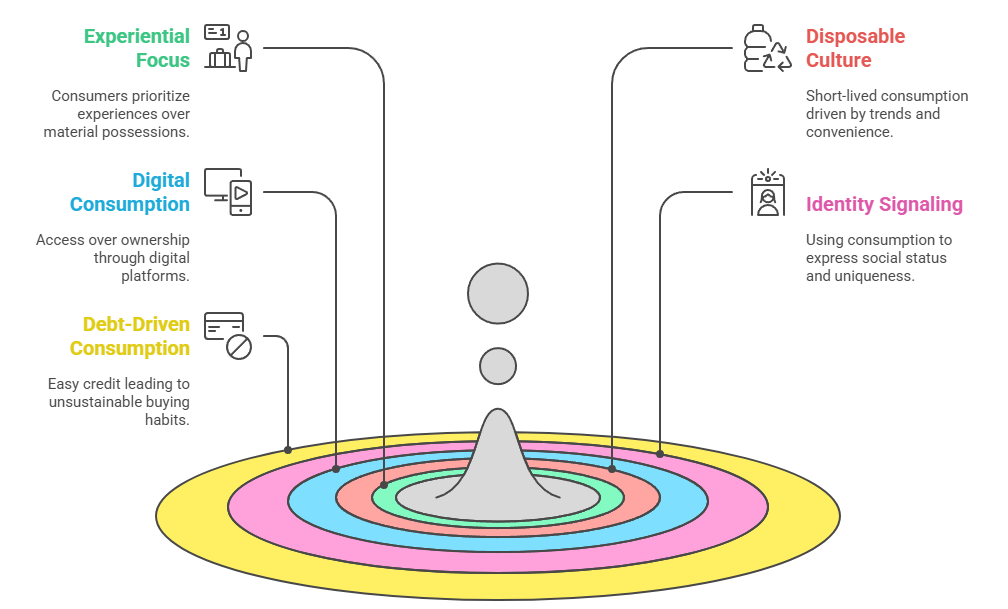
Experiential over Material: People increasingly value travel, concerts, digital subscriptions, and curated experiences over permanent goods.
Disposable and Temporary: The “use and throw” mentality dominates—from plastic packaging to fast fashion, consumption is short-lived and trend-driven.
Digitalization and Platform Economy: Streaming services, e-commerce, and app-based consumption define liquid consumerism. Ownership is replaced by access.
Identity through Consumption: Social media pushes consumers to constantly update lifestyles to signal modernity, success, or uniqueness.
Debt and Overconsumption: Easy credit and EMIs make consumption more accessible, but also fuel unsustainable cycles of buying and discarding.
Sociological Analysis
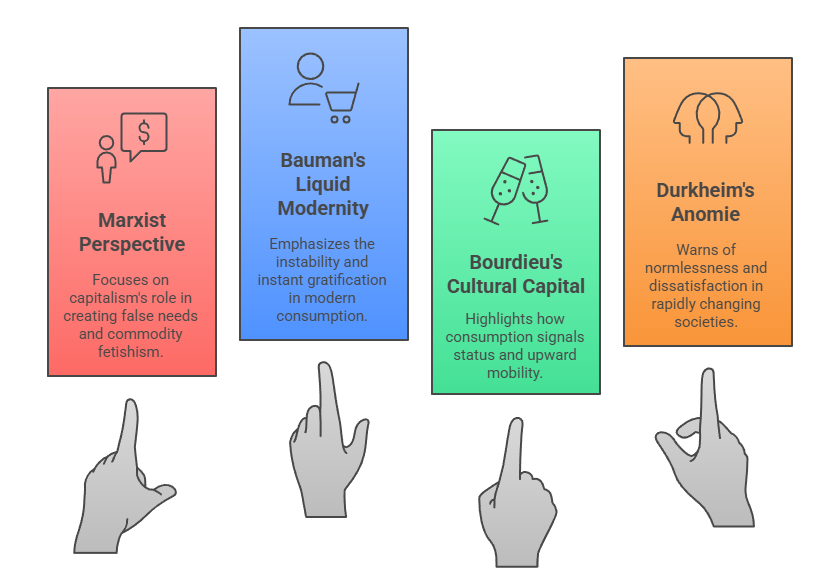
Marxist Perspective: Marx argued that capitalism creates false needs and promotes commodity fetishism. Liquid consumerism is the advanced stage of capitalism, where consumption becomes not only about needs but about identity performance. Fast-changing trends ensure continuous profit for capitalists while keeping consumers trapped in a cycle of desire.
Bauman’s Liquid Modernity
Bauman’s theory best explains liquid consumerism:
Life is fragmented and unstable.
Consumers chase instant gratification and novelty, not permanence.
Consumption replaces long-term community ties, leading to individualism and alienation.
Bourdieu’s Cultural Capital: Pierre Bourdieu’s concept of cultural capital shows how liquid consumerism is tied to lifestyle choices. Access to the latest gadgets, fashion, or experiences signals status and distinction. In India, the urban middle class increasingly uses liquid consumption as a marker of upward mobility.
Durkheim’s Anomie: Durkheim warned of anomie (normlessness) in rapidly changing societies. Liquid consumerism fosters anomie because values are constantly shifting, leaving individuals in a state of restlessness and dissatisfaction.
Liquid Consumerism in Indian Society
Urban Middle Class: India’s growing urban middle class is at the forefront of liquid consumerism. From malls to online shopping festivals like Amazon’s Great Indian Sale, consumption is tied to status and aspiration.
Youth and Social Media: Young Indians, influenced by Instagram, YouTube, and influencers, are trend-driven consumers. Viral challenges, brand collaborations, and influencer marketing fuel liquid consumerism.
Rural Penetration: Even rural areas are witnessing this trend through mobile-based apps, cheap data, and digital payment systems. The aspiration for modern goods has spread beyond cities.
Gender Dimensions: Women are both targets and agents of liquid consumerism. Fast fashion, beauty products, and social media platforms create new consumption identities but also reproduce gender stereotypes.
Caste and Class Intersections: Access to liquid consumerism is not equal. Upper castes and affluent classes dominate, while lower classes often participate through cheap imitations or credit-driven consumption, reflecting caste-class stratification in consumption patterns.
Consequences of Liquid Consumerism
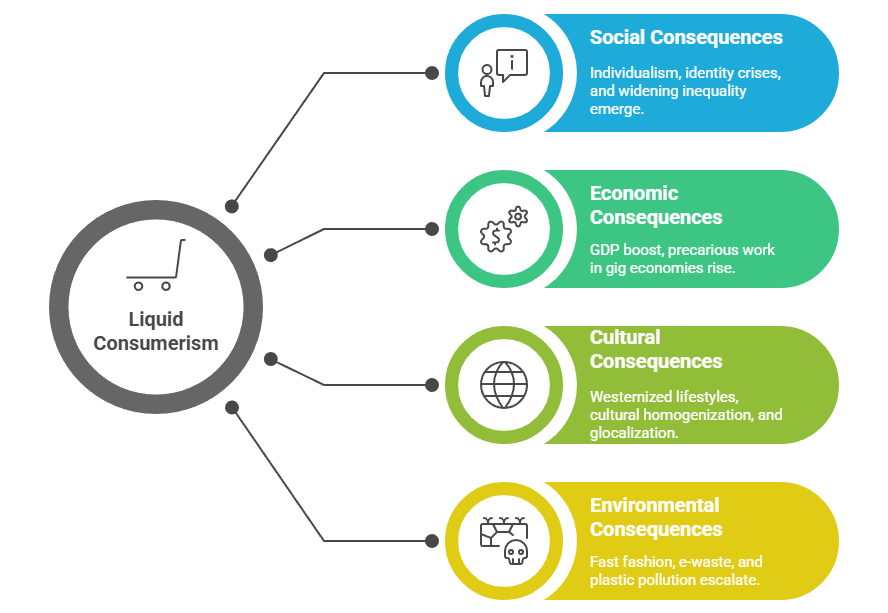
Social Consequences
Rise of individualism, decline of community values.
Identity crises as people rely on consumption for self-worth.
Widening inequality: Not everyone can afford rapid consumption cycles.
Economic Consequences
Boosts GDP and service economy through constant demand.
Creates precarious work in gig and platform economies (delivery workers, influencers).
Cultural Consequences
Promotes Westernized lifestyles over traditional ones.
Homogenizes global culture through global brands (McDonald’s, Netflix).
At the same time, encourages “glocalization” where Indian festivals (Diwali, Holi) are commodified into shopping events.
Environmental Consequences
Fast fashion, e-waste, and plastic pollution are direct results of liquid consumerism.
Short product life cycles accelerate ecological crises.
Way Forward
Promoting Sustainable Consumption: Policies should encourage recycling, repair, and slow fashion.
Consumer Awareness: Education campaigns must highlight the social and environmental costs of liquid consumerism.
Regulating Digital and Fast Fashion Platforms: Stricter regulation on waste management, product quality, and consumer exploitation is necessary.
Sociological Consciousness: A society aware of structural inequalities and cultural manipulation can resist the trap of endless consumption.
Conclusion
Liquid consumerism reflects the fragmented, unstable, and consumer-driven nature of contemporary society. Rooted in Bauman’s liquid modernity, it shows how capitalism reinvents itself through ephemeral trends, disposable goods, and digital experiences. While it boosts economic growth and offers new identities, it also creates anomie, inequality, and ecological crises.
Liquid consumerism provides a rich case study linking theories of social change, globalization, class stratification, and cultural transformation to real-world current affairs.
As India navigates the challenges of modernity, the key lies in balancing consumption with sustainability, ensuring that consumer culture does not undermine social cohesion and environmental stability.
Previous Year Questions
Paper-1
What are the sociological implications of the growth of consumerism in modern societies? (2014)
Explain Marx’s concept of commodity fetishism. How is it relevant in the context of consumer culture today? (2015)
Discuss the concept of anomie with reference to contemporary patterns of consumption. (2016)
Critically examine Bourdieu’s notion of cultural capital in the light of lifestyle and consumer choices. (2017)
How do media and technology influence social values in the era of consumerism? (2018)
Examine the role of globalization in shaping patterns of consumption and leisure. (2019)
Explain Bauman’s idea of “liquid modernity.” How does it help us understand contemporary consumer culture? (2020)
Discuss the relationship between social stratification and patterns of consumption. (2021)
Evaluate the impact of digital platforms and gig economy on work and consumption. (2022)
“Identity in contemporary societies is increasingly defined through consumption rather than production.” Discuss. (2023)
How do sociological theories explain the link between overconsumption, inequality, and ecological crisis? (2024)
Paper-2
Examine the impact of globalization on consumer culture in India. (2014)
Discuss how consumerism has transformed the Indian middle class. (2015)
“Youth culture in India today is primarily shaped by consumerism and social media.” Examine. (2016)
Evaluate the influence of malls, online shopping, and digital services on urban lifestyles in India. (2017)
Examine the commodification of Indian festivals in the age of consumerism. (2018)
Critically analyze how consumerism reproduces caste and class inequalities in India. (2019)
Discuss the role of women as both targets and agents of consumerism in Indian society. (2020)
Examine the impact of fast fashion, e-commerce, and OTT platforms on Indian cultural life. (2021)
How does consumerism intersect with rural aspirations and digital penetration in India? (2022)
Critically assess the role of influencer culture and social media in shaping consumption among Indian youth. (2023)
“Liquid consumerism in India reflects both aspiration and alienation.” Discuss with examples. (2024)






One comment