On 11 August 2025, a two-judge Bench of the Supreme Court directed Delhi and NCR authorities to pick up stray dogs from all localities and house them in shelters within six to eight weeks. The order bars release of dogs back on the streets even after sterilisation and vaccination. It calls for helplines, capture within four hours of a bite complaint, CCTV at shelters, and warns of action against anyone obstructing the drive. The case is titled In Re: “City Hounded by Strays, Kids Pay Price”.
There has been pushback. On 16 August 2025, Supreme Court Observer noted that a three-judge Benchreserved its decision on whether to stay the earlier order, following arguments that it conflicts with the Animal Birth Control (ABC) Rules 2023. Subsequent news reports show related pleas and listing requests continuing through 21 August 2025. In other words, litigation is active, but the August 11 directions remain the reference point.
The policy background:
India’s Animal Birth Control (ABC) Rules 2023 are notified under the Prevention of Cruelty toAnimals Act, 1960. They require local bodies to manage stray dog populations through sterilisation and anti-rabies vaccination. They also say sterilised, immunised dogs should be returned to the same location they were captured from. That “catch-neuter-vaccinate-return” logic is central to the Rules.
Because of that, lawyers, activists and analysts have argued that a blanket removal from territories appears to deviate from the 2023 framework, which has been repeatedly emphasised by courts and governments. This tension is at the heart of the present controversy.
Data we should know
Delhi bite numbers: MCD data show 26,334 dog bite cases reported in 2025 so far and 68,090 cases in 2024.
Rabies burden: WHO estimates India accounts for a very large share of global rabies deaths, with children disproportionately affected. National media syntheses peg India’s annual toll in the range of 18,000–20,000 in modelling, though official counts are lower and under-reporting is known.
National spike: Reuters flagged 430,000 dog bite cases in January 2025 nationwide, compared to 7 million in all of 2024. This suggests significant reporting spikes and a deteriorating risk environment.
These numbers explain why the Court framed the issue as one of public safety and Article 21. The order leans on a rights hierarchy that prioritises humans in public spaces, especially children, elderly people, and persons with disabilities.
Sociological Analysis
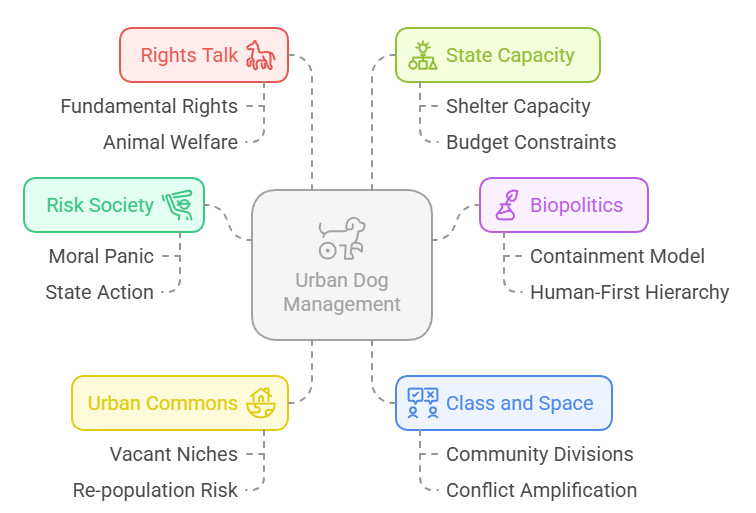
Risk society and urban fear: Ulrich Beck’s “risk society” helps explain the momentum behind the order. When everyday spaces like parks, alleys, and school routes feel unsafe, citizens demand decisive state action. Spikes in bite cases and viral videos create moral panic that can legitimise tough measures, especially when policymakers are accused of “doing nothing.” The Court’s language reflects that public anxiety.
Biopolitics and the governance of life: Foucault’s framework exposes a deeper question: who counts when state power manages bodies and populations. ABC Rules treat community dogs as part of the urban ecosystem, to be stabilised through sterilisation and vaccination. The Court’s order shifts to a containment model, relocating dogs and asserting a human-first rights hierarchy in public spaces. This is classic biopolitics, where the state calibrates life and risk to produce order.
Urban commons and territory: Territorial return after sterilisation is not a sentimental idea. It is a population ecology principle. When dogs are removed from territories, vacant niches can attract unvaccinated, unsterilised animals, and conflict restarts. ABC Rules were designed around this territoriality. Relocation challenges that equilibrium and risks re-population unless shelter capacity, waste management, and enforcement are airtight.
Class, space, and resident politics: Conflict theory explains the sharp divides between gated communities, RWAs, street vendors, slum residents, and dog-feeders. Different groups experience dogs differently. RWAs prioritise safety and cleanliness. Feeders see dogs as community members. Street vendors share pavements and face bites but may also rely on dogs as informal security. The order amplifies these conflicts and re-centres state authority. Recent NCR scuffles over removals show how quickly these tensions spill onto the street.
Rights talk: The judgment signals a hard distinction: fundamental rights belong to persons, not animals, though Article 51A (g) urges compassion and statutes protect animal welfare. That logic is used to justify the no-release directive. Critics argue that India already has a humane, court-tested ABC framework and that the new order risks undercutting those gains without clear evidence that relocation will reduce bites long term. This is the core normative clash.
State capacity and policy realism: Even if relocation is the policy, capacity decides outcomes. Delhi’s estimated stray population runs into several lakhs. Shelter building, staffing, veterinary care, food, waste management, adoption pipelines, and record-keeping need heavy and sustained budgets. MCD has signalled new shelters and helplines, but building a humane, scalable system in weeks is a huge administrative lift.
Relevant issues and linkages
Urban governance and federalism: ABC is a local body mandate guided by Central Rules. The Court’s order pulls the centre, Delhi government, MCD, and multiple NCR municipalities into a tight compliance regime. This is a live case on multilevel governance.
Public health policy: Bite numbers, vaccine stocks, rabies surveillance, and post-exposure prophylaxis are not “animal” issues alone. They are core health-system functions with equity angles because poorer families face higher exposure and treatment costs.
Judicial policy-making: The order shows the judiciary stepping into a domain with detailed executive rules already in place. For exam answers, compare judicial activism, administrative feasibility, and evidence-based policy.
Sociology of law and morality: The feeder vs RWA conflict is a classic case of competing moral economies. Both sides claim public interest. The Court’s framing privileges one set of risks over another.
What could go right and what could go wrong?
Potential gains
Short-term reduction in street conflicts and severe bite incidents in high-risk zones.
A new push to upgrade veterinary and shelter infrastructure.
Better complaint response through a time-bound helpline.
Potential risks
Capacity gaps could lead to overcrowded shelters, poor welfare, disease spread, and public backlash.
Territorial vacuum may invite new unvaccinated dogs if relocation is partial.
A chilling effect on community participation if feeders fear contempt or police action, undermining neighborhood-level vaccination and reporting.
A humane and evidence-based way forward
Treat ABC-ARV as non-negotiable public health: Even if dogs are sheltered, sterilisation and vaccination must remain the backbone. WHO and decades of practice point to sustained ABC-ARV as the only scalable way to reduce rabies. If shelters become the sole strategy, coverage will lag.
Triage high-risk zones: Start with school routes, transport hubs, dense slums, and reported hot-spots. Use the helpline data to drive deployments. Publish weekly dashboards with captures, vaccinations, adoptions, and bite trends.
Waste and abandonment control: Unmanaged garbage feeds populations. Pet abandonment feeds strays too. Enforce fines for abandonment and mandatory pet registration. This often gets ignored but is crucial to stabilise numbers. (Policy logic from ABC Rules and urban practice.)
Shelter standards and civil-society partnerships: Minimum floor area per dog, ventilation, daily feeding logs, round-the-clock staff, and CCTV audits are already in the order. Bring NGOs and community volunteers inside the fence as formal partners to improve welfare and adoption outcomes.
Serious adoption pipelines: Adoption must be rule-bound and safe. Follow the Animal Welfare Board’s standard adoption protocol, prioritise temperament-assessed animals, and prevent “release by adoption.”
Transparent data and independent evaluation: Track monthly, bite rates by ward, PEP availability, shelter occupancy, mortality inside shelters, sterilisation and vaccination coverage. Commission independent audits so policy stays guided by results, not fear cycles.
Exam takeaways
Thesis: The SC order recentres human safety and Article 21 in public spaces, responding to rising bite numbers and public anxiety. It asserts a rights hierarchy and a relocation-to-shelter model.
Antithesis: The order conflicts with the ABC Rules 2023 logic of sterilise-vaccinate-return. Critics fear ecological backfire, welfare crises, and implementation gaps. Litigation since 14–21 August shows the issue is still evolving.
Synthesis: A workable path blends targeted removal from high-risk zones, strong ABC-ARV coverage, strict waste control, and well-run shelters. It needs money, manpower, transparent data, and community buy-in.
Conclusion
The Court’s order has reframed a long-running policy debate. It reflects the politics of fear and safety in a crowded city, but it also tests state capacity and our commitment to humane management. For UPSC answers, ground your arguments in data, law, and sociological theory, and show a clear path from principle to implementation. That balance is what examiners reward.






One comment