The caste system is generally associated with Hindu society, where hierarchy, endogamy, and occupational segregation have historically structured social life. However, caste-like formations are not limited to Hinduism alone. Over centuries, social stratification has extended into Indian Muslim, Christian, Sikh, and even Buddhist communities. Despite the egalitarian philosophies of these religions, caste has adapted and persisted in different forms, shaping identities, opportunities, and inequalities. Understanding caste-like formations beyond Hindu society is crucial. It highlights the resilience of caste as a social institution and its capacity to transcend religious boundaries. This topic connects with the sociology syllabus themes of social stratification, social mobility, religion and society, caste system, and contemporary social issues in India.
Historical Roots of Caste-like Formations
Colonial Context
British ethnographers such as H.H. Risley documented caste divisions among Muslims and Christians, noting how localized hierarchies resembled Hindu varna and jati categories. Colonial policies of census classification and legal codification reinforced these divisions.
Sanskritization and Social Imitation
M.N. Srinivas’s concept of Sanskritization helps explain caste persistence. Lower-status groups, including those within non-Hindu religions, often emulated higher-status practices of purity, dietary rules, and social exclusiveness to gain prestige. This led to parallel hierarchies.
Caste among Muslims in India
Egalitarian Ideals vs. Social Reality
Islam preaches equality of believers before Allah. Yet, in India, caste-like stratification is visible:
Ashraf: Claim descent from foreign (Arab, Persian, Turk) lineages, considered socially superior.
Ajlaf: Converts from lower Hindu castes, engaged in artisanal and service occupations.
Arzal: “Lowest” status, associated with “unclean” occupations such as scavenging.
Regional Variations
In Uttar Pradesh and Bihar, the Pasmandas (backward and Dalit Muslims) face exclusion in mosques, burial grounds, and matrimonial ties.
In Kerala, Mappila Muslims show internal hierarchies between landowning elites and occupational castes.
Sociological Perspective
Imtiaz Ahmad argued that caste among Muslims is less about ritual purity and more about social exclusion, occupation, and endogamy, showing caste’s adaptability across religions.
Caste among Christians in India
Legacy of Conversion
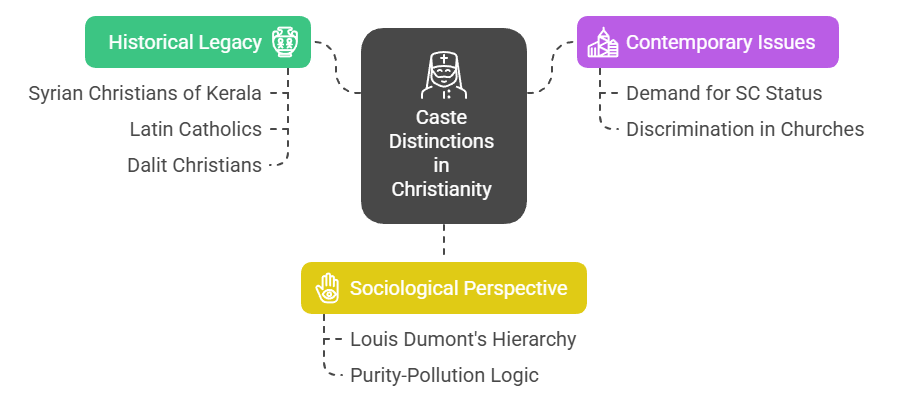
Despite Christianity’s universalist ideals, caste distinctions persisted after conversion:
Syrian Christians of Kerala: Trace origins to upper-caste Namboodiris and Nairs, claiming higher ritual status.
Latin Catholics: Descendants of lower-caste converts, historically marginalized.
Dalit Christians: Continue to face untouchability and exclusion despite legal protection.
Contemporary Issues
Dalit Christians demand Scheduled Caste (SC) status for affirmative action benefits, highlighting caste’s role in shaping educational and occupational mobility.
Discrimination is visible in separate seating arrangements in churches and separate cemeteries.
Sociological Perspective
Caste here shows continuity with pre-conversion identities, aligning with Louis Dumont’s idea of hierarchy and purity-pollution logic.
Caste among Sikhs
Egalitarian Teachings vs. Social Practice
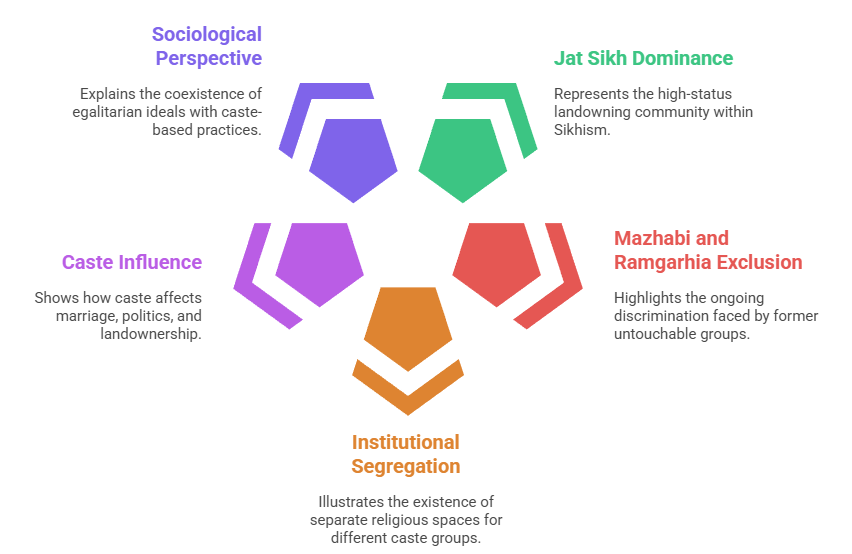
Guru Nanak rejected caste discrimination, emphasizing equality (Ik Onkar). Yet, in practice, caste distinctions persist:
Jat Sikhs: Dominant landowning community, enjoying high status.
Mazhabi and Ramgarhia Sikhs: Former untouchable groups, facing exclusion in gurdwaras and village social life.
Institutionalization of Segregation
Separate gurdwaras exist for Dalit Sikhs in Punjab.
Caste influences marriage alliances, electoral politics, and landownership.
Sociological Perspective
This shows McKim Marriott’s idea of “little traditions” and “great traditions”—egalitarian Sikh philosophy (great tradition) coexists with caste practices rooted in rural Punjab (little tradition).
Caste among Buddhists
Ambedkarite Conversion Movement
Dr. B.R. Ambedkar’s mass conversion of Dalits to Buddhism in 1956 was aimed at escaping caste oppression. However, caste identities did not vanish entirely:
Many Dalit Buddhists still face stigma from higher castes in villages.
Inter-caste marriages remain rare, showing structural continuity of caste even after religious transformation.
Sociological Perspective
This reflects A.R. Desai’s Marxist view that caste is embedded in material conditions, land relations, and power structures, not just religion.
Why Do Caste-like Formations Persist across Religions?
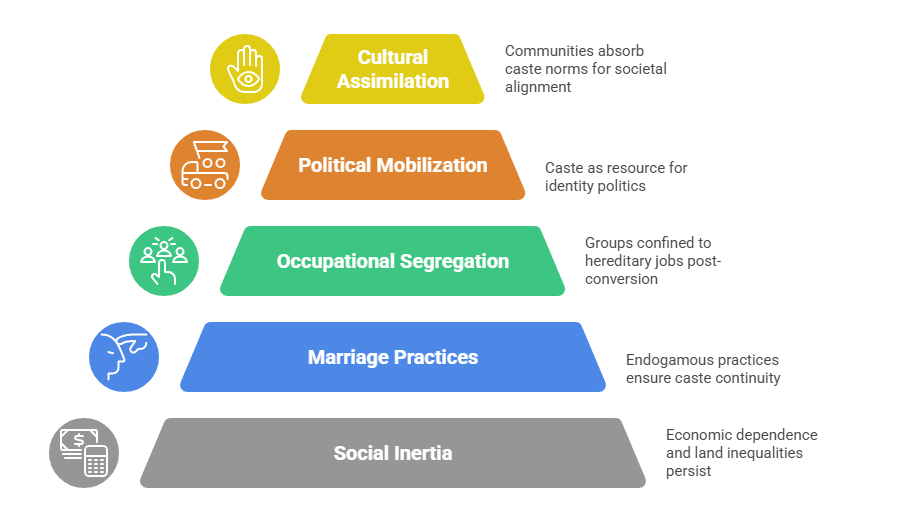
Social Inertia: Conversion did not erase economic dependence and land inequalities.
Marriage and Endogamy: Religious communities continued endogamous practices, ensuring caste continuity.
Occupational Segregation: Even after conversion, many groups remained confined to hereditary jobs.
Political Mobilization: Caste became a resource for identity politics among Muslims, Christians, and Sikhs.
Cultural Assimilation: Non-Hindu communities absorbed caste norms to align with larger society.
Caste and Social Mobility in Non-Hindu Communities
Education and Urbanization: Dalit Christians and Pasmanda Muslims have used education to achieve upward mobility, but exclusion persists.
Affirmative Action: Demands for SC status by Dalit Christians and Muslims show caste’s continued influence in shaping access to state resources.
Migration: Migration to Gulf countries has provided some Muslims relief from caste-based occupations, but back home hierarchies endure.
Way Forward
Policy Recognition: Extend affirmative action to Dalit Christians and Muslims to address caste-based disadvantages.
Religious Reforms: Encourage inclusive practices in gurdwaras, churches, and mosques.
Educational Interventions: Promote awareness campaigns to dismantle caste prejudices across religions.
Sociological Engagement: Use frameworks of stratification and intersectionality to understand caste’s persistence.
Conclusion
Caste-like formations in non-Hindu religious communities reveal that caste in India is not confined to Hinduism but has become a pan-Indian social institution. Despite the egalitarian teachings of Islam, Christianity, Sikhism, and Buddhism, caste has survived by adapting to new religious and social contexts. For UPSC aspirants, this topic demonstrates the interplay between religion, social stratification, and identity politics, making it essential to study caste as a dynamic and enduring feature of Indian society.
PYQs
Paper 1
Discuss the persistence of caste in modern society. (2014)
Is caste system changing, weakening or disintegrating in India? (2015)
Distinguish between caste and class with suitable illustrations. (2016)
Discuss Louis Dumont’s perspective on purity and hierarchy in caste system. (2017)
Examine André Béteille’s critique of viewing caste as a system of social stratification. (2018)
How far do you agree with the view that caste system is assuming new forms under the impact of modernization? (2019)
Examine how caste intersects with class in shaping social mobility. (2020)
Discuss the relevance of M.N. Srinivas’s concept of “Sanskritisation” in the context of caste persistence. (2021)
Examine whether caste is losing its relevance in urban India. (2022)
Critically evaluate the statement: “Caste is an institution of both inclusion and exclusion.” (2023)
How does the concept of “dominant caste” explain rural power structure in India? (2024)
Paper 2
Discuss the existence of caste among Indian Muslims and Christians. (2014)
Examine caste-like distinctions among Indian Christians and their impact on social life. (2015)
Discuss the persistence of caste in Sikh and Muslim communities in India. (2016)
“Despite conversion to Islam and Christianity, caste identities have persisted in India.” Discuss. (2017)
Examine the role of caste in shaping the social and political behavior of non-Hindu religious communities. (2018)
Analyse the impact of caste among Dalit Christians and their demand for Scheduled Caste status. (2019)
Caste among Muslims is more a matter of social exclusion than ritual hierarchy. Discuss. (2020)
Examine the coexistence of egalitarian religious ideologies and caste-based practices among Sikhs. (2021)
Critically examine the role of caste among Indian Buddhists after Ambedkarite conversion. (2022)
Evaluate the statement: “Caste is no longer confined to Hindus; it has become a pan-Indian institution.” (2023)
Discuss the contemporary significance of Pasmanda politics in understanding caste among Muslims. (2024)







One comment