(Relevant for Sociology Paper I: Politics and Society; Social Change in Modern Society and Sociology Paper II: Politics and Society; Challenges of Social Transformation)
Language is not merely a medium of communication; it is a marker of identity, culture, and political power. In multilingual nations like India, with 122 major languages and over 19,500 dialects (Census 2011), the politics of language shapes national integration, regional autonomy, and socio-cultural identities. The sociology of language examines how linguistic diversity interacts with social structures, power relations, and state policies.
Historical Roots of Language Politics in India
Colonial Legacy: The British administration institutionalized English as the language of higher administration, education, and judiciary, creating a divide between the English-educated elite and the masses. This led to linguistic elitism and the persistence of English as a status symbol.
Post-Independence Language Debates
The Constituent Assembly debates revealed tensions between promoting Hindi as a national language and respecting linguistic diversity.
The Official Languages Act, 1963 allowed continued use of English alongside Hindi, acknowledging practical and political realities.
Language and Identity:
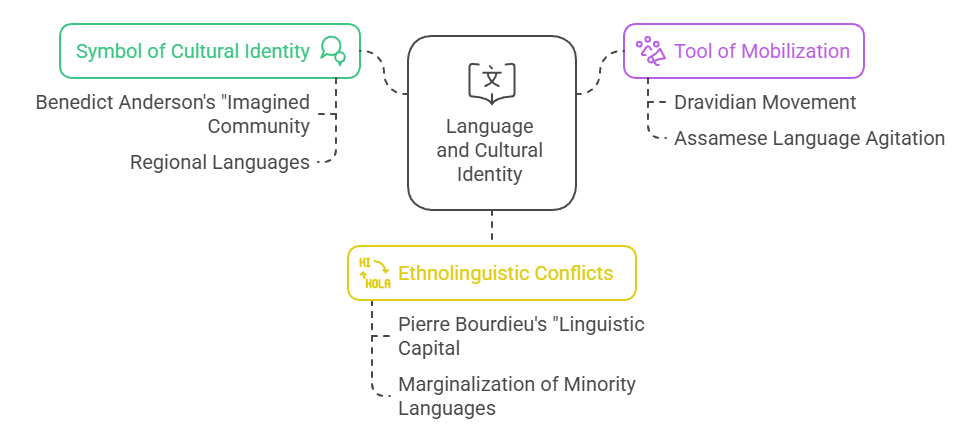
Symbol of Cultural Identity
Language binds communities together. According to Benedict Anderson, shared language fosters an “imagined community.”
Regional languages like Tamil, Bengali, and Marathi are deeply tied to ethnic pride and cultural heritage.
Language as a Tool of Mobilization
Movements like the Dravidian movement in Tamil Nadu and Assamese language agitation show how linguistic identity can fuel political mobilization.
Ethnolinguistic Conflicts
Pierre Bourdieu’s idea of “linguistic capital” explains how dominant languages confer social advantages, marginalizing speakers of minority languages.
State Policies and the Politics of Language
Three Language Formula
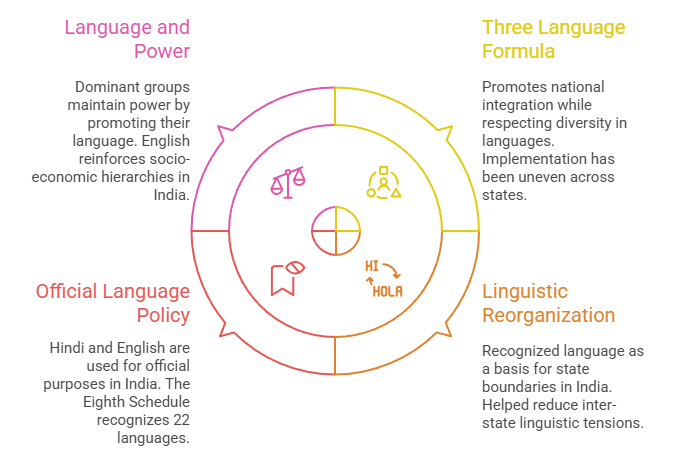
Introduced in the National Policy on Education (1968) to promote national integration while respecting diversity.
Criticism: Implementation has been uneven, with southern states resisting compulsory Hindi.
Linguistic Reorganization of States (1956)
Based on the States Reorganisation Commission recommendations, this was a landmark in recognizing language as a basis for state boundaries.
Helped reduce inter-state linguistic tensions but reinforced regional identities.
Official Language Policy
Hindi and English are used for official purposes, while states can use their own languages for governance.
The Eighth Schedule of the Constitution recognizes 22 languages, but demands for inclusion of more languages (g., Bhojpuri, Tulu) continue.
Language and Power Relations
Gramsci’s theory of cultural hegemony applies here: dominant groups maintain power by promoting their language as “neutral” or “natural.”
In India, English remains the language of elite bureaucracy, judiciary, and corporate sectors, reinforcing socio-economic hierarchies.
Minority language speakers often face barriers in education, administration, and job markets.
Contemporary Language Controversies in India
Hindi Imposition Debate
Resistance from southern and northeastern states over central policies promoting Hindi.
Seen as a threat to regional autonomy and cultural identity.
English vs. Vernacular Medium in Education
National Education Policy 2020 promotes mother tongue at the primary level.
Concerns about global competitiveness and access to higher education remain.
Digital and Linguistic Inclusion
Growth of regional language content online has democratized access to information but also reinforced linguistic silos.
Global Comparisons:
Switzerland manages multilingualism (German, French, Italian, Romansh) through federalism and equal official recognition.
Canada (English and French) shows the importance of bilingual governance in preventing separatism.
These cases suggest that linguistic pluralism, rather than forced uniformity, fosters unity.
Sociological Analysis
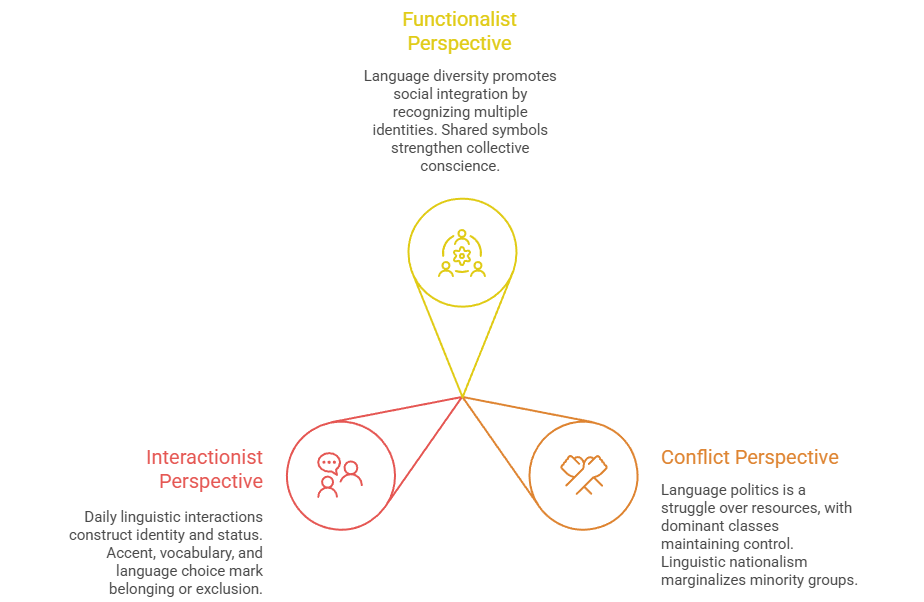
Functionalist Perspective: Language diversity, if managed well, can promote social integration by recognizing multiple identities within a national framework. Emile Durkheim would argue that shared symbols (including multiple languages) can strengthen collective conscience.
Conflict Perspective: Karl Marx would see language politics as part of the struggle over resources, with dominant classes promoting their language to maintain control. Linguistic nationalism can be used to marginalize minority groups, as seen in Sri Lanka’sSinhala-only policy (1956), which fueled civil war.
Interactionist Perspective: Erving Goffman’s symbolic interactionism highlights how daily linguistic interactions construct identity and status. Accent, vocabulary, and language choice become markers of belonging or exclusion.
Challenges in Managing Language Politics
Balancing Unity and Diversity – Avoiding dominance of one language over others while promoting a common link language.
Educational Inequality – English-medium education remains an advantage, creating linguistic hierarchies.
Linguistic Endangerment – UNESCO lists several Indian languages as endangered due to lack of policy support.
Way Forward:
Promote Multilingual Competence: Encourage proficiency in mother tongue, Hindi, and English without coercion.
Equal Resource Allocation: Fund translation, regional literature, and media in all official languages.
Digital Language Inclusion: Support regional language technology for AI, education, and governance.
Community Participation: Involve linguistic communities in policy-making to reduce alienation.
Conclusion
The politics of language in a multilingual nation like India is a delicate balancing act between national integration and regional autonomy. Language is not just about words—it is about identity, dignity, and access to opportunities. A pluralist approach, respecting linguistic diversity while promoting inter-language communication, is essential for social harmony.
PYQs
Paper 1 –
Analyse the role of language in the process of cultural integration in a plural society. (2015)
Discuss the relationship between language and social identity with suitable sociological examples. (2016)
Discuss the significance of language in the process of socialisation and identity formation. (2017)
Explain Benedict Anderson’s idea of “imagined communities” in the context of language and nation-building. (2018)
Examine the functionalist and conflict perspectives on language diversity in a multilingual society. (2019)
Explain how symbolic interactionism helps in understanding language as a medium of constructing social reality. (2020)
How does Pierre Bourdieu’s concept of “linguistic capital” explain the link between language and social mobility? (2021)
Paper 2 –
Examine the role of language in fostering regionalism in India with suitable examples. (2015)
Discuss the implications of the linguistic reorganisation of states for national integration. (2016)
Analyse the role of language movements (e.g., Dravidian, Assamese, Manipuri) in shaping Indian politics. (2017)
Critically analyse the Three Language Formula as a tool for promoting unity in diversity. (2018)
How has the politics of Hindi imposition influenced centre–state relations in India? (2019)
How does language serve as a medium for both integration and conflict in Indian society? (2020)
Discuss the relevance of the Eighth Schedule of the Constitution in preserving linguistic diversity in India. (2021)
Evaluate the National Education Policy 2020 in the context of promoting mother tongue instruction in a multilingual society. (2022)