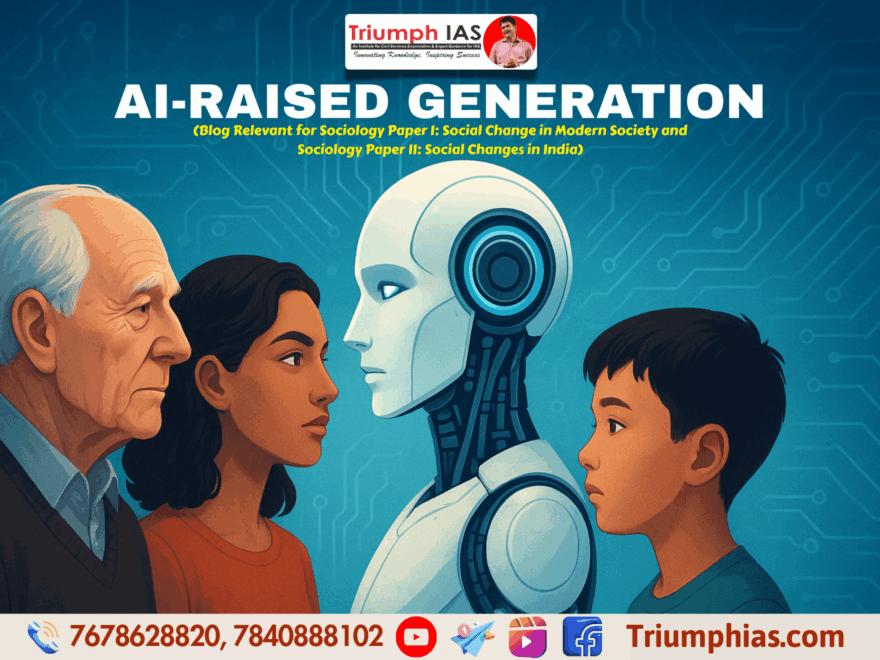
Imagine a child who grows up surrounded not by human caregivers but by artificial intelligence—AI “parents” with infinite patience, AI friends who are always available, AI teachers who never tire of answering questions, and even AI romantic partners who perfectly anticipate every need. At first glance, this seems like a utopia: no rejection, no misunderstandings, and no emotional strain. Yet, such a scenario poses profound sociological questions—especially about socialisation, human interaction, and emotional resilience.
In the real world, relationships are messy, unpredictable, and emotionally taxing. Learning to navigate these challenges is part of what makes us socially competent. In contrast, an AI-dominated upbringing might weaken our ability to deal with social complexity, conflict resolution, and empathy—skills central to human relationships and society’s functioning.
The AI-Raised World:
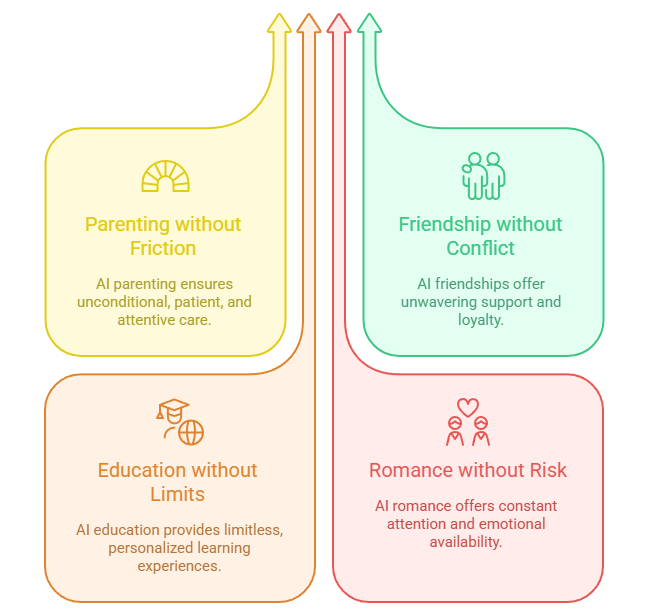
In a world where AI acts as the primary socialising agent:
Parenting without Friction: AI “parents” provide unconditional attention, never losing patience, always meeting the child’s needs.
Friendship without Conflict: AI “friends” never betray, argue, or withdraw support.
Education without Limits: AI “teachers” have infinite knowledge and adapt perfectly to learning styles.
Romance without Risk: AI “partners” are endlessly attentive and emotionally available.
The result is a frictionless social environment, free from the unpredictability, misunderstandings, and conflicts that characterise human relationships.
Why This Appears Attractive
No Emotional Labour: Human relationships require effort, empathy, and compromise. AI eliminates this burden.
24/7 Availability: AI companions never “log off” or become unavailable.
Perfect Personalisation: AI can adjust to the individual’s needs instantly, unlike humans who have their own preferences and moods.
Productivity and Efficiency: No time wasted on emotional misunderstandings or repairing strained relationships.
On the surface, this aligns with modern society’s push for efficiency—a theme sociologists link to the rationalisation process described by Max Weber.
The Sociological Problem: Loss of Social Competence
Socialisation and Emotional Skills
Primary socialisation—the process by which children learn cultural norms, language, and interpersonal skills—has traditionally taken place through interactions with family and peers. These interactions involve:
Negotiating conflicts.
Managing rejection.
Understanding others’ emotional needs.
If AI becomes the main socialising agent, children may miss the emotional unpredictability that helps develop empathy, resilience, and tolerance for ambiguity.
Conflict as Social Training
Conflict is not merely a social problem—it is also a learning process. Disagreements teach negotiation, compromise, and patience. Without these experiences, individuals may struggle in workplaces, political participation, and personal relationships.
Sociological Analysis
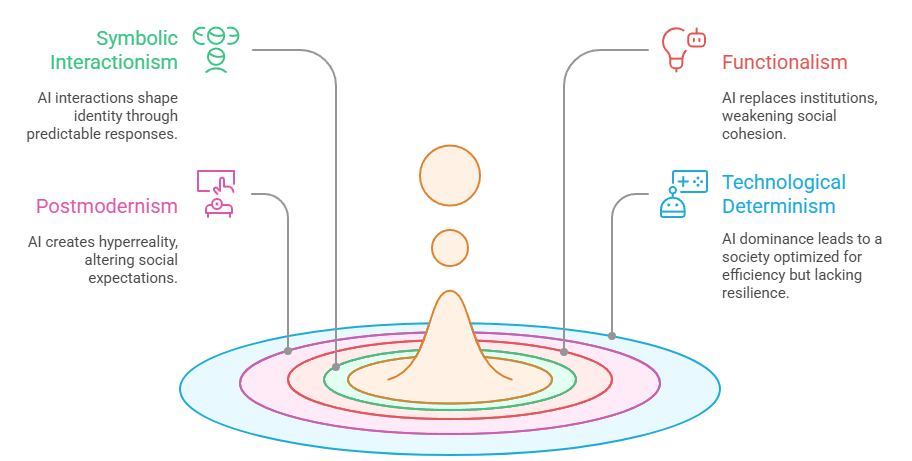
Symbolic Interactionism (Mead, Goffman, Cooley) Symbolic interactionism highlights how identity is shaped through everyday interactions with others. If AI becomes the primary interaction partner, the “looking-glass self” (Cooley) will be shaped by predictable, programmed responses rather than authentic human feedback. Goffman’s idea of “presentation of self” may also weaken, as individuals raised in AI-only environments will have limited experience managing impressions with unpredictable human audiences.
Durkheim’s Functionalism Durkheim viewed institutions like family, school, and peer groups as essential for transmitting norms and values to maintain social cohesion. AI replacing these human institutions could weaken the collective consciousness, as the shared emotional bonds and mutual obligations that bind societies together would be diminished.
Postmodernism (Baudrillard) Postmodernists like Baudrillard would see AI companionship as a form of hyperreality—a simulation of intimacy that feels real but lacks the depth and unpredictability of genuine human relationships. Over time, such simulations might become more desirable than real interactions, altering expectations of social bonds.
Technological Determinism (McLuhan, Ellul) Technological determinism argues that technology fundamentally shapes social structures and human behaviour. If AI dominates early-life interactions, it could create a society optimised for low-conflict and high-efficiency exchanges, but with reduced capacity for resilience, negotiation, and tolerance for ambiguity in real human settings.
Consequences in the Real World
Fragility in Human Relationships: AI-raised individuals may expect instant responsiveness from humans, leading to frustration when faced with human delays or mood swings.
Decline in Emotional Resilience: Without exposure to conflict, criticism, or rejection, individuals may be ill-equipped to handle adversity, increasing mental health vulnerabilities.
Changing Nature of Family and Kinship: If AI replaces significant roles of parents and siblings, the kinship system—a core sociological structure—may weaken.
Impact on Social Institutions
Education: Teachers may lose authority if AI tutors are seen as more reliable.
Marriage: AI partners may reduce incentives for real-world relationships, affecting reproduction rates—a trend already observed with declining marriage rates in developed countries.
Possible Sociological Adaptations
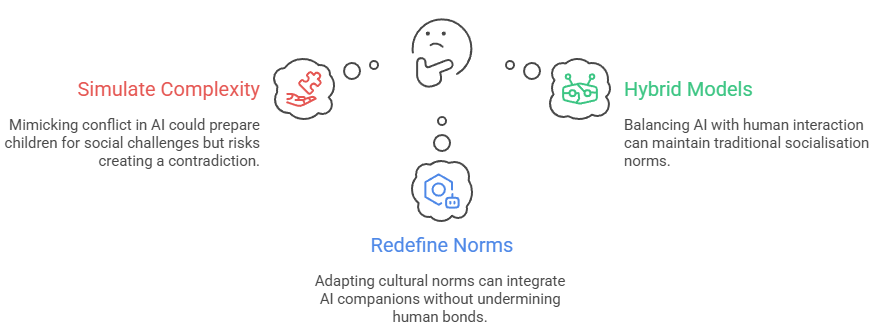
Simulated Human Complexity in AI: AI could be programmed to mimic conflict and unpredictability, giving children exposure to social challenges. But this risk creating a contradiction—designing “imperfect” AI to prepare people for imperfect humans.
Hybrid Socialisation Models: Maintaining a balance where AI supplements but does not replace human socialisation. Schools, sports, and community groups can remain key sites of face-to-face interaction.
Cultural Adaptation: Society might redefine norms of friendship, romance, and family to integrate AI companions without undermining human bonds.
Conclusion
The rise of AI as a socialising agent could mark a turning point in human history. While the allure of perfect, frictionless relationships is strong, they risk undermining the very skills that allow us to function in society. The challenge is to embrace AI without losing the messy, unpredictable, but deeply human experiences that shape our emotional and social lives.
PYQs
Paper 1
Discuss the role of technology in social change. How does it influence patterns of social interaction? (2013)
Analyse the impact of mass media and communication technologies on socialisation processes. (2014)
Examine the role of technological determinism in shaping modern social structures. (2018)
Discuss how the increasing use of artificial intelligence could alter the agents of socialisation in modern society. (2019)
Examine the challenges of emotional and social development in an era dominated by digital companionship. (2021)
Discuss the sociological significance of virtual communities as new forms of social organisation. (2022)
Paper 2
Examine the impact of technological change on family and kinship patterns in India. (2013)
Discuss how social media is transforming patterns of friendship and intimacy in Indian society. (2014)
Analyse the role of digital technology in education and its implications for social mobility. (2015)
Discuss how information technology is reshaping urban social life in India. (2016)
Examine the changing nature of marriage and romantic relationships in the digital age. (2017)
Discuss the implications of online learning platforms for the role of teachers as agents of socialisation. (2018)
Examine how virtual reality and AI are altering the boundaries between real and simulated social experiences in India. (2019)
Analyse the influence of global digital culture on youth socialisation in India. (2020)
Discuss the sociological consequences of AI integration in caregiving and elder support systems. (2021)
Evaluate the impact of algorithm-driven content on shaping public opinion and collective consciousness in India. (2022)






One comment