The digital revolution has redefined every sphere of social life, including one of the most intimate aspects—relationships and matchmaking. From matrimonial websites like Shaadi.com and Bharat Matrimony to dating apps such as Tinder, Bumble, and Hinge, technology has transformed how individuals meet, interact, and form relationships. This process is often termed tech-mediated intimacy, where digital platforms facilitate emotional connections, dating, and even long-term marital ties. This topic intersects with themes such as marriage and family, kinship, social change, globalization, technology and society, gender relations, and youth culture. The emergence of technology as a mediator of intimacy raises important sociological questions about modernity, identity, cultural values, and social stratification.
Historical Context
Traditionally, marriage in India has been a family-regulated institution, deeply tied to caste, community, religion, and kinship. Sociologists like Irawati Karve and N. Srinivas highlighted how caste endogamy and arranged marriages ensured continuity of social structures.
With the rise of urbanization and globalization, individual choices began to expand. Yet, caste and community considerations persisted. The shift from arranged marriages through kinship networks to digitally arranged marriages represents continuity with change—technology has expanded matchmaking platforms, but caste, class, and religion still remain crucial filters.
The Rise of Tech-Mediated Matchmaking
Matrimonial Websites: Matrimonial websites such as Shaadi.com, Jeevansathi.com, and Bharat Matrimony have digitized the traditional arranged marriage process. Families and relatives still play a major role in browsing profiles, ensuring that caste, community, and religion remain central to partner selection. Even in the digital age, filters for caste, sub-caste, income, and occupation show that these platforms largely reproduce traditional patterns of endogamy.
Dating Apps: Dating apps like Tinder, Bumble, and Hinge are popular among urban youth. They emphasize individual choice, attraction, and lifestyle compatibility rather than family preferences. However, research shows that even on these platforms, patterns of caste, class, and religious preference persist. Thus, while dating apps represent modernity and personal freedom, they are not free from the biases of Indian society.
Hybrid Models: Some newer platforms offer a blend of tradition and modernity. Apps such as Aisle market themselves as serious alternatives to casual dating, targeting Indians who want meaningful relationships outside of strict family control. These hybrid models highlight the negotiation between arranged marriage and love marriage, showing how technology adapts to cultural expectations in India.
Sociological Analysis
Caste and Endogamy: Despite the modern veneer, digital matchmaking platforms often reproduce endogamous patterns. Studies by Surinder S. Jodhka show that caste remains a key criterion in online matrimonial searches. Even on dating apps, users often prefer matches from their own community, reflecting continuity of caste boundaries in digital spaces.
Gender and Power
Gender dynamics shape tech-mediated intimacy:
Women face cyberstalking, harassment, and objectification on dating platforms.
Men often dominate matrimonial searches, while women’s “virtue” and family background are scrutinized.
Yet, dating apps have also provided women greater autonomy in partner selection, as in Bumble where women initiate conversations.
Globalization and Hybrid Identities: Global exposure through technology has encouraged intercaste and interreligious marriages, though still limited. Diaspora communities also use matrimonial sites to maintain cultural ties, leading to transnational marriages. This reflects Arjun Appadurai’s idea of global cultural flows, where technology creates hybrid forms of intimacy.
Commodification of Relationships: Dating apps operate on a market logic, where profiles are curated, swiped, and evaluated like commodities. This echoes Karl Marx’s idea of commodification—relationships are shaped by consumerist patterns of choice, branding, and visibility. Love is increasingly mediated by algorithms.
Individualization and Modernity: According to Anthony Giddens, modern relationships are characterized by the “pure relationship”, based on choice and emotional satisfaction rather than duty. Dating apps embody this shift, where individuals seek partners for companionship, not merely social obligation. However, this individualization clashes with India’s collectivist family structures, producing negotiation between personal desire and social expectations.
Digital Divide and Class: Access to tech-mediated intimacy is unequal. Urban, English-speaking, middle-class youth dominate dating apps, while rural and lower-class groups remain underrepresented. This creates a digital stratification of intimacy, where modern forms of matchmaking remain restricted to privileged groups.
Case Studies and Examples
Tinder in India: Reports show that caste and religion still influence swiping patterns, with subtle forms of exclusion.
com caste filters controversy (2020): Activists criticized the platform for promoting casteism by allowing caste-based searches. The company later removed “skin color” filters after backlash, showing how digital platforms reflect social biases.
Intercaste Marriages via Apps: Some stories highlight how dating apps enable intercaste unions, challenging traditional family control. However, these often face backlash from families, sometimes leading to honor crimes.
Challenges with Tech-Mediated Intimacy in Indian Society
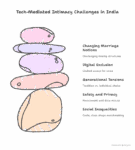
Reinforcement of Social Inequalities – Caste, class, and gender continue to shape online matchmaking.
Safety and Privacy Concerns – Cyber harassment, fake profiles, and misuse of personal data are widespread.
Generational Tensions – Parents prefer matrimonial sites, while youth prefer dating apps, leading to conflicts between traditional authority and individual choice.
Digital Exclusion – Rural and marginalized groups have less access to tech-based platforms.
Changing Notions of Marriage – Increased acceptance of live-in relationships and delayed marriages challenge conventional kinship structures.
Way Forward
Awareness against Casteism – Remove caste-based filters and encourages intercaste matchmaking.
Gender-Sensitive Platforms – Stronger protections against online harassment of women.
Digital Literacy Programs – Include rural and marginalized communities in digital matchmaking.
Policy Interventions – Data protection laws and ethical algorithms for dating apps.
Sociological Research – More studies on digital intimacy to understand youth, culture, and changing family patterns.
Conclusion
Tech-mediated intimacy and matchmaking represent the intersection of tradition and modernity. While technology provides greater autonomy, choice, and opportunities for new forms of intimacy, it also reproduces old social hierarchies like caste and gender discrimination. This topic illustrates how social change in India is paradoxical—modernization expands possibilities but old structures adapt to survive in new digital forms.
PYQs
Paper I
Does the institution of marriage continue to be sacred in Indian society? Comment. (2020)
Examine the relationship between the contemporary trends in marriage and changing form of family. (2017)
Paper II
Why is the study of marriage important in Sociology? Analyse the implications of changing marriage patterns for Indian society. (2024)
Analyse the role of market and modern forces in understanding the changing trends in marriage systems in India. (2023)
Discuss different forms of kinship system in India. (2021)
Discuss the consequences of across-region marriage on kinship system in modern Indian society. (2020)






One comment