Space exploration has transcended the realm of mere curiosity—today, its technologies and discoveries directly influence life on Earth. From satellite-driven climate monitoring to experiments growing food in microgravity, the benefits are far-reaching.
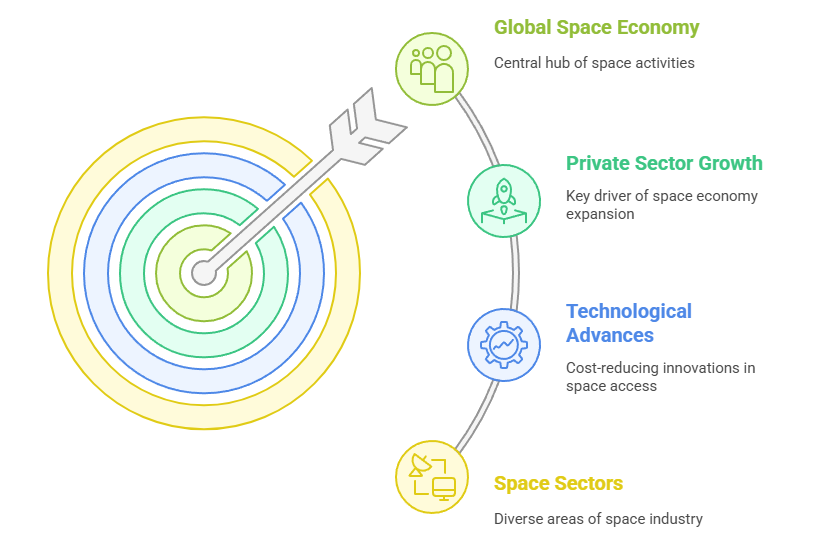
The Global Space Economy & NewSpace
According to the World Economic Forum and McKinsey, the global space economy was valued at $630 billion in 2023, projected to reach $1.8 trillion by 2035, driven primarily by private-sector growth
This shift—referred to as “NewSpace”—includes satellite telecommunications, earth observation, space tourism, and even asteroid mining.
Technological advances like reusable launch vehicles and miniaturized satellites have drastically reduced the cost of accessing space, enabling frequent, affordable missions.
India’s Leap in Space
ISRO Achievements:
Chandrayaan-3 successfully soft-landed near the Moon’s south pole and deployed the Pragyan rover, bolstering India’s lunar credentials.
Aditya‑L1, India’s first solar observatory, reached its halo orbit in January 2024 and aids solar and space weather forecasting.
Reusable Launch Vehicle (RLV) tests—two in 2024—show promising strides toward cost-effective launch reusability (cutting costs by ~80%).
SpaDeX, India’s Space Docking Experiment, marked India as the fourth country to autonomously dock satellites
Gaganyaan, India’s crewed mission, is planned for 2025, aiming to place three astronauts in orbit—a pivotal moment in human spaceflight.
Policy Momentum:
The Indian Space Policy 2023 and creation of IN‑SPACe have unlocked 100% FDI in several space sub-sectors, accelerating private participation.
National goals under Space Vision 2047 include:
Launching the Bharatiya Antariksha Station (BAS) by 2035
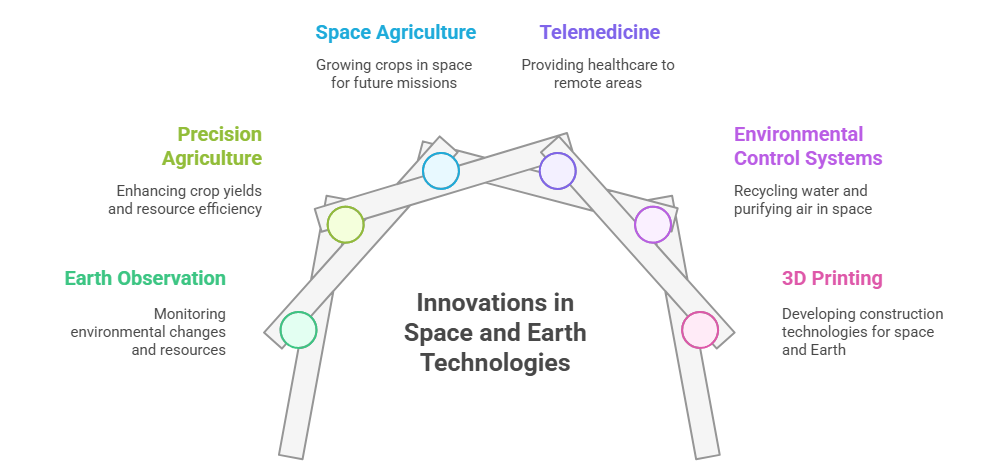
Satellite programs like ESA’s Copernicus (Sentinel series) and NASA’s Landsat monitor deforestation, glacier retreat, water-use, pollution, and greenhouse gas emissions .
Precision agriculture powered by hyperspectral satellite data could retrieve up to 0.8 billion tonnes of crops annually, reduce pesticide and fertiliser use by up to 50 million tonnes of CO₂, and conserve 5–10% freshwater (~2.8 billion litres).
Satellite-based monitoring improves drought forecasting, crop health analysis, pest outbreak detection and supports disaster management like flood and fire tracking.
Agriculture & Food Security Experiments in Space
Experiments aboard the ISS:
The Vegetable Production System (Veggie) has grown lettuce, mustard, kale, pak choi, tomatoes—and even peppers in the APH module—offering insights into soil-less farming for deep-space and Earth use.
Indian astronauts aboard Axiom‑4 are set to grow superfoods like green gram and fenugreek in microgravity to support future space missions and build autonomous life‑support systems.
Cannabis seeds and grapevines have been flown to study radiation-induced mutations for more resilient crop strains back on Earth
NASA-developed biocontrol systems and aeroponics for disease-resistant plant growth in closed systems could revolutionize terrestrial vertical farming.
Health, Water, and Environmental Technologies
Satellite-enabled telemedicine connects remote areas with expert healthcare, especially during emergencies and disease outbreaks.
The ISS’s Environmental Control and Life Support System recycles water (>90%) and purifies air—benefiting water-scarce regions and disaster relief efforts on Earth.
3D-printing technologies developed for building space habitats and parts can translate into affordable, durable construction here on Earth.
Challenges & Responsible Exploration
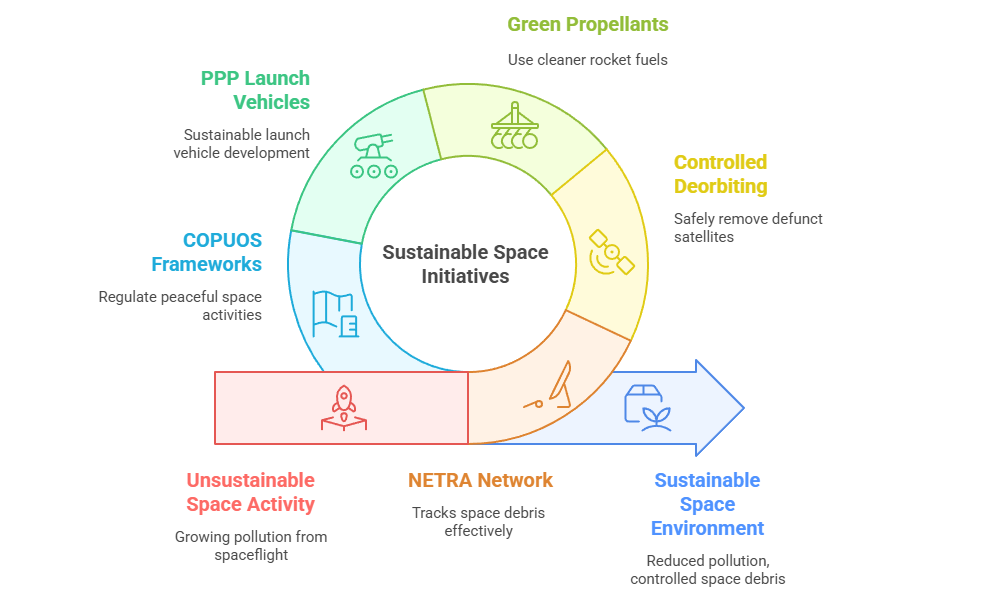
Environmental footprint: Rocket emissions (CO₂, black carbon, ozone-depleting chemicals) and space debris (13,000+ derelict satellites) are growing concerns
India is taking steps:
NETRA network tracks debris
Controlled deorbiting
Development of green propellants (hydrogen peroxide, liquid methane‑LOX)
PPP in sustainable launch vehicles via Agnikul, Skyroot, and iBooster systems
Regulatory frameworks via COPUOS support peaceful, sustainable space activity.
Strategic Imperatives for India and UPSC Aspirants
Integrate satellite data across sectors: agriculture, water resources, infrastructure planning, public health, and urban governance platforms like Bhuvan and NyayaVikas.
Boost private-public synergy: IN‑SPACe, ISpA-supported policies, FDI reforms, and VC funding (₹1,000 crore fund in FY 2024‑25) are spurring a boom in startups such as Skyroot, Agnikul, and Pixxel.
Advance R&D and biotechnology for space-enhanced agriculture, pharmaceuticals, and materials—critical for resilience and innovation on Earth.
Environmental responsibility must underpin all space activities—from emissions controls to debris mitigation.
Human resource development: Skilling through ISRO-led tech and incoming space jobs across Earth observation, propulsion systems, AI satellites, and space biotech.
Conclusion
Exploring space isn’t a luxury—it’s a necessity for Earth’s future. Space-based insights are already safeguarding our climate, improving agriculture, enabling remote health solutions, and empowering innovations that benefit millions. For India, space is a tool for achieving Atmanirbhar Bharat, economic growth, strategic advantage, and global collaboration.







2 comments