


Secularism
(Relevant for Sociology Paper I: Religion and Society and Sociology Paper II: Religion and Society, Challenges of Social Transformation)

Introduction
Secularism is one of the most debated and vital concepts in Indian democracy and modern sociology. It refers to the separation of religion from political, economic, social, and cultural aspects of life, with religion being treated as a strictly personal matter. In India, however, secularism is not merely the separation of church and state (as in the West) but is characterized by the equal respect and recognition for all religions.
Origins and Historical Evolution of Secularism
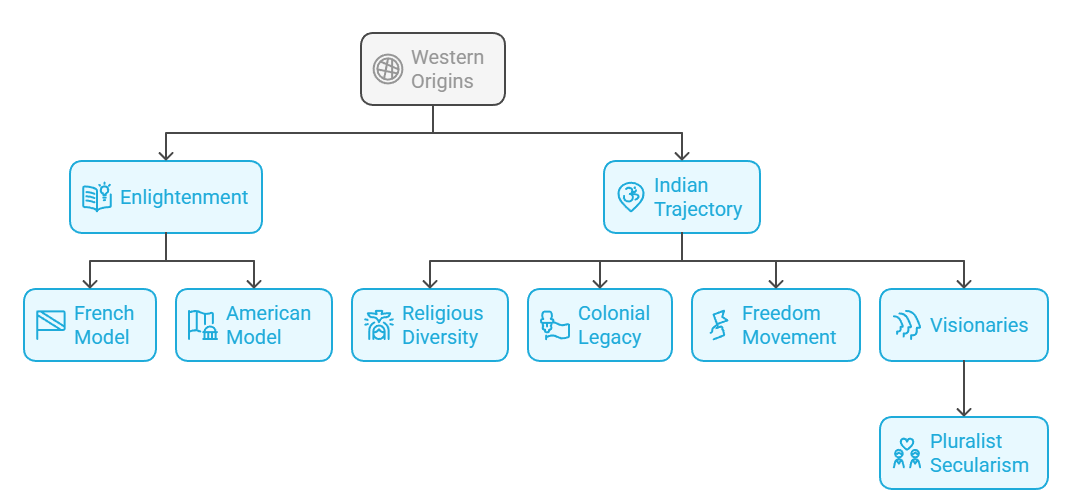

Western Origins
- The term “secularism” was coined by George Holyoake in the 19th century.
- In Europe, it emerged during the Enlightenment, advocating reason, scientific thought, and individual freedom over dogma.
- The French model of laïcité emphasizes strict exclusion of religion from the public sphere.
- The American model focuses on a “wall of separation” between church and state.
Indian Trajectory
India’s path to secularism was unique and emerged out of:
- Religious diversity across castes, communities, and faiths.
- Colonial legacy of ‘divide and rule’ policies that amplified religious divisions.
- Freedom movement that united diverse religious groups under a common national goal.
- Visionaries like Mahatma Gandhi, Jawaharlal Nehru, and R. Ambedkar envisioned a pluralist, inclusive secularism that recognizes all religions.
Constitutional and Legal Dimensions of Secularism in India
- The term “secular” was inserted into the Preamble of the Indian Constitution by the 42nd Amendment (1976).
- Articles 25–28 ensure freedom of religion, including the right to profess, practice, and propagate any faith.
- Article 14 ensures equality before the law, while Article 15 prohibits discrimination on religious grounds.
- State-funded secularism: The state may engage with religions to ensure social reform (e.g., abolition of untouchability, temple entry movement).
- Judicial interpretation: The Supreme Court’s doctrine of the “essential religious practices” test often determines state intervention in religious matters.
Sociological Analysis
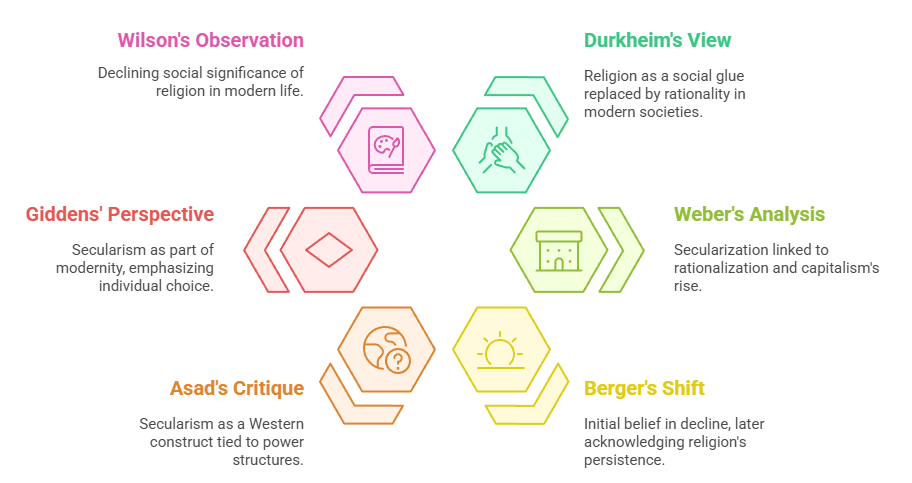

- Emile Durkheim: Viewed religion as foundational for social cohesion; as societies modernize, secular values gradually replace religious norms, fostering rationality.
- Max Weber: Linked secularization to rationalization and bureaucratization, seeing modern capitalism as eroding religious authority and creating a disenchanted worldview.
- Peter Berger: Initially supported the secularization thesis, predicting religion’s decline, but later acknowledged its persistence and resurgence in pluralistic societies.
- Talal Asad: Critiqued secularism as a Western construct, arguing it often reflects dominant power structures and is tied to state control rather than genuine neutrality.
- Anthony Giddens: Suggests secularism is part of broader modernity processes, where tradition loses authority and individual choice becomes central.
- Bryan Wilson: Saw secularization as the declining social significance of religion in modern societies, shifting toward scientific and rational explanations.
Indian Secularism vs. Western Secularism
| Aspect | Western Model (France/USA) | Indian Model |
| Definition | Strict separation of state and religion | Equal respect for all religions |
| State Role | Passive/neutral | Active engagement to ensure equality and reform |
| Uniform Civil Code | Enforced or separate legal systems (e.g., Sharia in UK) | Ongoing debate under Directive Principles (Article 44) |
| Secularization | Result of modernization | Coexists with religiosity and pluralism |
Challenges to Secularism in Contemporary India
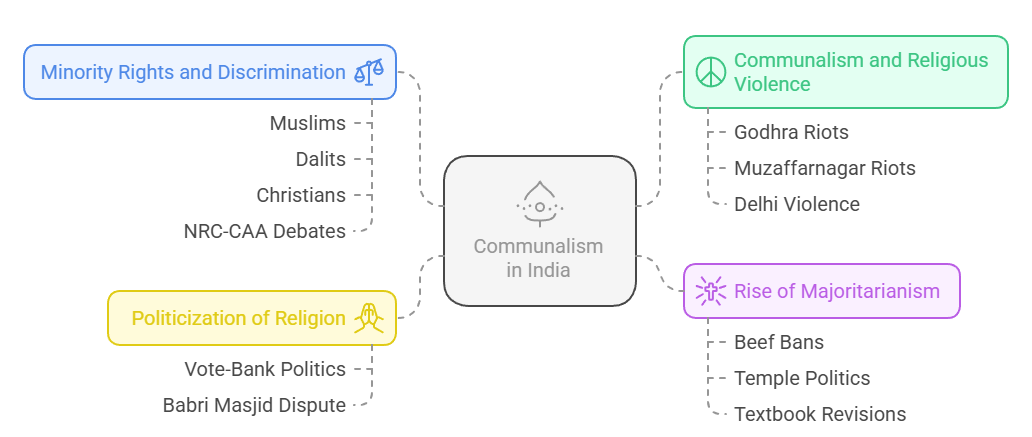

- Communalism and Religious Violence
- Incidents like Godhra riots (2002), Muzaffarnagar riots (2013), and Delhi violence (2020) underscore deep-rooted communal tensions.
- Sociology links communalism to identity politics, social stratification, and economic competition.
- Rise of Majoritarianism
- Critics argue that majority religious sentiments are increasingly influencing political discourse and policies.
- Issues like beef bans, temple politics, and textbook revisions challenge the neutrality of the state.
- Politicization of Religion
- Political parties often mobilize religious identities to gain votes—vote-bank politics.
- The Babri Masjid-Ram Janmabhoomi dispute is a textbook case of religious symbolism being politicized.
- Minority Rights and Discrimination
- Muslims, Dalits, and Christians often report systemic discrimination and underrepresentation.
- NRC-CAA debates raised questions about citizenship based on religion, threatening constitutional secular values.
Secularism and Social Institutions
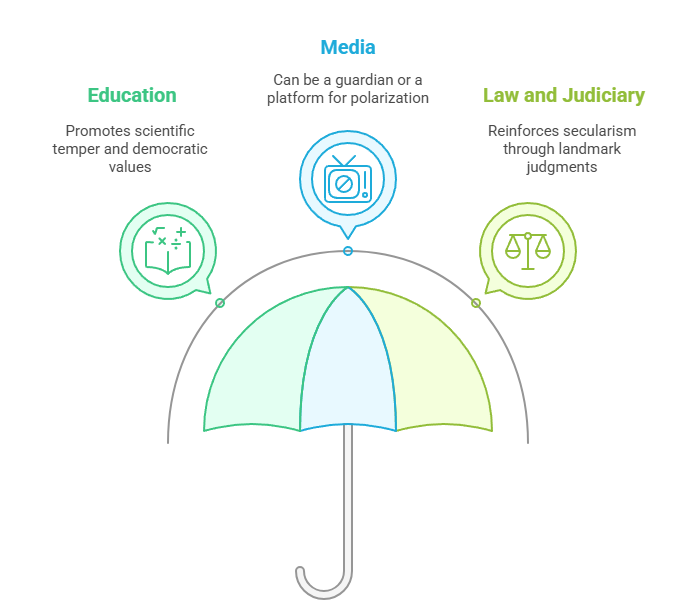

- Education
- Secular education promotes scientific temper, gender equality, and democratic values.
- NCERT textbooks and CBSE curriculum reflect secular ethics, though under periodic ideological scrutiny.
- Media
- Can be both a guardian of secularism and a platform for polarization.
- The rise of social media has created digital echo chambers promoting communal rhetoric.
- Law and Judiciary
- Landmark judgments like S.R. Bommai vs. Union of India (1994) reinforced secularism as part of the basic structure doctrine.
- Courts also mediate religious freedoms vs. public order concerns.
Recent Developments
- Uniform Civil Code (UCC) discussions revived in states like Uttarakhand and Gujarat.
- Supreme Court’s involvement in religious processions, dress codes (Hijab ban in Karnataka).
- Debate over Hate Speech laws and censorship as affecting secular values.
- Civil society movements like India Against Hate highlight growing public assertion of secular ideals.
Conclusion:
Secularism is more than a constitutional value—it is a daily lived experience in a diverse society like India. From a sociological perspective, it acts as a mediator of conflict, a promoter of pluralism, and a reflection of modernity.
However, the erosion of secular values, increasing religious polarization, and state complicity in communalism pose serious threats. Understanding secularism in its theoretical depth, legal frameworks, and practical complexities is crucial for effective essay writing, ethics, polity, and sociology paper answers.
PYQs
Paper I —
- Problematise the concept of secularism in the present context. (2017)
- How is the Indian concept of secularism different from the Western model of secularism? (2018)
- Discuss the challenges thrown by religious revivalism to a secular nation‑state. (2018)
- With increase in education and economic development is Indian society becoming more secular? (2018)
Paper II —
- “Secularism was an outcome of 20th century humanistic radicalism.” Comment on this statement. (2020)
- Examine different understandings of secularisation in India. (2022)
- How do your account for the increasing significance of religion in public and personal spheres in the context of the secularisation thesis in India?(2023)
- Distinguish between secularism and secularisation. Analyse the nature and extent of secularisation in contemporary India.(2023)

To Read more topics, visit: www.triumphias.com/blogs
One comment