


Totemism: A Deep Dive into Tribal Identity, Social Cohesion & Belief Systems
(Relevant for Sociology Paper I: Sociological Thinkers; Religion and Society and Sociology Paper II: Tribal Communities in India; Religion and Society)

IntroductionTotemism is one of the most foundational concepts in the study of religion, culture, and tribal societies. At its core, totemism is a belief system in which humans have a spiritual connection or kinship with a particular natural element—often an animal, plant, or other natural object—known as a “totem.” Far more than primitive superstition, totemism represents an intricate social institution that helps structure kinship systems, regulate marriages, enforce taboos, and ensure group cohesion. Pioneering sociologists like Émile Durkheim, James Frazer, and Claude Lévi-Strauss used totemism to explore how early societies maintained order and collective identity. What is Totemism?
In tribal societies, totemism is not merely religious—it is also social, cultural, and regulatory. Totemism in Indian Tribes
In India, many tribal groups practice totemism as part of their indigenous religious traditions. For instance:
Totemism in India often regulates marriage alliances (exogamy) and community behavior through taboos, reflecting how belief is interwoven with social structure. Sociological Analysis
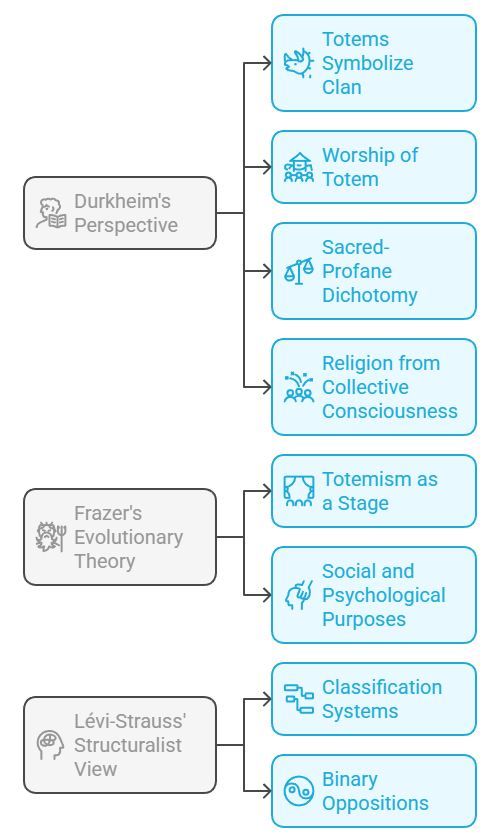
Émile Durkheim’s PerspectiveDurkheim viewed totemism as the earliest and most basic form of religion. In his work The Elementary Forms of Religious Life, he studied Australian Aboriginal tribes and observed:
James Frazer’s Evolutionary TheoryIn his book Totemism and Exogamy, Frazer viewed totemism as an early form of magical thinking and social evolution. He believed:
Criticism: Frazer was criticized for Eurocentric and linear views of social development. Claude Lévi-Strauss: Structuralist ViewIn Totemism (1962), Lévi-Strauss criticized the idea that totemism was a “stage” of evolution.
Totemism and Social FunctionsTotemism is not merely religious or symbolic. It has concrete sociological functions:
Contemporary Relevance
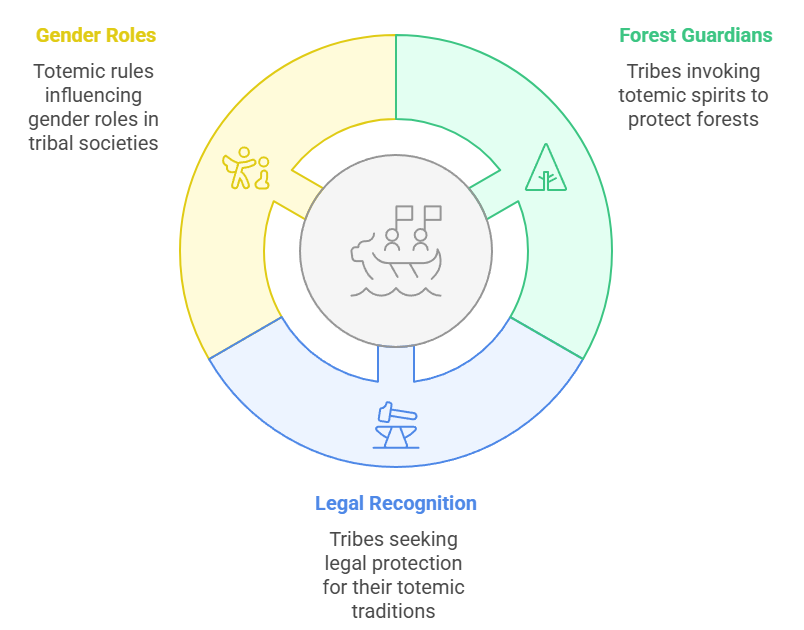
In today’s era of globalization and displacement, totemic practices are symbols of tribal resistance against cultural homogenization.
Some tribes demand recognition of their totemic traditions under the Fifth Schedule and Forest Rights Act, asserting that their identity is tied to totemic ecology.
In many tribes, totemic rules also regulate gender roles, such as who performs certain rituals or who may interact with sacred objects. Totemism in Comparison with Other Belief Systems
ConclusionTotemism, far from being an obsolete or primitive idea, remains a living tradition among many tribal communities and continues to be an important sociological tool for understanding kinship, religion, ecology, and identity. Studying totemism offers insights into how belief systems shape society, regulate behavior, and sustain cultures over generations. In a world increasingly driven by modernity, totemism reminds us of the organic bond between humans, nature, and society—a bond we may need to re-learn in our efforts toward sustainable living and inclusive development. PYQsPaper I:
Paper II:
|



To Read more topics, visit: www.triumphias.com/blogs