India’s education system—spanning pre-school to higher education—is in the midst of a dynamic and transformative era, largely driven by the National Education Policy (NEP) 2020. With an ambitious aim to raise public education investment, revamp curricula, and bridge equity gaps, the nation is seeking to create an education system that is holistic, inclusive, multidisciplinary, and aligned with global standards. Here’s a deep dive into the strides India is making—and the gaps it still must resolve.
Foundational & School Education Reforms
5+3+3+4 structure
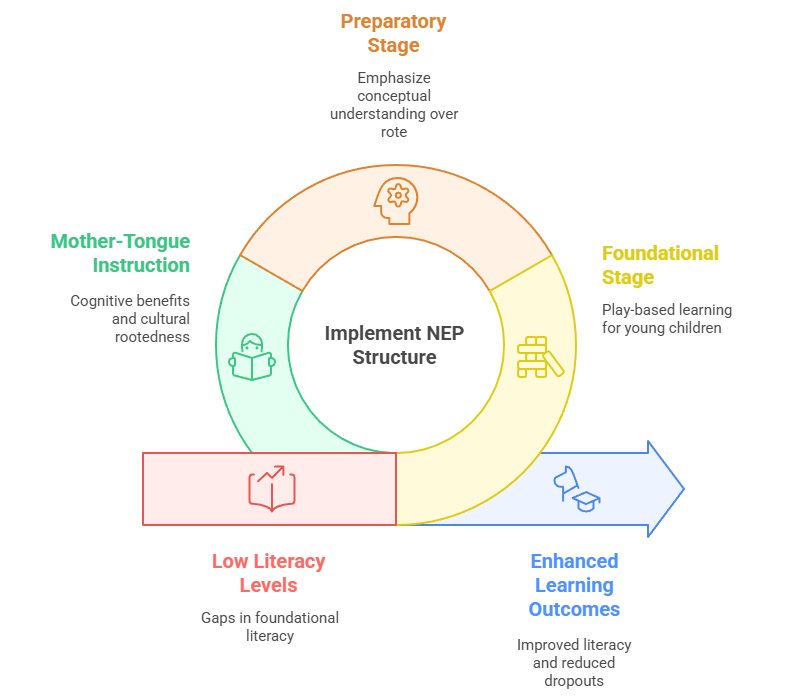
NEP replaces the traditional 10+2 system with a 5+3+3+4 model:
Foundational stage (3–8 years) includes early childhood care & education (ECCE) with play-based learning.
Preparatory, Middle, and Secondary stages build on this to emphasize conceptual understanding over rote learning
Literacy & Learning Outcome
The PLFS 2023‑24 reports adult literacy at 80.9% (urban: 88.9%, rural: 77.5%; male: 87.2%, female: 74.6%).
While foundational literacy programs like NIPUN Bharat have reached ~1.8 crore students, critical gaps persist—only ~23.4% of Grade III students can read second-grade-level text.
Government school enrollments dipped slightly (2022: 72.9% → 2024: 66.8%), and dropout rates in ages 15‑16 declined from 13.1% to 7.9%, but remain higher among girls (8.1%).
Mother‑Tongue Instruction
CBSE will implement a “mother‑tongue first” policy until Grade 5 (with possible extension to Grade 8) starting 2025‑26.
States like Karnataka, Maharashtra, Assam are piloting bilingual education.
This emphasizes cognitive benefits and cultural rootedness, though concerns remain about bridging to English at higher levels.
Teacher Training & Curriculum Development
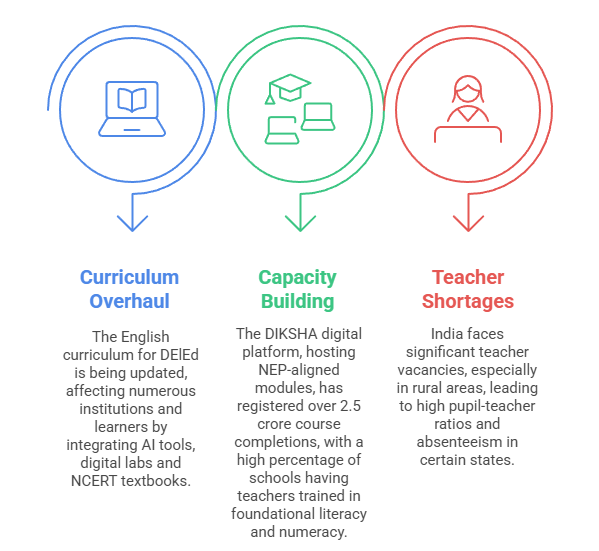
DElEd Overhaul In Uttar Pradesh, the English curriculum for DElEd (Diploma in Elementary Education) is being updated—affecting 67 government DIETs and ~3,000 private institutes, with ~3.25 lakh learners in 2024—integrating AI tools, digital labs, and NCERT textbooks.
Capacity Building via DIKSHA The DIKSHA digital platform—host to NEP‑aligned modules—registered over 2.5 crore course completions. Additionally, 75% of schools have at least one teacher trained in foundational literacy and numeracy.
Teacher Shortages Save learning gains, India still faces serious teacher vacancies—approximately 10 lakh vacancies in government schools. Rural areas, especially Bihar, Jharkhand, Odisha, report a pupil–teacher ratio up to 57:1 and rampant absenteeism in class.
Higher Education & Research
Multidisciplinary Education & FYUP NEP champions multidisciplinary institutions and a Four‑Year Undergraduate Program (FYUP) with multiple exit options (certificate, diploma, degree). Over 105 universities adopted FYUP, including central institutions like DU & BHU.
Academic Bank of Credits (ABC) Launched in June 2023, ABC allows credit portability across institutions; over 100 institutions have integrated so far.
Higher Education Commission of India (HECI) HECI, envisioned under NEP, will unify regulation, accreditation, funding, and quality assurance across HEIs. Operational rollout is expected by late 2024.
Global Footprint of Indian Institutes IITs are expanding globally—e.g., IIT Madras in Zanzibar and IIT Delhi planning Abu Dhabi campus—to attract international students.
Research & Innovation Programs like Anusandhan NRF, Atal Innovation Mission, and PARAKH (assessment reforms) emphasize skill-based education and research excellence.
Digital & Vocational Education
Online Platforms & Vocational Training Platforms like PM eVidya, SWAYAM, and e-Pathshala have democratized access, with over 1 crore vocational learners and ~US$ 3.94 billion market investment Atal Tinkering Labs number over 8,000 across India.
Digital Divide Yet 90% of rural schools lack reliable internet; only ~8% of rural students have consistent e-learning access. Smartphone access among teens is high (~90%), but socio-gender disparities persist
One Nation One Subscription (ONOS) A Rs 6,000 crore initiative (2025–27) to provide universal access to academic journals and resources.
Indian Knowledge Systems (IKS) UGC mandates 5% curricular credits in IKS, with 1.5 million teachers to undergo training by 2025.
Infrastructure & Equity
School Facilities About 47% of Indian schools have drinking water, toilets, and electricity. Between 2018–24:
Girl restrooms improved from 66.4% → 72%
Drinking water access rose from 74.8% → 77.7%.
PM‑SHRI Schools Launched in 2022, 10,855 schools were upgraded under PM‑SHRI by October 2024, aiming for 14,500 total.
Education Budget & Expenditure Current public expenditure is ~3–3.5% of GDP; NEP targets increasing this to 6%. Average government school spending per student is ~₹10,000 annually.
Dropouts: Secondary-level dropouts (ages 15–16) remain at ~7.9%.
Teacher Deficit: ~10 lakh vacancies and high pupil–teacher ratios in remote areas .
Digital Divide & Infrastructure Gaps: Low connectivity in rural schools and limited ed-tech access .
Towards 2047: A Vision
India’s roadmap is clear: strengthen foundational learning; upgrade teacher quality; expand multidisciplinary higher education; build digital bridges; and ensure equity across gender, region, and socio-economic status. The educational architecture is being retooled, but success lies in effective implementation, quantified governance, and community engagement.
As India charts its course to becoming a knowledge-driven economy and a global education hub—with NEP targets like achieving 50% GER by 2035—it is critical to remember that inclusive, contextual, and culturally-rooted education remains the backbone of national progress.











One comment