(Relevant for Sociology Paper I: Social Change in Modern Society and Sociology Paper II: Visions of Social Change in India; Social Movements; Challenges of Social Transformation)
India is witnessing a significant sociocultural transition in how queer relationships are perceived and discussed. While Section 377 of the IPC was read down in 2018, decriminalizing consensual homosexual acts, social acceptance, legal recognition, and institutional support for queer individuals remain limited. As debates on same-sex marriage, queer parenting, and gender fluidity intensify, it becomes essential to analyze these transformations through a sociological lens.
Why Recently in News?
In recent months, the Supreme Court of India’s refusal to legalize same-sex marriage has sparked widespread debates on civil liberties and constitutional morality. Additionally, the rise of pride parades, queer representation in popular culture and the UGC’s inclusion of gender and sexuality modules in university syllabi has fueled fresh academic and political interest in LGBTQ+ rights.
Sociological Analysis
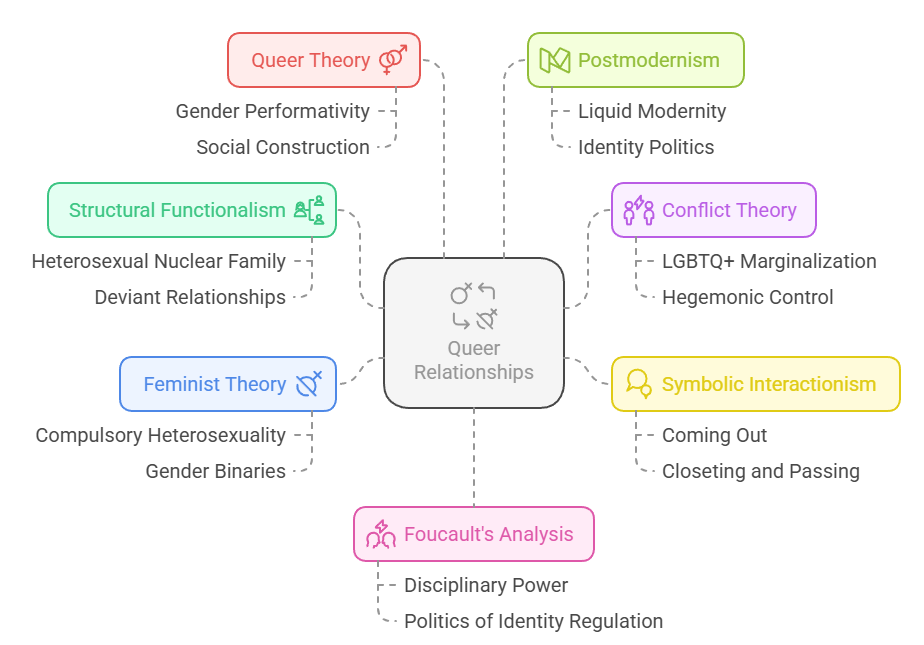
Structural functionalists like Talcott Parsons viewed the heterosexual nuclear family as essential for social order, emphasizing roles like instrumental (male) and expressive (female). Queer relationships, from this lens, were seen as deviant or dysfunctional. However, this perspective is now considered limited as it ignores emerging family forms like same-sex parenting or non-binary partnerships that can also fulfill social functions like care, emotional support, and economic stability.
Conflict theorists see queer relationships through the prism of power, domination, and inequality. Marginalization of LGBTQ+ people in laws, employment, healthcare, and marriage rights reflects hegemonic control by dominant (heteronormative) groups. Drawing on Marxist analysis, the exclusion of queer individuals is understood as a strategy to maintain control over social resources and preserve traditional gender roles that serve capitalist interests.
Symbolic Interactionism focuses on everyday meaning-making and identity formation. Queer identities are not biologically fixed but are constructed through interactions, language, and social labels. Concepts like “coming out,” “closeting and passing” is socially mediated experiences that shape self-perception. This perspective highlights how queer individuals continuously negotiate their identities in various social contexts—family, workplace, and public spaces.
Feminist theorists like Ann Oakley critique patriarchal norms that dictate what counts as “normal” in terms of sexuality and family. Feminism, particularly in its radical and intersectional forms, supports queer struggles by questioning compulsory heterosexuality and rigid gender binaries. Feminists argue that queer relationships challenge the gendered division of labor, emotional roles, and sexuality, thus subverting patriarchal structures.
Queer theory, developed by thinkers like Judith Butler and Michel Foucault, seeks to deconstruct normative ideas of gender and sexuality. It challenges binaries such as male/female and gay/straight, arguing that these categories are performative and socially constructed. Butler’s idea of gender performativity posits that gender is enacted through repeated acts, opening space for non-binary and fluid identities. Queer theory empowers marginalized sexualities and critiques institutional control over bodies and desires.
Postmodernist Perspective emphasizes plurality, fragmentation, and fluidity. From this perspective, queer relationships represent the breakdown of grand narratives like the heterosexual family. In a liquid modern world (as described by Zygmunt Bauman), relationships are no longer fixed; they are negotiated, transient, and diverse. Postmodernists celebrate queer relationships as expressions of individual autonomy and identity politics in an era of cultural change.
Michel Foucault’s History of Sexuality outlines how sexuality is regulated not by morality but by power-knowledge systems. He showed how the state, medicine, and religion define “normal” sexuality through discourse. Queer relationships, then, are not simply private matters but political acts of resistance. Foucault’s analysis explains how queerness disrupts disciplinary power and exposes the politics of identity regulation.
Queer Movements in India:
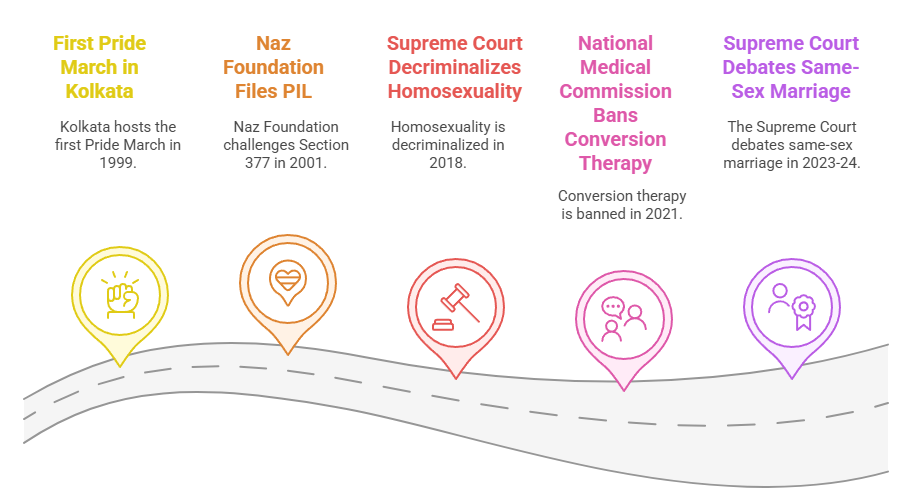
1999: First Pride March in Kolkata
2001: Naz Foundation files PIL against Section 377
2018: Supreme Court decriminalizes homosexuality
2021: National Medical Commission bans conversion therapy
2023–24: Supreme Court debates on same-sex marriage
These movements reflect a shift from victimhood to agency, where queer individuals are not just seeking protection but demanding recognition, representation, and rights.
Current Challenges in Queer Relationships
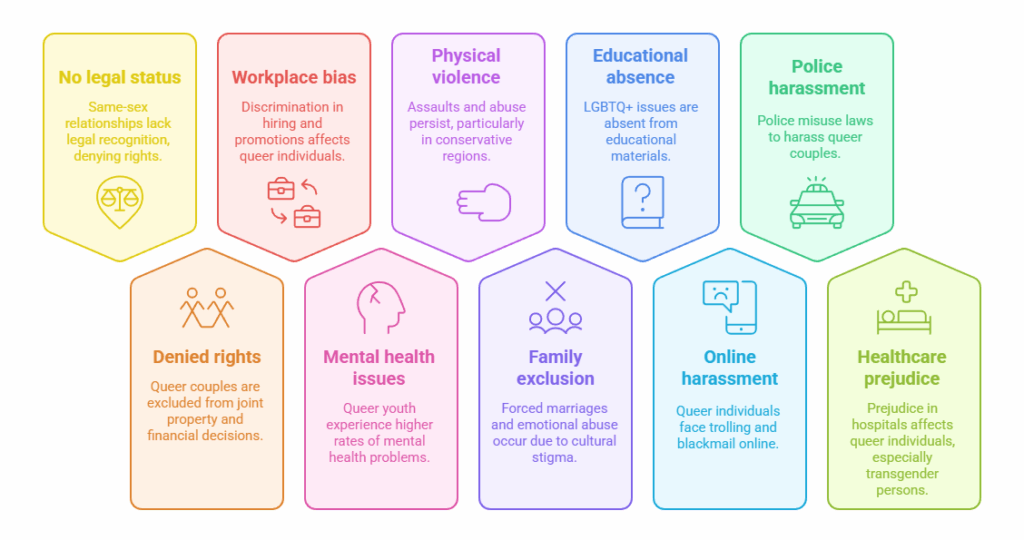
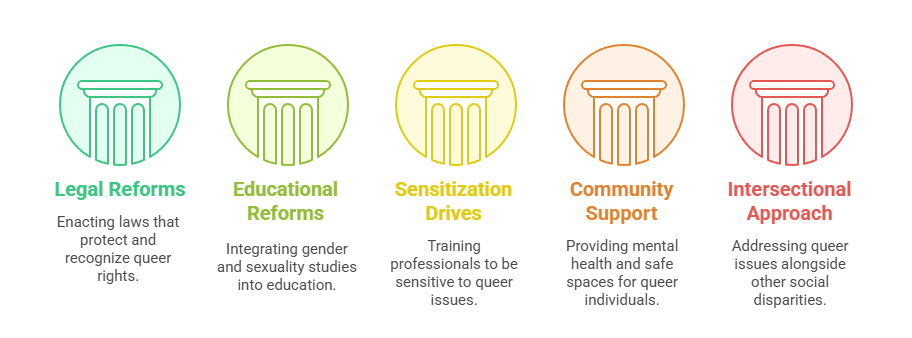
No legal status for same-sex marriage, civil unions, or domestic partnerships under Indian law.
Queer couples are denied joint property rights, succession, and financial decision-making privileges.
Widespread bias in recruitment, promotions, and rental housing markets due to sexual orientation.
Higher rates of anxiety, depression, and suicide among queer youth due to societal rejection and lack of queer-affirmative therapy.
Physical assaults, “corrective” rape, and verbal abuse continue, especially in rural and conservative areas.
Forced heterosexual marriages, emotional abuse, and exclusion from family functions persist due to cultural stigma.
Absence of LGBTQ+ issues in school and university textbooks reinforces ignorance and prejudice.
Queer individuals face trolling, doxxing, and blackmail on social media platforms.
Despite Section 377 being read down, police continue to misuse other laws (e.g., public obscenity) to harass queer couples.
Queer individuals often face prejudice in hospitals, including refusal of care, especially transgender and intersex persons.
Role of Social Media and Pop Culture
Social media has become a site of resistance and visibility for the queer community. Hashtags like #LoveIsLove, #PrideIndia, and #LGBTQRights enable youth to express and connect.
Web series, films, and advertisements featuring queer characters are normalizing diverse relationships and reducing stigma—contributing to attitudinal change in urban India.
The emergence of a new outlook toward queer relationships signals a progressive shift in Indian society—but the journey from tolerance to acceptance remains incomplete. Sociology helps decode this transformation not just as a legal reform, but as a deep social restructuring of institutions like family, marriage, gender, and morality.
PYQs
Paper I
Discuss the social construction of gender with suitable illustrations. (2014)
Distinguish between sex and gender. Discuss the role of socialization in the formation of gender identity. (2015)
How do the social movements in post-independent India address issues of gender inequality? (2019)
Examine the impact of LGBTQ+ activism on the understanding of gender identities in contemporary India. (2021)
Explain how post-modernism helps us understand gender fluidity and sexual diversity. (2022)
What are the key contributions of Michel Foucault to the sociology of sexuality? (2023)
Paper II
Examine the changing structure of the family in modern India with reference to emerging alternative forms like single-parent and same-sex families. (2014)
Discuss the legal and social struggles of LGBTQ+ community in India post-2014. (2015)
Analyze the role of judiciary in addressing gender and sexual rights in India. (2016)
Evaluate the implications of the NALSA judgment (2014) on the transgender community. (2017)
How far has the Indian state been successful in ensuring rights for sexual minorities? Illustrate with recent examples. (2018)
Critically assess the impact of decriminalization of Section 377 on Indian society. (2019)
Discuss the role of civil society and NGOs in promoting rights of LGBTQ+ persons in India. (2020)
How do gender and sexuality intersect with caste and class in India? Substantiate with examples. (2021)
What are the sociological implications of the queer pride parades and digital activism in India? (2022)
Examine the resistance faced by same-sex couples in accessing marriage, inheritance, and adoption rights in India. (2023)