Communal Harmony as a National Security Imperative
Communal Harmony as a National Security Imperative
(Relevant for Sociology Paper I: Politics and Society; Religion and Society and Sociology Paper II: Religion and Society; Challenges of Social Transformation)
India is a pluralistic and deeply diverse society, with over 2000 ethnic groups and multiple religions, languages, and cultural traditions. This diversity, while enriching, also makes India vulnerable to communal tensions. When communal harmony breaks down, it does not merely threaten individual liberties or local peace, but compromises national unity, development, and international image—thus becoming a national security issue.
Why This Topic is in the News?
In light of recent sectarian tensions in Manipur, Karauli (Rajasthan), Haryana’s Nuh, and communal flare-ups across states like Uttar Pradesh, West Bengal, and Delhi, the Indian government and judiciary have emphasized that communal harmony is not just a social ideal but a national security necessity. A recent statement by the Union Home Minister linked peace between communities to internal stability and the realization of Viksit Bharat 2047 goals.
How Communal Tensions Threaten National Security
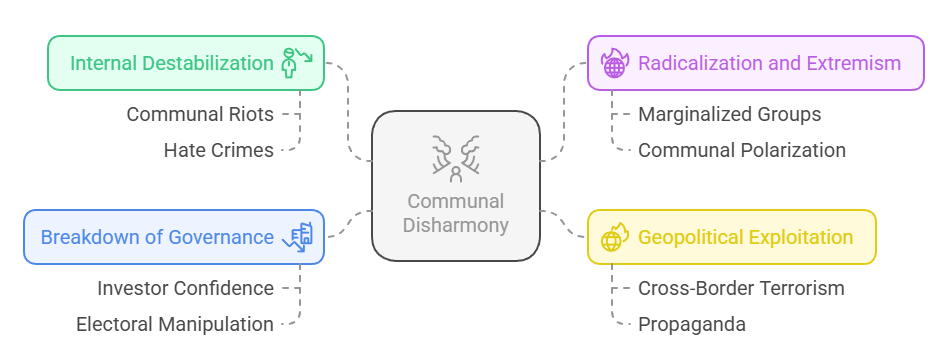
Internal Destabilization
Communal riots, like those in Gujarat (2002) or Delhi (2020), paralyze law enforcement and divert national security resources.
Rise in hate crimes and mob lynching leads to erosion of trust in state institutions.
Radicalization and Extremism
Marginalized religious groups may become vulnerable to radical ideologies, threatening internal peace.
Intelligence reports often cite communal polarization as a breeding ground for extremism.
Geopolitical Exploitation
Countries hostile to India (e.g., Pakistan) exploit religious tensions to foment cross-border terrorism and propaganda.
Breakdown of Governance
Prolonged communal disharmony can lead to loss of investor confidence, breakdown of administrative efficiency, and electoral manipulation.
Sociological Analysis
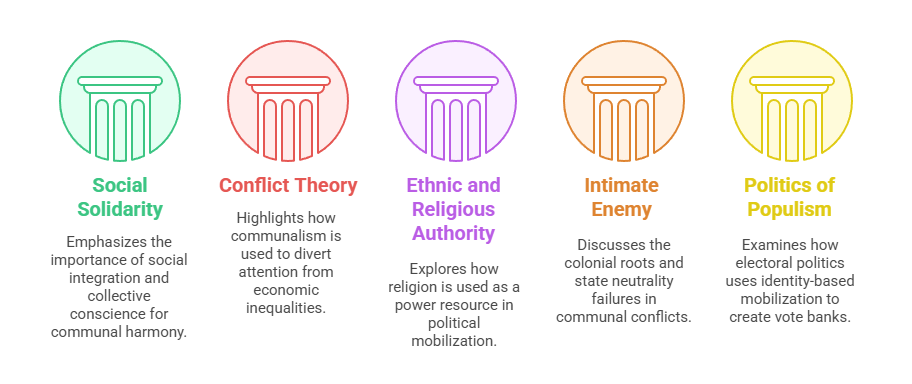
Social Solidarity: Emile Durkheim emphasized the importance of social integration and collective conscience. In India, communal harmony is a form of ‘organic solidarity’ where interdependence among diverse communities fosters cohesion.
Conflict Theory: Marxist theorists argue that communalism is often a tool of ruling classes to divert attention from economic inequality and class exploitation, promoting false consciousness among the working masses.
Ethnic and Religious Authority: Max Weber viewed religion as a source of identity and legitimacy. In Indian society, communal identities often overlap with political mobilization, turning religion into a power resource rather than a personal belief system.
Intimate Enemy: Ashis Nandy emphasizes that communalism arises from colonial distortions and the internalization of communal boundaries in post-colonial India. The state’s failure to remain neutral often fuels communal conflicts.
Politics of Populism: Rajni Kothari argued that electoral politics in India often thrives on identity-based mobilization. Communal polarization is used to create vote banks, eroding secular values.
State’s Role in Maintaining Communal Harmony as a Security Imperative
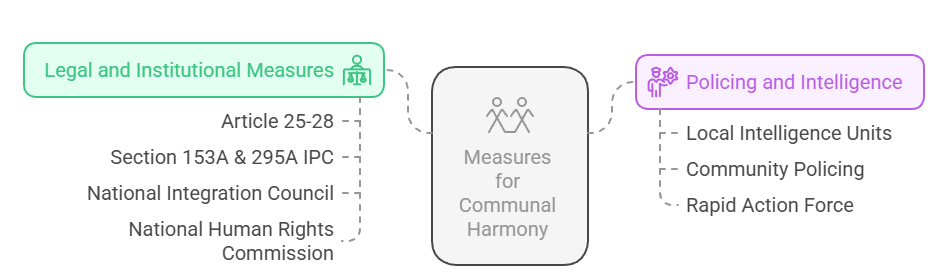
Legal and Institutional Measures:
Article 25-28 ensures religious freedom
Section 153A & 295A IPC penalize hate speech and religious insult
National Integration Council works to promote communal peace
National Human Rights Commission (NHRC) monitors rights violations in communal riots
Policing and Intelligence:
Strengthening local intelligence units in communally sensitive areas
Community policing initiatives like Mohalla Committees in Maharashtra
Deployment of Rapid Action Force (RAF) during potential flashpoints
Civil Society and Media as Peace Builders
NGOs like Aman Biradari and PUCL have worked to rehabilitate riot victims and promote inter-faith dialogue.
Responsible media coverage and countering fake news is crucial to prevent rumor-led violence.
Educational reforms promoting multiculturalism and moral education can help nurture tolerance from a young age.
Contemporary Examples of Communal Harmony and Discord
Year
Event
Nature
2023
Manipur Violence
Communal-ethnic conflict (Kuki-Meitei)
2022
Karauli Riots (Rajasthan)
Hindu-Muslim clash
2021
Shaheen Bagh Protests
Muslim assertion met with polarization
2020
Delhi Riots
Politically-triggered communal violence
Ongoing
Eid & Diwali celebrations in peace zones
Symbol of harmony
Global Comparison
In multicultural democracies like Canada, Malaysia, and South Africa, communal harmony is seen as vital to national integration and economic development. India’s diversity is its strength, but only if tolerance, dialogue, and justice are upheld through inclusive governance.
Conclusion:
In a globalized and volatile world, internal peace is as important as border security. Communal harmony is no longer a soft issue—it is a hard power necessity, directly tied to national security, economic stability, and global stature. For UPSC aspirants, this topic sits at the intersection of sociology, polity, and ethics, and calls for an integrated understanding of how peace-building in society ensures state strength.
PYQs
Paper I:
Discuss the sociological factors responsible for communal violence in multi-ethnic societies.
How does Durkheim’s theory of social solidarity explain communal harmony?
Paper II:
Examine the role of caste and religion in the rise of identity politics in India.
Discuss the impact of communalism on national integration.
How do civil society organizations help in managing communal conflicts?









2 comments