(Relevant for Sociology Paper I:Social Change in Modern Society and Sociology Paper II: Rural and Agrarian Transformation in India; Social Movements; Women and Development)
Self-Help Groups (SHGs) are voluntary associations of 10–20 people, typically women, from similar socio-economic backgrounds, who come together to save small amounts regularly, access microcredit, and engage in collective decision-making to improve their livelihoods. SHGs have emerged as a transformative model of participatory development, especially under initiatives likeNational Rural Livelihoods Mission (NRLM) and DAY-NULM.
Importance of SHGs in Contemporary India
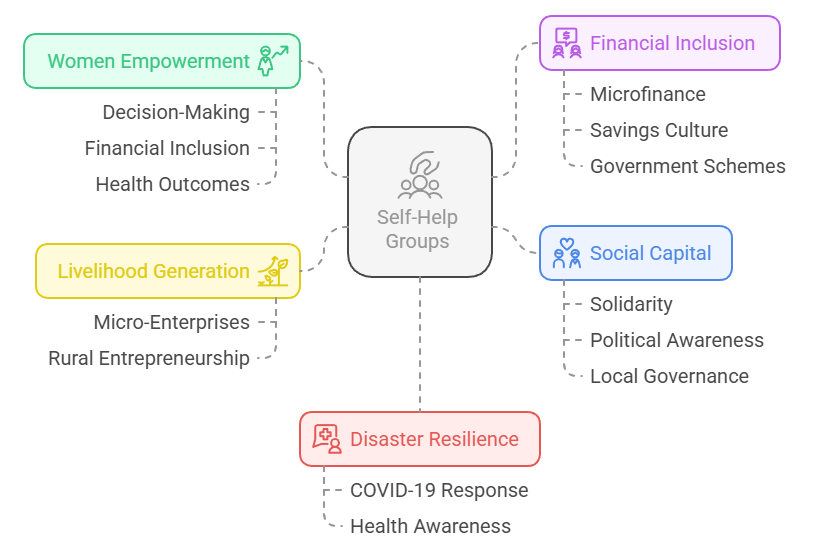
Women Empowerment: SHGs have significantly enhanced women’s agency in decision-making, reduced gender-based financial exclusion, and improved household nutrition, education, and health outcomes. Government schemes like Deendayal Antyodaya Yojana – NRLM empower women through federated SHG networks.
Financial Inclusion: SHGs promote microfinance without middlemen, encouraging savings and credit culture among rural women. SHGs are instrumental in extending Jan Dhan Yojana, Direct Benefit Transfer (DBT) schemes, and PM Awas Yojana benefits at the grassroots.
Livelihood Generation: SHG members often initiate micro-enterprises in sectors like handicrafts, dairy, poultry, food processing, tailoring, etc., thus promoting rural entrepreneurship.
Social Capital and Collective Action: SHGs foster solidarity and mutual trust, which can transform into political awareness, participation in Gram Sabhas, and local governance.
Disaster Resilience and COVID-19 Response: During the COVID-19 crisis, SHGs across India were pivotal in producing masks, running community kitchens, and spreading health awareness.
Sociological Analysis
Structural Functionalism: SHGs function as key social institutions that help maintain stability in rural society. By offering economic support, emotional bonding, and social integration, they fulfill vital societal needs. Durkheim’s concept of mechanical solidarity is evident as SHG members—often from similar socio-economic backgrounds—develop strong cohesion. Parsons’ view of institutions as fulfilling system needs is seen in how SHGs ensure the smooth functioning of family, economy, and local governance.
Conflict Theory: From a conflict perspective, SHGs represent collective resistance to structural inequalities like caste, patriarchy, and class-based exploitation. Marx would view SHGs as tools for redistributing power and economic control to marginalized groups, especially poor women. A.R. Desai’s critique of Indian capitalism supports the idea that SHGs empower the oppressed by challenging the dominance of moneylenders, landlords, and patriarchal norms.
Feminist Theory: SHGs directly challenge the gendered division of labor and the exclusion of women from financial autonomy. Feminist theorists like Ann Oakley would see SHGs as platforms where women gain identity beyond household roles. Sylvia Walby’s concept of patriarchal structures—economic, cultural, and political—can be applied to analyze how SHGs help dismantle these layers of domination by giving women control over credit, skills, and decision-making.
Max Weber’s Theory of Social Action: Weber’s typology of social action helps understand SHGs as both value-rational (working for long-term empowerment and self-sufficiency) and instrumentally rational (accessing credit, earning income). His idea of rational-legal authority applies when SHGs formalize into federations under schemes like NRLM. However, bureaucratization may sometimes dilute the original participatory ethos of SHGs.
Pierre Bourdieu’s concept of social capital—the networks and relationships that enable individuals to access resources—are highly relevant. SHGs generate strong bonding social capital within the group, based on trust and cooperation. As they connect with NGOs, banks, and government bodies, they develop bridging capital, enabling members to access new opportunities, markets, and institutional support.
Case Studies
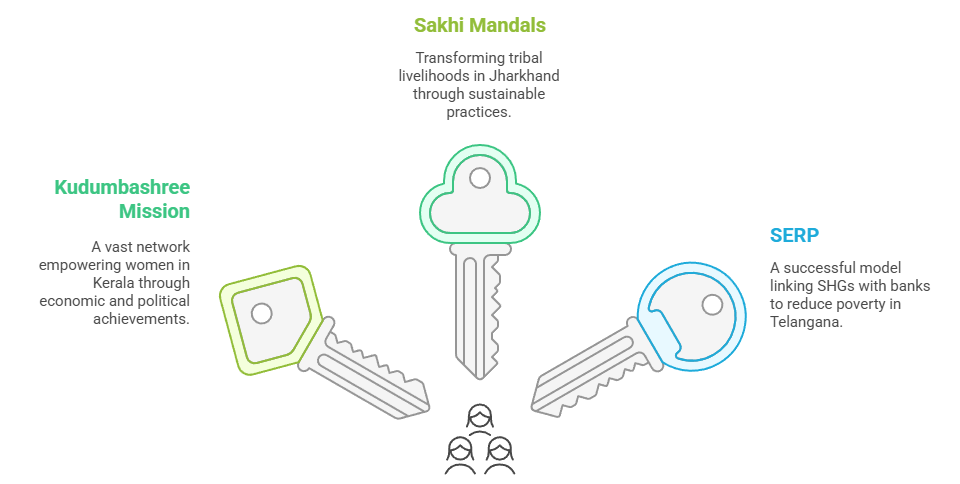
Kudumbashree Mission, Kerala: One of the world’s largest women-empowering SHG movements; operates across urban and rural areas with economic and political achievements.
Jharkhand’s Sakhi Mandals: These women-led SHGs have transformed tribal livelihoods through goat rearing, lac production, and seed banks.
Telangana’s SERP (Society for Elimination of Rural Poverty): Demonstrated large-scale SHG-bank linkage model with significant reduction in poverty and empowerment metrics.
Challenges Faced by SHGs
Inadequate training and capacity building.
Over-reliance on external facilitation by NGOs/government officials.
Issues of group dynamics, elite capture, and intra-group conflict.
Inconsistent credit flow and limited access to market linkages.
Weak formal recognition of SHG-led care work and unpaid labor.
Government Schemes Supporting SHGs
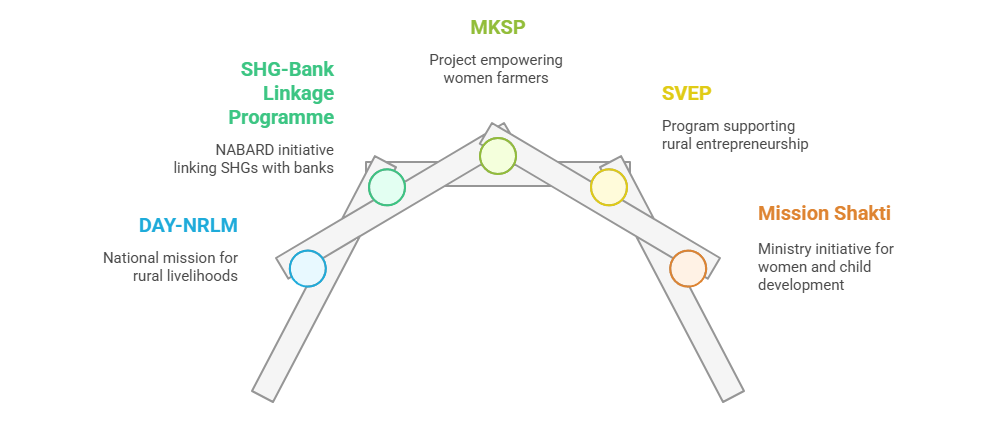
DAY-NRLM (Deendayal Antyodaya Yojana – National Rural Livelihoods Mission)
SHG-Bank Linkage Programme (NABARD)
Mahila Kisan Sashaktikaran Pariyojana (MKSP)
Startup Village Entrepreneurship Programme (SVEP)
Mission Shakti (Ministry of Women and Child Development)
Current Affairs
Budget 2024–25 emphasized enhancing SHG involvement in One District One Product (ODOP) and PM Vishwakarma Yojana.
Digital SHG training initiatives under DAY-NRLM.
SHGs being integrated into supply chains of e-commerce platforms like ONDC.
SHGs as delivery agents in health and nutrition schemes like POSHAN Abhiyan and Janani Suraksha Yojana.
Conclusion: Toward Inclusive and Participatory Development
Self-Help Groups represent a microcosm of bottom-up development, where empowerment is not a policy prescription but a collective experience. For UPSC aspirants, SHGs offer a unique entry point to understand how social structure, gender, economy, and state intersect in contemporary India.
As India moves toward becoming a $5 trillion economy, SHGs remain crucial in ensuring that development is not only fast but fair, inclusive, and people-centered.
PYQs
Paper II
Discuss the role of Self-Help Groups in rural development and women empowerment in India.(2020)
How do grassroots democratic institutions like SHGs transform power relations in rural society?(2017)
Examine the link between development-induced social change and emergence of new rural movements like SHGs. (2015)