


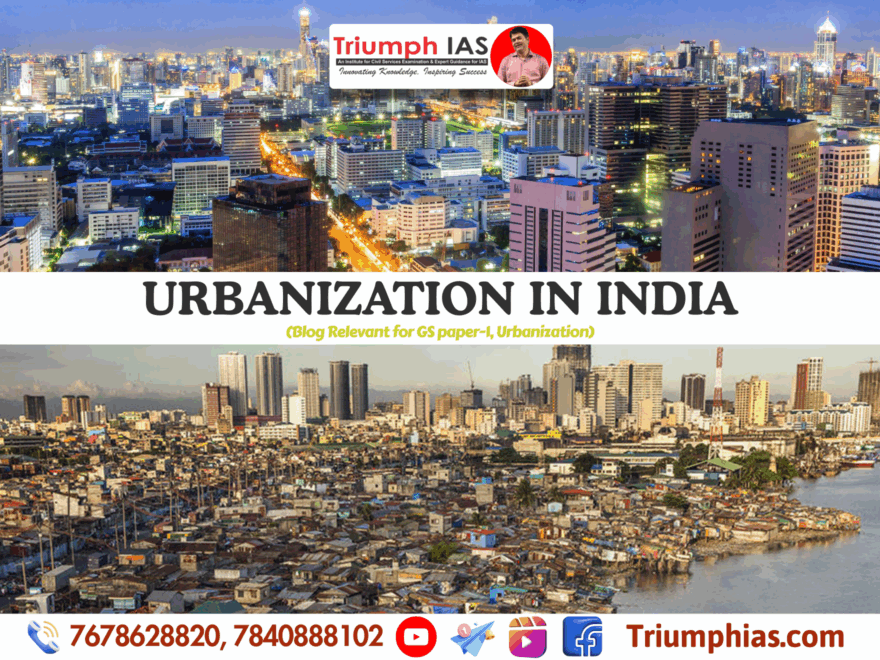
Urbanization in India: Challenges and Opportunities
(Relevant for GS paper-1, Urbanization)

|
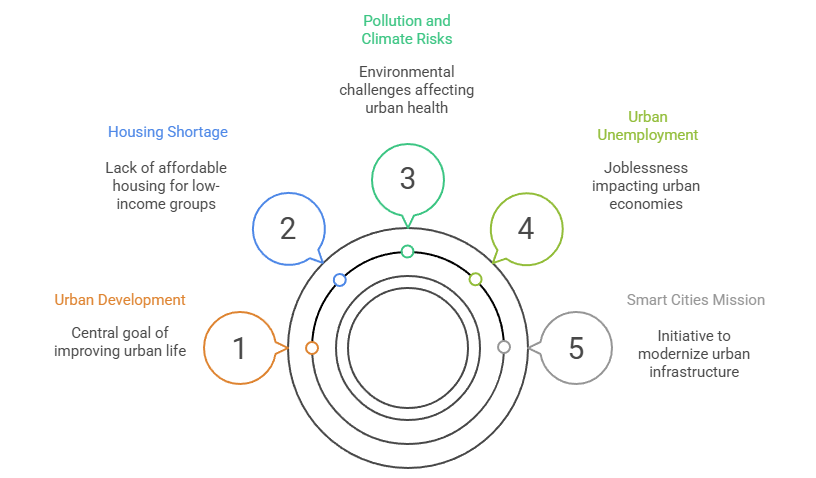
Urbanization is a defining trend of the 21st century, particularly in India, which is experiencing one of the fastest urban expansions in the world. According to the United Nations World Urbanization Prospects 2024, nearly 35.4% of India’s population resides in urban areas, a figure expected to rise to 43.2% by 2035. This growth has far-reaching implications for economic development, infrastructure, social services, and environmental sustainability. As India envisions becoming a $5 trillion economy, planned and inclusive urbanization becomes not only desirable but essential. Understanding Urbanization in IndiaUrbanization refers to the increasing population concentration in cities and towns. In India, this phenomenon has been shaped by both natural population growth in cities and rural-to-urban migration, driven by employment, education, and better living standards. The number of urban agglomerations in India has increased from 384 in 2001 to over 500 in 2021. Mega-cities like Delhi, Mumbai, Bengaluru, and Hyderabad are already facing immense pressure on housing, transport, water, and sanitation systems. Recent Trends and Data (As of 2025)
Government Initiatives for Urban Development
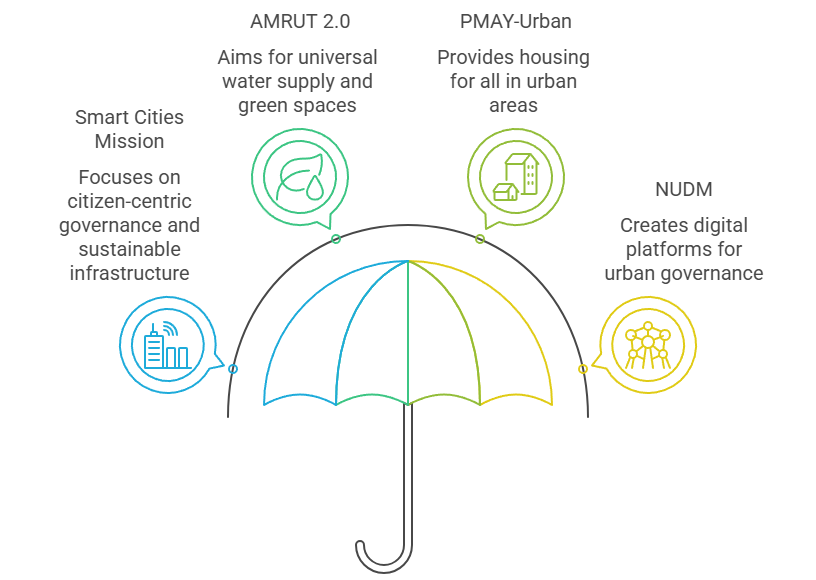
Launched in 2015, the mission aims to promote citizen-centric governance, efficient public services, and sustainable infrastructure in 100 selected cities. It encourages the use of technology for improving urban management.
Extended till 2026, AMRUT 2.0 focuses on universal water supply, sewerage management, and green spaces. The target is to make all cities “water secure”.
This aims to provide “Housing for All” in urban areas by 2025. As of this year, over 1.2 crore houses have been sanctioned, with around 75 lakh already completed.
NUDM is creating digital platforms for better urban governance, helping cities deliver real-time and data-driven services. Opportunities from Urbanization
Urban areas contribute to over 60% of India’s GDP, and this is expected to rise with greater urban productivity and consumption. Cities act as hubs for industries, services, and innovation.
Urbanization opens doors to better education, healthcare, employment, and connectivity—particularly for women and youth.
Startup ecosystems in Bengaluru, Pune, and Hyderabad demonstrate how cities catalyze entrepreneurship and technological advancements, attracting global investment. Challenges of Rapid Urbanization
Many Indian cities face crumbling infrastructure, with congested roads, poor public transport, water scarcity, and inadequate waste management.
More than 25% of urban Indians live in slums or informal settlements, lacking basic amenities like clean water, toilets, and electricity.
Urban areas contribute significantly to air pollution, solid waste, and urban heat islands. Cities like Delhi frequently exceed safe air quality limits set by the WHO.
Urban sprawl has led to the loss of agricultural land, encroachment on wetlands, and poor land-use patterns, resulting in urban flooding (e.g., Chennai 2023, Bengaluru 2022).
Urbanization often excludes marginalized groups, particularly migrant workers, in terms of housing, healthcare, and social welfare. Sustainable Urbanization: The Way Forward
Master plans must integrate land use, mobility, infrastructure, and climate resilience. Tools like Geospatial Information Systems (GIS) should be leveraged.
Promoting public transport (metros, BRTS) and non-motorized transport (walking, cycling) will reduce congestion and emissions.
Enhancing the Affordable Rental Housing Complexes (ARHC) scheme and public-private partnerships can address the housing shortage.
Developing green belts, parks, wetlands, and urban forests is critical to improve liveability and fight climate change.
Empowering urban local bodies (ULBs) with financial autonomy and skilled manpower will ensure better service delivery. Urban mobility councils and citizen participation must be institutionalized. ConclusionUrbanization in India presents a dual narrative—of immense opportunities for economic transformation, but also of social and environmental challenges. If managed wisely, it can be a catalyst for achieving Sustainable Development Goals (SDGs), especially SDG-11 (Sustainable Cities and Communities). As India prepares to add over 400 million urban residents by 2050, the need for resilient, inclusive, and sustainable cities has never been greater. The future of India lies not just in its villages, but increasingly in the cities it builds today. |





To Read more topics, visit: www.triumphias.com/blogs
One comment