Hate crimes in India are acts of violence or hostility directed at individuals or communities because of their identity — such as religion, caste, ethnicity, gender, or sexual orientation. In the Indian context, the increasing incidence of hate crimes, especially along communal, caste, and gender lines, poses a grave threat to the constitutional promise of equality and secularism. These crimes are not just legal offenses; they reflect deep-rooted social prejudices and cultural anxieties. Hate crimes are not isolated acts but systemic manifestations of structural inequalities, cultural stigmas, and power hierarchies. Understanding them involves delving into social stratification, identity politics, and collective behavior—themes central to the sociology.
Defining Hate Crimes
According to the U.S. Department of Justice, a hate crime in India is “a criminal offense against a person or property motivated in whole or in part by an offender’s bias.” In India, while the term “hate crime” lacks an explicit legal definition, many acts fall under it, such as:
Mob lynching based on religious identity
Caste-based violence
Targeted attacks on Dalits and minorities
Gender and sexuality-based assaults
Types of Hate Crimes in India
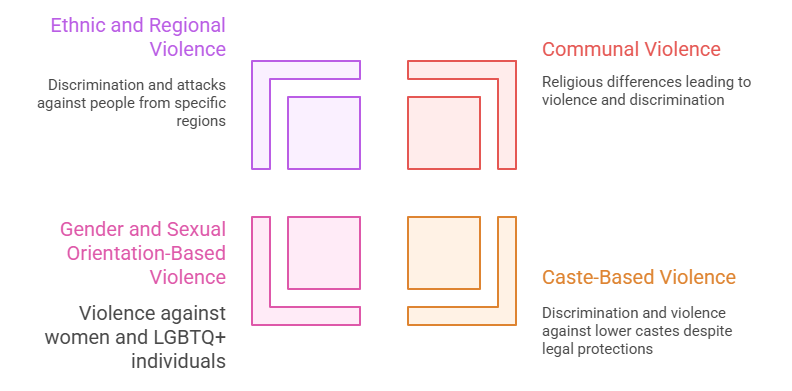
Communal Hate Crimes
Communal violence—such as the 2020 Delhi riots, Muzaffarnagar riots, and attacks on Muslims over beef consumption—illustrates how religion becomes a basis for hate.
Caste-Based Hate Crimes
Despite constitutional safeguards, Dalits continue to face violence—especially when asserting rights. The Una flogging incident (2016) and Khairlanji massacre (2006) are chilling examples.
Gender and Sexual Orientation-Based Hate
Violence against women, acid attacks, and crimes against the LGBTQ+ community also fall under hate crimes. The Nirbhaya case (2012) sparked national outrage on gender-based violence.
Ethnic and Regional Hate
People from the North-East and migrants from Bihar or Uttar Pradesh often face discrimination, slurs, and attacks in metros like Delhi and Mumbai.
Recent Trends and Data
According to reports by National Crime Records Bureau (NCRB) and independent human rights organizations:
India has seen a rise in hate speech and mob lynching incidents in the last decade.
Cow-related violence, primarily targeting Muslims and Dalits, surged post-2015.
Online hate crimes, including trolling and doxing, have grown due to digital anonymity.
Sociological Analysis
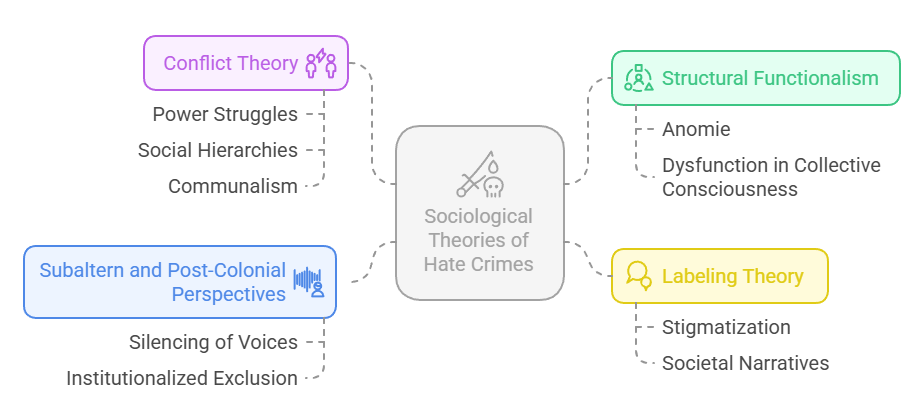
Structural Functionalism: From Durkheim’s point of view, crime, including hate crime, is a reflection of anomie—a breakdown of social norms during periods of transition or crisis. Hate crimes reflect a dysfunction in collective consciousness, wherein people define “the other” as a threat to societal order.
Conflict Theory: Karl Marx would interpret hate crimes as an outcome of power struggles between dominant and subordinate groups. Hate crimes reinforce social hierarchies—such as upper caste vs. Dalit, majority vs. minority—by using violence as a tool for social control. A.R. Desai’s analysis of communalism as a byproduct of the class conflict under capitalism can also be used to understand how elites often manufacture communal tensions to divert attention from real economic issues.
Labeling Theory: Howard Becker’s labeling theory explains how individuals or communities become stigmatized based on dominant societal narratives. For example, portraying Muslims as “anti-national” or Dalits as “criminals” leads to the internalization and justification of violence against them.
Subaltern and Post-Colonial Perspectives: Subaltern thinkers like Gayatri Spivak emphasize that hate crimes stem from the silencing of marginalized voices in history, media, and state policy. The “othering” of communities becomes an institutionalized form of exclusion and violence.
Causes of Hate Crimes in India
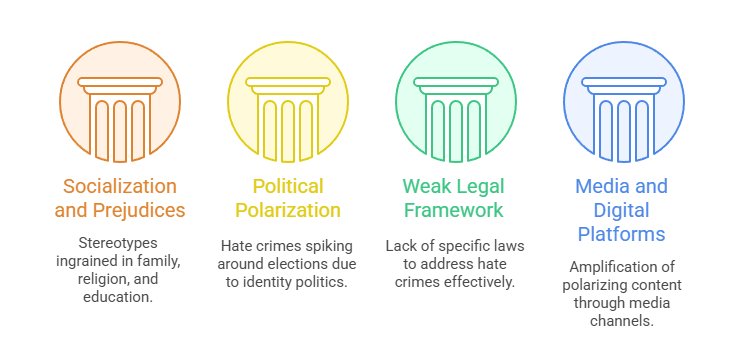
Socialization and Prejudices: Stereotypes are deeply embedded in family, religion, and education. Children grow up internalizing biases against certain communities or castes.
Political Polarization: Hate crimes often spike around elections due to identity politics, vote bank mobilization, and majoritarian narratives. Leaders sometimes use hate speech to consolidate their base.
Weak Legal Framework: India lacks a specific law to address hate crimes. Most cases are registered under Indian Penal Code (IPC) sections for assault, murder, or riots, without acknowledging the bias motivation.
Media and Digital Platforms: Mainstream and social media platforms often amplify polarizing content. Algorithms that thrive on engagement inadvertently promote hate-driven content.
Consequences of Hate Crimes
Psychological trauma for victims and entire communities
Increased polarization in society
Undermining of constitutional values like secularism and fraternity
Erosion of public trust in law enforcement and judiciary
International condemnation impacting India’s democratic image
Measures to Prevent Hate Crimes
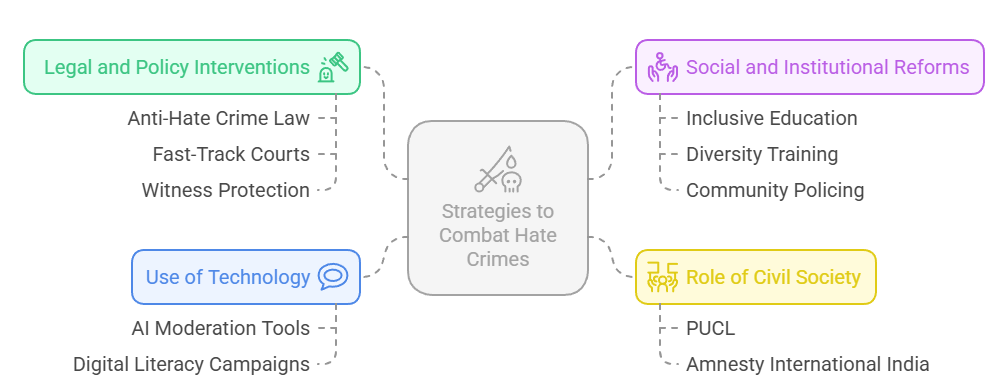
Legal and Policy Interventions
Enacting a comprehensive Anti-Hate Crime Law
Fast-track courts for hate crimes
Strengthening witness protection mechanisms
Social and Institutional Reforms
Incorporating inclusive education in schools and colleges
Diversity training for police and judiciary
Encouraging community policing and interfaith dialogues
Role of Civil Society
NGOs like PUCL (People’s Union for Civil Liberties) and Amnesty International India play a key role in documentation, awareness, and advocacy.
Use of Technology
AI-driven moderation tools to flag hate speech
Digital literacy campaigns to counter fake news and online radicalization
Hate Crimes and the Indian Constitution
The Preamble of the Constitution envisions justice, liberty, equality, and fraternity. Hate crimes strike at the very core of these ideals.
Article 14 – Equality before law
Article 15 – Prohibition of discrimination
Article 19(1)(a) – Freedom of speech (with reasonable restrictions)
Article 21 – Protection of life and liberty
Courts have reiterated in cases like Tehseen Poonawalla v. Union of India (2018) that mob lynching is a threat to the rule of law and called for strict guidelines.
Case Studies
Jharkhand Lynching Case (2019) – Tabrez Ansari’s mob lynching and forced chant of “Jai Shri Ram.”
Khairlanji Massacre (2006) – Brutal caste-based hate crime against a Dalit family.
Northeast Students in Delhi – Repeated cases of racial discrimination and hate violence.
Delhi Riots (2020) – Religious violence claiming over 50 lives, showing state inaction.
Conclusion
Hate crimes are not merely about individual prejudice; they are the collective failures of society, institutions, and politics. To counter hate, we need both structural reform and cultural transformation. From a sociological standpoint, understanding hate crimes through social stratification, identity politics, and symbolic violence provides a comprehensive framework.
As aspirants and citizens, it is crucial to uphold constitutional morality, resist collective silence, and promote inclusive development where no identity becomes a reason for fear or violence.
PYQs
Paper 1
Discuss the concept of violence in society. How can sociological theories help in understanding different forms of violence?– (2019)
Examine the role of caste and communal identities in the perpetuation of social conflicts in India.– (2021)
How do power and authority contribute to structural violence in society? Illustrate with suitable examples.– (2020)
Discuss the relevance of conflict theory in explaining contemporary social tensions in India.– (2022)
What is social exclusion? Discuss how social exclusion leads to marginalization and violence.– (2015)
Examine the contribution of subaltern studies in understanding the history and voice of the oppressed.– (2018)
Paper 2:
Discuss the impact of communalism on Indian society.– (2014)
Critically examine the role of caste in incidents of mob violence and lynching in recent times.– (2022)
What do you understand by the term ‘collective conscience’? Discuss its erosion in the context of communal hate crimes.– (2020)
Discuss the role of civil society in resisting hate crimes and promoting social harmony. – (2016)