


Uniform Civil Code and the Future of Individual Freedom
(Relevant for Sociology Paper I: Politics and Society; Systems of Kinship and Sociology Paper II: Politics and Society; Systems of Kinship in India)

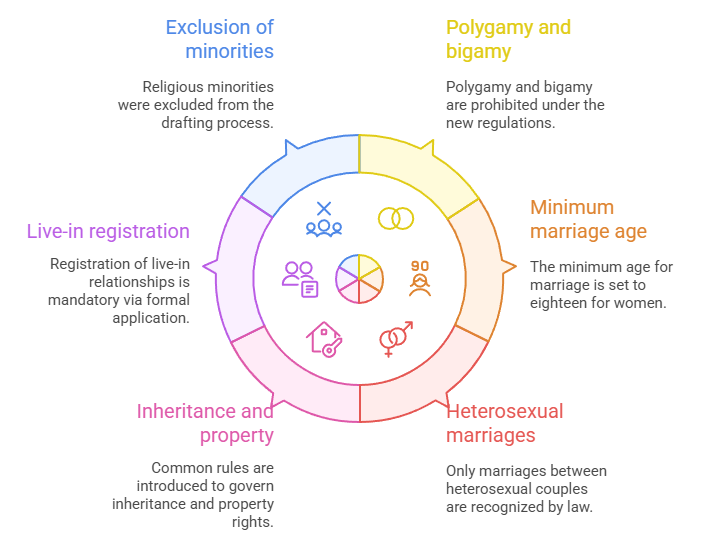
Introduction:The recent enactment of the Uniform Civil Code (UCC) in Uttarakhand (2024) has reignited national debates on civil liberties, gender equality, and the constitutional promise of secularism. While framed as a progressive step toward uniformity in personal laws, critics argue that it enforces paternalistic moral values, especially by policing live-in relationships, reinforcing heteronormativity, and eroding individual autonomy. This development is not just a legal reform but a sociological phenomenon, embedded in ideological assertions of the state, changing family structures, and contestations over individual rights. What is the Uniform Civil Code (UCC)?The UCC proposes to replace religion-specific personal laws governing marriage, divorce, inheritance, and adoption with a common set of civil laws applicable to all citizens, irrespective of religion, caste, or gender. Article 44 of the Indian Constitution mentions the directive principle of enacting such a code to promote national integration and gender justice. Uttarakhand UCC Highlights (2024):
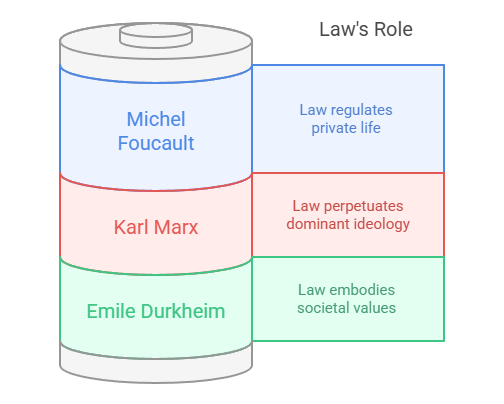
Sociological Analysis
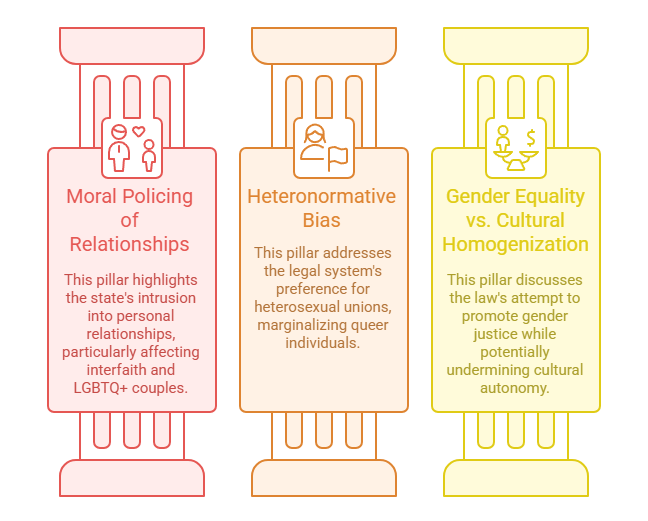
Key Issues:
The law requires couples in live-in relationships to register with the state, implicitly criminalizing non-traditional unions. This disproportionately impacts:
It criminalizes privacy and restricts the right to love, which Article 21 of the Indian Constitution guarantees as part of personal liberty.
By recognizing only heterosexual marriages, the law reinforces heteronormativity, marginalizing queer individuals. This contradicts the Supreme Court’s 2018 judgment decriminalizing homosexuality (Navtej Singh Johar vs Union of India), and recent debates on same-sex marriage rights.
While the law claims to promote gender justice by outlawing polygamy and ensuring equal inheritance, it paradoxically:
This contradiction has been flagged by intersectional feminist theorists, who argue that real gender justice lies in empowering women within their own communities, not imposing a majoritarian patriarchal ideal. The UCC and Hindutva Politics:The push for UCC has long been part of the RSS-BJP ideological framework, viewing uniformity in personal laws as a marker of national integration. However, this version of integration is rooted in:
The absence of Muslim, Christian, Sikh, and tribal voices in the Uttarakhand committee highlights its top-down, exclusionary nature. Rather than being a consensus-driven reform, it becomes a cultural imposition cloaked in legal rationality. UCC in Goa and Global ModelsWhile Goa is often hailed as having a UCC, its code allows different rules for different communities, including:
Globally, most secular democracies like France and the USA do not police consensual relationships or mandate uniformity in personal practices as aggressively as the Uttarakhand UCC. Implications for the Future of Individual FreedomThe Uttarakhand UCC may set a precedent for other BJP-ruled states, with Madhya Pradesh and Gujarat already hinting at similar bills. But the risk is that:
In a country where Article 25 ensures freedom of religion and Article 21 guarantees privacy, the challenge is to balance reform with pluralism, and not sacrifice rights for rigid uniformity. Conclusion:The UCC debate cannot be reduced to a binary of modernity vs tradition or progress vs regression. It must be viewed as a complex sociological issue that involves:
If India truly seeks equality and justice, reforms must emerge from dialogue, representation, and constitutional morality—not from ideological imposition or surveillance. As sociologist Andre Béteille cautioned, “Uniformity is not the same as equality.” In the name of civil code, we must not encode inequality under the garb of uniform regulation. Previous Year QuestionsPaper I
Paper II
|





To Read more topics, visit: www.triumphias.com/blogs
2 comments