


Social Conflict and Social Change
(Relevant for Sociology Paper I: Sociological Thinkers- Talcott Parsons; Social Change in Modern Society and Sociology Paper II: Social Problems)

Introduction:In sociology, the concepts of social conflict and social change are deeply interrelated. Social conflict refers to struggles between groups in society over scarce resources, values, or power. It often emerges from inequality, discrimination, or competing interests. Social change, on the other hand, refers to significant alterations over time in behavior patterns, cultural values, and social institutions. For UPSC aspirants, understanding how social conflict acts as a catalyst for transformation is essential. From caste movements in India to global revolutions, conflict has been a powerful force driving structural change. What is Social Conflict?Social conflict is a form of social interaction wherein individuals or groups oppose each other due to divergent interests or values. Conflict may be:
According to Lewis Coser, conflict is not only inevitable in human society but also functional, as it can strengthen group solidarity, foster adaptation, and lead to reform. What is Social Change?Social change is the transformation of culture, behavior, social institutions, and social structure over time. It can be:
Key agents of social change include technology, economy, law, education, and social movements. Conflict often acts as the trigger or accelerator of change, particularly in stratified or unequal societies. Sociological Analysis
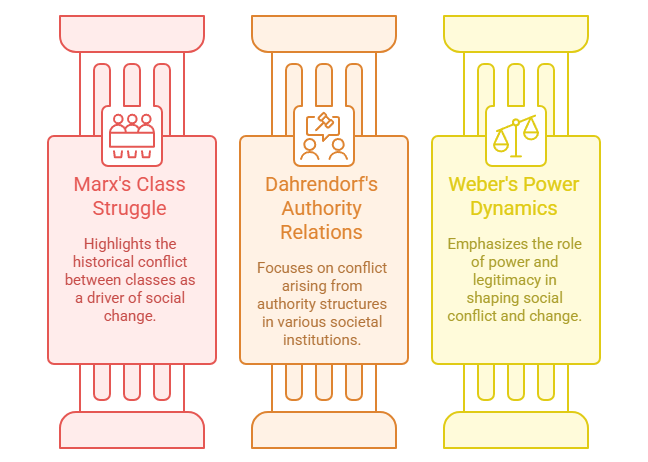
Karl Marx emphasized the role of class struggle as the engine of history. According to Marx, every historical epoch is marked by a fundamental conflict between the ruling and the oppressed class:
Quote: “The history of all hitherto existing society is the history of class struggles.” In this view, conflict is not merely a disturbance but a structural feature of society that leads to a qualitative transformation—social change.
Dahrendorf introduced a neo-conflict theory, arguing that conflict arises not just from class but from authority relations in any structured society (e.g., bureaucracy, religion, family). He believed that institutional conflict could lead to constructive change and better democracy.
Max Weber recognized multiple sources of conflict—not only economic class but also status and party interests. He emphasized power dynamics, showing that modern society experiences conflict over legitimacy, authority, and values, which push social institutions to evolve. Sociological Dimensions of Conflict and Change in India
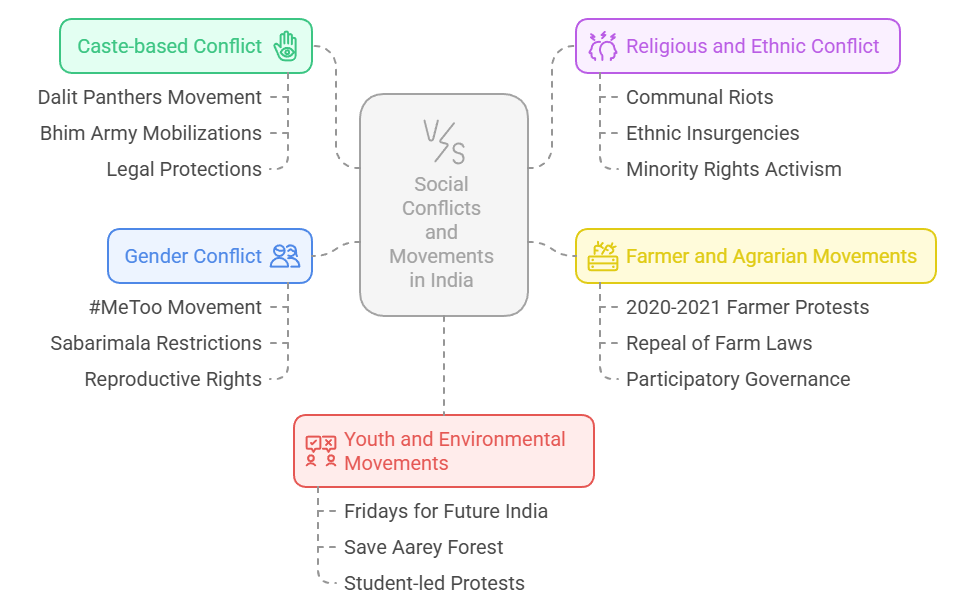
India’s caste system has historically institutionalized inequality. Conflict emerged as a reaction to caste discrimination, leading to:
These movements initiated structural social changes in terms of affirmative action, increased awareness, and legal protections.
From communal riots to ethnic insurgencies (e.g., in Northeast India), conflicts based on identity have shaped national policies, federalism, and law enforcement. While often tragic, such conflicts have led to:
The 2020–2021 Farmer Protests in India represent how economic grievances can fuel mass mobilization and demand policy change. These protests influenced the repeal of farm laws and invigorated debates on MSP, rural distress, and participatory governance.
The #MeToo movement, women’s protests against Sabarimala restrictions, and demand for reproductive rights (e.g., abortion law reforms) showcase how gender conflict is a potent source of social transformation.
Movements like Fridays for Future India, Save Aarey Forest, and student-led protests against NEET exams or unemployment reflect generational conflict that challenges existing power structures and influences public discourse. Social Movements as Agents of ChangeConflict often manifests through social movements, which organize discontent and direct it toward structural reform. Major types include:
Sociologist Alain Touraine emphasized that modern social movements are not just about material gains but also about identity, meaning, and rights. Antithetical ViewsTalcott Parsons (Functionalism): Parsons viewed society as a stable system striving for equilibrium. Conflict, for him, was a sign of dysfunction or disintegration. Conflict Theorists (Marx, Coser, Dahrendorf): They argued that consensus often masks coercion and that conflict is essential for removing inequality, oppression, and outdated norms. Conflict Leading to Progressive and Regressive Change
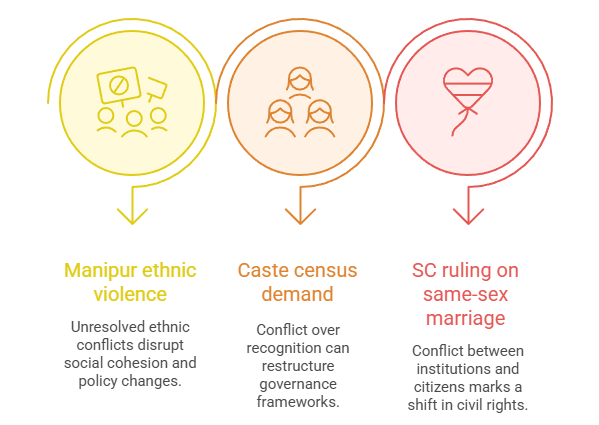
Recent Examples
Conclusion:While often feared, social conflict is a double-edged sword. It can disrupt harmony but also ignite progress. From revolutions to reforms, India’s journey of nation-building has been shaped by negotiating conflicts—through laws, protests, and participation. For a just society, conflict must be channeled into constructive dialogue and inclusive policymaking. As Emile Durkheim once noted, “Conflict is a pathological form of the normal process of evolution.“ Previous Year QuestionsPaper 1
Paper 2
|





To Read more topics, visit: www.triumphias.com/blogs
One comment