India is not a monolithic agrarian society — it is a geographically and socially diverse nation where the rural landscape reflects multiple patterns of class, caste, and land relations. The agrarian class structure shaped by historical legacies, caste hierarchies, ecological conditions, and state policies, exhibits sharp regional diversity.
What is Agrarian Class?
In sociology, agrarian class refers to the stratification in rural society based on:
Ownership and control of land
Access to agricultural capital (irrigation, tools, credit)
Relationship with labor (self-employed, wage labor, sharecropping)
Status and power in the rural economy
Scholars like Karl Marx emphasized class conflict between landlords and laborers, while Weber focused on status and prestige derived from caste and land ownership. Indian sociologists like A.R. Desai, M.N. Srinivas, and G. Parthasarathy have contributed immensely to understanding India’s rural class complexity.
Why Regional Diversity Matters in Agrarian Class?
India’s vast geographical spread brings varying climatic zones, soil fertility, rainfall patterns, access to markets, and colonial histories, which have produced region-specific agricultural systems and class relations.
A Jat landlord in Punjab, a Patidar capitalist farmer in Gujarat, a landless Dalit worker in Bihar, and a tribal cultivator in Jharkhand all belong to distinct agrarian worlds despite being under the same national agricultural policy.
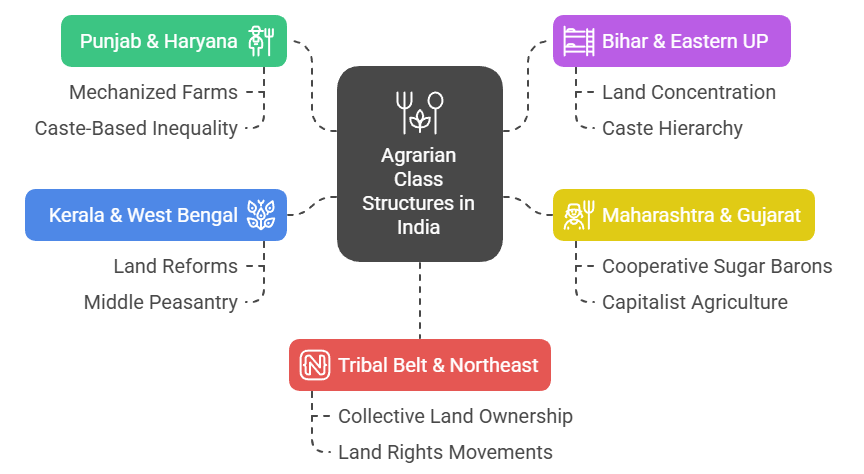
Post-Green Revolution areas with mechanized, surplus-producing farms.
Dominated by Jat Sikh and Jat Hindu landowners.
Small and marginal farmers exist but are often tenant farmers or contract laborers.
Dalits (mostly landless) form a large agrarian proletariat, often facing social exclusion.
The region reflects capitalist agrarian relations, with class inequality aligned along caste lines, leading to mass mobilization like the 2020–21 farmers’ protest.
Bihar and Eastern UP: Semi-Feudal Landlordism
Land concentration among upper castes (Bhumihars, Rajputs, Kayasths).
Presence of sharecropping and bonded labor, particularly among Dalits and backward castes.
Weak state capacity and failed land reforms have preserved feudal remnants.
Increasing out-migration due to agrarian distress.
This region showcases semi-feudal agrarian class structures, where class oppression is deeply interwoven with caste hierarchy, often resulting in violent conflicts and Naxalite mobilization.
Maharashtra and Gujarat: Agrarian Capitalism with Inequality
Western Maharashtra: Maratha landlords turned cooperative sugar barons.
Gujarat: Patidar farmers dominate capitalist agriculture, especially in cash crops.
Coexistence of rich entrepreneurial farmers with marginalized Adivasi and Dalit laborers.
These states reflect agro-industrial linkages, where rural elites wield political and economic power, but rural inequality remains entrenched due to class-based exclusion.
Kerala and West Bengal: Success and Limitations of Land Reforms
Kerala implemented radical land reforms, reducing landlordism and empowering tenants.
West Bengal launched “Operation Barga” to recognize sharecroppers’ rights.
Emergence of a strong middle peasantry; better health, education, and social indicators.
However, agrarian stagnation and rural-to-urban migration have grown.
These regions show how pro-poor agrarian reform, coupled with leftist mobilization, can weaken class domination — though not eliminate caste and gender-based exclusion.
Tribal Belt and Northeast: Dispossession and Alienation
Tribal communities often follow collective land ownership and subsistence agriculture.
Faced with displacement due to mining, forestry, and mega-projects.
State and private capital often appropriate land, leading to class formation through dispossession.
In tribal and forest regions, agrarian class struggle takes the form of land rights movements, forest rights battles, and resistance against state-corporate nexus.
Caste and Class Interplay in Rural India
In many regions, caste is the axis of class – dominant castes are landowners; Dalits are laborers.
The Dominant Caste Theory (N. Srinivas) helps explain why certain castes emerge as agrarian elites.
Agrarian class formation cannot be separated from ritual status, social capital, and historical privileges.
E.g.,Marathas in Maharashtra, Vellalars in Tamil Nadu, Reddys in Andhra Pradesh, and Jats in Haryana dominate land and politics.
New Trends in Agrarian Class Structure
Feminization of Agriculture: Due to male migration, women increasingly manage farms but lack land titles or policy support.
Contract Farming and Agribusiness: Corporate contracts shape class dynamics — marginal farmers are vulnerable to exploitation.
Disguised Unemployment & Rural Distress: Decline of agricultural profitability pushes youth towards gig jobs, informal urban labor.
Caste Assertion Movements: Dalit and OBC farmers forming unions and cooperatives, challenging traditional elites.
Sociological Analysis
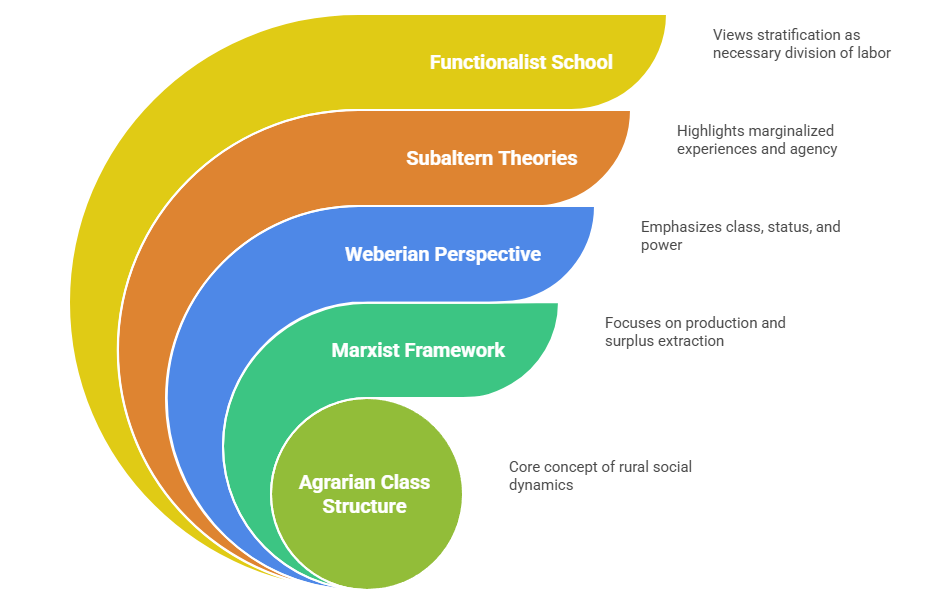
The Marxist framework views agrarian class structures as rooted in the mode of production and the relations of surplus extraction. A.R. Desai highlighted how the introduction of capitalist agriculture, especially after the Green Revolution, deepened class polarization in rural India. Rich peasants and landlords accumulated profits while landless laborers and small farmers faced marginalization, intensifying class conflict.
Max Weber offered a multidimensional view of social stratification, where class, status, and power are distinct but interrelated. In the Indian context, agrarian inequality is not just economic but also status-based, shaped by caste. This framework helps explain how land ownership is accompanied by ritual superiority and social prestige, making class mobility difficult even for economically upward-moving lower castes.
Subaltern theorists emphasize the experiences and agency of those excluded from dominant narratives — particularly Dalits, Adivasis, and rural women. In the context of agrarian class, this approach critiques mainstream economic models for overlooking structural violence and the voices of the oppressed. It brings attention to the invisibility and exploitation of marginalized communities in rural class discourse.
The functionalist school, particularly Parsons, tends to see agrarian stratification as a necessary part of the rural social system that ensures the division of labor. However, this perspective has been widely criticized for legitimizing social hierarchies and ignoring the realities of exploitation, coercion, and inequality in land distribution and labor relations, especially among lower castes and landless workers.
Why It Matters Today
Farm Bills Debate: Sparked national conversation on agrarian capitalism vs. peasant rights.
MSP and Procurement Politics: Regional disparity in procurement benefits reveals class privilege.
Landlessness and Farmer Suicides: Maharashtra, MP, and Telangana see high suicide rates among marginal cultivators.
Digital Divide: Agritech and digital platforms benefit large farmers but exclude non-literate small holders.
Way Forward
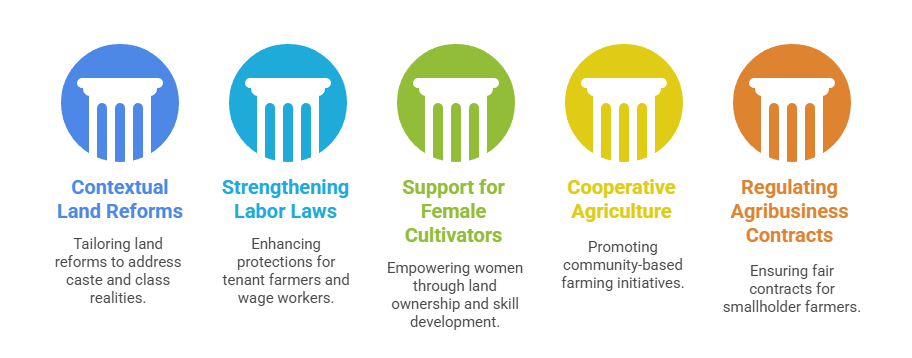
Contextual Land Reforms tailored to caste-class realities.
Strengthening rural labor laws for tenant farmers and wage workers.
Support for female cultivators through land ownership and skill training.
Promotion of cooperative and community-based agriculture.
Regulation of agribusiness contracts to protect smallholders.
Conclusion
India’s agrarian class structure is a mirror of its regional, cultural, and caste diversities. It is a powerful reminder that rural India cannot be understood through a single lens. UPSC aspirants must approach the topic with multi-theoretical, regionally grounded, and critically reflective perspectives to address contemporary challenges of agrarian inequality, class conflict, and policy design.
Previous Year Questions
Paper I
Examine the interface between tradition and modernity in changing rural class structure. (2021)
Explain how caste and class combine to shape the agrarian structure in India. (2020)
Discuss the Marxist approach to understanding social classes in agrarian society. (2019)
Examine the applicability of Marxian theory to the agrarian social structure in India. (2017)
How do land reforms influence patterns of social stratification in rural areas? (2016)
Paper II
Examine the role of women in agrarian economy and the emerging trends of feminization of agriculture. (2023)
Examine the relationship between regional development and agrarian unrest in India. (2022)
Critically examine the impact of land reforms on agrarian class structure in post-independence India. (2021)
Analyze how commercialization of agriculture has affected class formation in rural India. (2020)
Discuss the role of caste and class in the agrarian structure of India. (2019)
Explain how economic and technological changes have transformed the agrarian structure in India. (2018)
Evaluate the role of dominant caste in agrarian economy with suitable examples. (2016)
Examine the agrarian class structure in rural India and its regional variations. (2015)
What is the significance of peasant movements in the transformation of rural class relations in India? (2014)
Analyze the impact of the Green Revolution on rural class differentiation. (2013)







One comment