The rise of precarious work is one of the most significant transformations in the global labor market in the 21st century. In India, precarious employment has become the norm rather than the exception, especially after economic liberalization and the growth of the digital and gig economies.
Precarious work refers to employment that is uncertain, unstable, and insecure, offering little to no benefits, social protection, or job security. This phenomenon holds deep sociological relevance, intersecting with themes of class, caste, gender, globalization, and social justice.
Defining Precarious Work
Precarious work includes jobs that are:
Temporary or contract-based
Part-time or on-call
Lacking union representation
Paid on a task basis without social security
Insecure and non-standard (g., gig work, platform work)
It spans across sectors — from construction, domestic work, and agriculture to food delivery, app-based transportation, and teaching.
Forms of Precarious Work in India
Gig and Platform Work
Swiggy, Zomato, Uber, Ola, Urban Company
Workers paid per task; no fixed wages or employment benefits
Contract and Casual Labor
Used widely in manufacturing, infrastructure, sanitation, and retail
Employed through middlemen; vulnerable to wage theft and arbitrary dismissal
Home-Based and Piece-Rate Work
Common in textile, handicrafts, packaging sectors
Largely invisible; mostly performed by women
Self-Employment and Informal Vending
Lacks protection under labor laws; affected by urban eviction drives and policy neglect
Key Features of Precarious Work
Low job security
Irregular income and long working hours
Lack of social security (PF, ESI, gratuity)
No formal grievance redressal mechanisms
Power asymmetry between employer and worker
Invisibility in labor statistics
Sociological Analysis
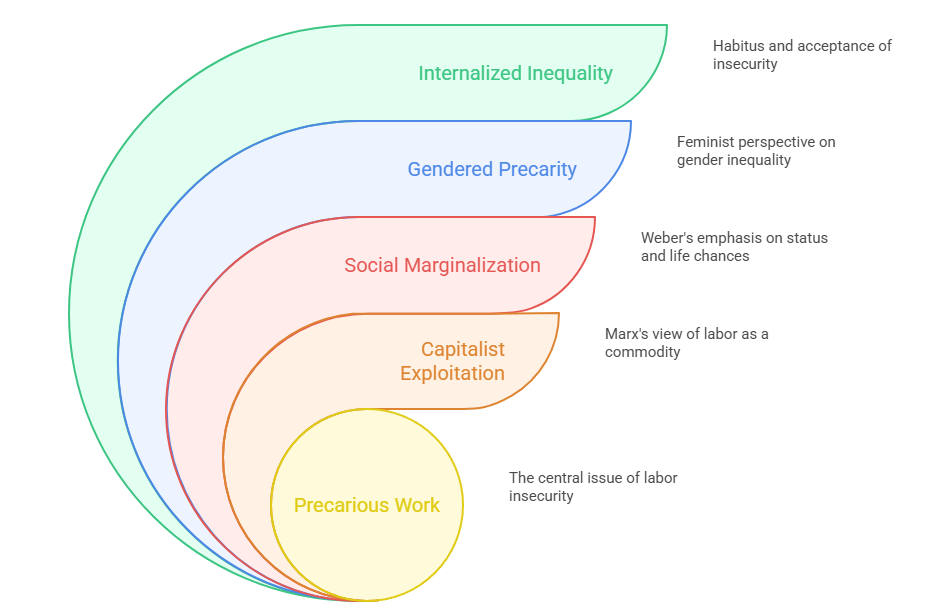
Marx viewed labor as a commodity under capitalism. Precarious work is a reflection of capitalist exploitation, where surplus value is extracted from labor without offering protection or dignity. Gig workers today resemble Marx’s “reserve army of labor,” disposable and replaceable.
Max Weber emphasized status and life chances. Precarious workers have low social status and poor mobility. Their economic insecurity translates into social marginalization and limited access to healthcare, housing, and education.
Precarious labor disproportionately affects women, who dominate unpaid care work and are overrepresented in low-paid, insecure sectors (e.g., domestic work, home-based work). Feminist scholars argue that precarity is gendered and invisible, normalized through patriarchal structures.
Precarious workers internalize inequality and lack confidence in asserting rights. Their habitus – shaped by years of subordination – often makes them accept insecurity as natural. Employers exert symbolic violence by branding precarious work as “flexible” or “entrepreneurial.”
Precarity in Post-COVID India
COVID-19 lockdown exposed the vulnerabilities of precarious workers — particularly migrant laborers, gig workers, and domestic help.
Platform workers protested across India for better pay, insurance, and grievance redressal.
The rise of AI and automation threatens to further precarize mid-skilled jobs.
India has over 90% workforce in informal/precarious employment (as per PLFS 2023).
Legal and Policy Frameworks
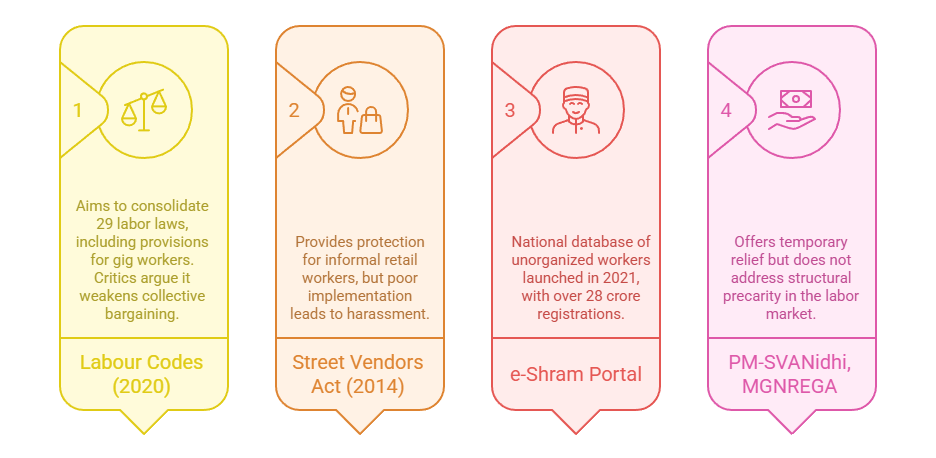
Labour Codes (2020)
Aim to consolidate 29 labor laws.
Include provisions for gig and platform workers under Social Security Code.
However, critics argue the laws weaken collective bargaining and widen employer discretion.
Street Vendors Act (2014)
Provides protection for informal retail workers.
Poor implementation has led to ongoing harassment and evictions.
e-Shram Portal
National database of unorganized workers launched in 2021.
As of 2023, over 28 crore registrations, but benefits delivery remains inconsistent.
Schemes like PM-SVANidhi, MGNREGA
Offer temporary relief but do not address structural precarity.
Precarious Work and Inequality: Caste, Class, and Gender Dimensions
Dalits and Adivasis are concentrated in the most hazardous and low-paying precarious jobs, such as manual scavenging, waste collection, and construction.
Women in precarity face dual exploitation — economic and social. E.g., female domestic workers are underpaid and often face sexual harassment.
Youth and migrants are overrepresented in gig jobs due to lack of alternatives.
Case Study:
A Zomato delivery worker earns around ₹20 per delivery, with no fuel allowance or insurance.
Many work 12–14 hours/day, without weekends or legal leave.
Strikes in Bengaluru and Delhi (2022–23) highlighted demands for minimum wage, accident cover, and fair algorithms.
Gig work has reshaped precarity by digitally mediating exploitation and obscuring the employer-employee relationship.
Global Context:
Even developed economies face rising precarious employment.
ILO’s “World Employment and Social Outlook” warns that non-standard employment is growing faster than formal jobs worldwide.
In countries like the US, UK, and Germany, debates over “zero-hour contracts” and Uberization of labor echo the concerns in India.
Is Precarious Work Always Negative?
While often exploitative, some view precarious work as a bridge to employment or supplementary income. For students, homemakers, or part-time workers, it may offer flexibility. However, when precarity becomes permanent, it traps individuals in cycles of poverty and insecurity.
Way Forward
Universal Social Security for all workers, regardless of employment type
Legally recognizing gig and platform workers as employees, not partners
Skill-building and digital literacy for precarious workers
Encouraging worker cooperatives and unions in the informal sector
Ensuring gender-sensitive labor policies to protect women in precarious work
Periodic labour market audits and wage floor mechanisms
Conclusion
Precarious work is not a side effect but a systemic feature of contemporary capitalism, especially in post-liberalization India. It undermines workers’ rights, dignity, and long-term economic security. A sociological understanding of precarity demands attention to structural inequalities, power dynamics, and state policy failures. As India enters a phase of digital and demographic transformation, ensuring decent work for all must become a top priority.
For UPSC aspirants, understanding precarious work from a theoretical, empirical, and current affairs perspective is crucial for scoring well in optional papers, essays, and general studies.
PYQs
Paper I
“Critically evaluate the gig economy from a sociological perspective.” (2023)
Paper II
“Explain the role of labor laws in addressing precarity in the informal sector.” (2021)
“Discuss the nature of informal labor in India and its implications for development.” (2020)
“Examine the impact of globalization on employment patterns in India.” (2018)
“What are the sociological implications of economic liberalization on working-class structure?” (2016)







One comment