Career mobility refers to the ability of an individual to move within or across occupations, either vertically (e.g., promotion) or horizontally (e.g., change of field). It is an essential indicator of social mobility, economic opportunity, and inequality in a society. In India, career mobility is shaped not just by education and skill but also by deeply embedded social structures like caste, class, gender, and region.
What Is Career Mobility?
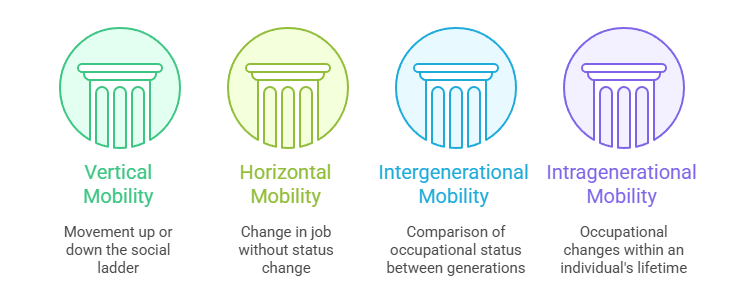
Career mobility is the movement of individuals across different levels or types of jobs during their working lives. It can be:
Vertical Mobility
Upward mobility (e.g., from a clerk to a manager)
Downward mobility (e.g., from an executive to a daily-wage worker)
Horizontal Mobility
Change in job or sector without a shift in status (e.g., teacher to HR trainer)
Intergenerational Mobility
Comparison of occupational status between parents and children.
Intragenerational Mobility
Occupational changes within an individual’s lifetime.
Career mobility reflects both individual agency and the structural factors that either facilitate or hinder movement.
Sociological Analysis
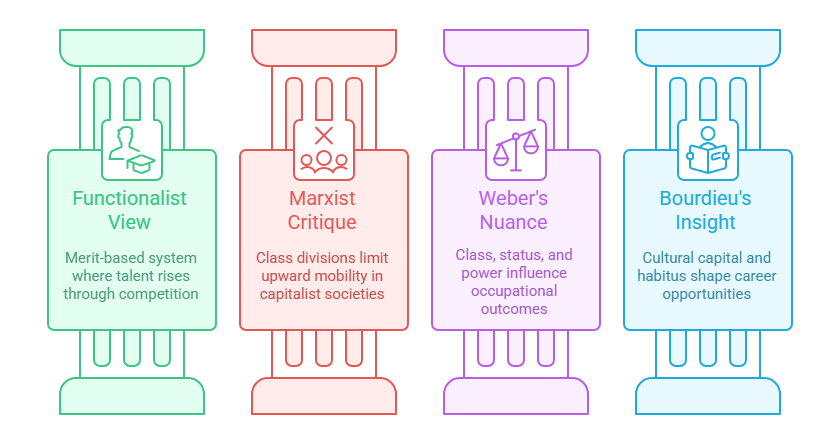
Functionalists argue that career mobility is merit-based, and societies reward individuals who are most capable. The best talent rises to the top through education and competition. However, critics argue that this ignores structural barriers like poverty, discrimination, and unequal access to resources.
Marxists see career mobility as a myth in capitalist societies, where class divisions are rigid, and the ruling class ensures the reproduction of its dominance. Upward mobility is limited and often symbolic (tokenism) rather than structural. It emphasizes economic capital and class ownership as key factors limiting career mobility.
Max Weber introduced a more nuanced understanding by linking class, status, and party to occupational outcomes. Career mobility depends not only on economic resources but also on social networks, prestige, and power. For instance, caste-based status groups may restrict or enable mobility regardless of individual merit.
Pierre Bourdieu’s concepts of cultural capital and habitus explain how individuals from elite backgrounds possess language, mannerisms, and networks that help them navigate competitive career structures. Those lacking such capital face invisible barriers, despite formal equality.
Determinants of Career Mobility in India
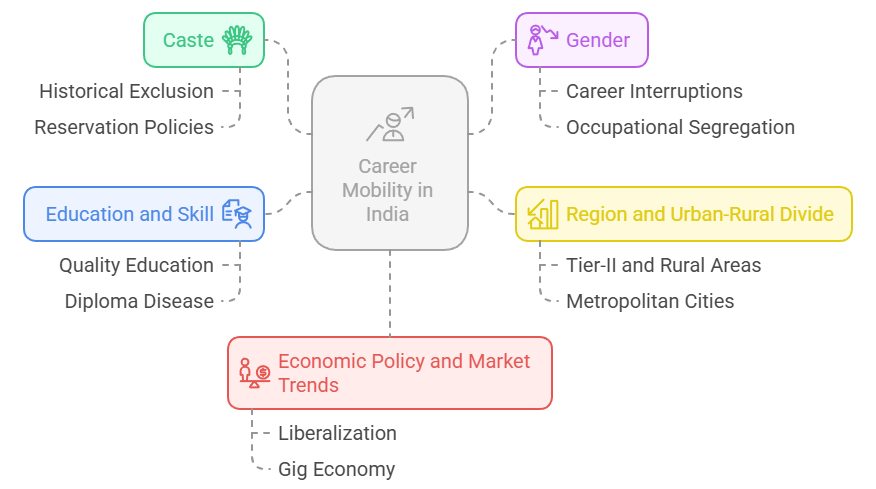
Caste
Lower castes face historical exclusion from skilled occupations.
Reservation policies (SC/ST/OBC) have improved access to education and public jobs, but private sector remains exclusionary.
Dalit upward mobility is still rare without state support.
Gender
Women often experience career interruptions due to marriage, maternity, and caregiving.
Glass ceiling persists in corporate, STEM, and leadership roles.
Women face occupational segregation into lower-paying “feminized” jobs.
Region and Urban-Rural Divide
Youth from Tier-II and rural areas face fewer career mobility opportunities due to poor schooling, limited access to networks, and digital divide.
Metropolitan cities offer greater mobility but come with high competition and discrimination.
Education and Skill
Access to quality education is a key driver.
Yet, the diploma disease (unemployment despite degrees) highlights that credentials alone don’t ensure mobility.
NEP 2020 and Skill India aim to bridge this gap, though outcomes remain mixed.
Economic Policy and Market Trends
Liberalization (1991 onwards) created new job avenues but also informalized labor.
Rise of gig economy and platform labor (g., Swiggy, Ola) offers short-term work but limited long-term upward mobility.
Public sector stagnation has reduced safe mobility routes for the middle and lower-middle classes.
Career Mobility in India
Inequality of Opportunity Report (World Bank, 2022)
Found that India has lower intergenerational mobility compared to developed countries.
Caste and parental occupation significantly impact children’s career trajectories.
PLFS Data (2023)
Youth unemployment remains high at around 16–17%, especially among graduates and women.
Suggests a mismatch between skills and employment opportunities.
Digital Divide
Rural and low-income students lack access to digital resources, preventing them from entering new-age careers in AI, coding, and analytics.
Reservation in Private Sector Debate
Growing demand for affirmative action in private jobs to enable upward mobility among backward communities.
Types of Career Mobility:
Type of Mobility
Example
Upward Vertical
Dalit IAS officer breaking generational poverty through education
Downward Vertical
Middle-class salaried employee forced into gig work after COVID layoffs
Horizontal Mobility
A schoolteacher becoming an online education content creator
Intergenerational
Child of an agricultural laborer becoming an engineer through scholarships
Barriers to Career Mobility in India
Informal labor markets with no promotion paths or job security
Discriminatory hiring practices, especially in private sector
Cultural capital deficit among rural, marginalized, and first-generation learners
Lack of mentorship, networks, and guidance, particularly for marginalized youth
Unpaid internships and urban relocation costs, excluding low-income aspirants
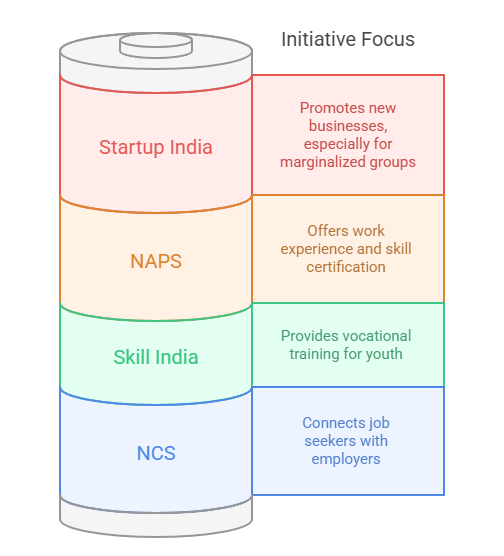
Government Schemes Promoting Career Mobility
National Career Service (NCS): Job matching platform with career counseling.
Skill India Mission: Vocational training for youth, especially in Tier II and rural areas.
Startup India & Stand-Up India: Promotes entrepreneurship among SC/ST and women.
National Apprenticeship Promotion Scheme (NAPS): Provides work experience and skill certification.
Linking Career Mobility and Social Stratification
Career mobility in India is a reflection of social closure (Weber), where dominant groups protect privileges through exclusionary practices.
Meritocracy is more an ideal than a reality; structural inequalities ensure that only a few can climb the career ladder.
Caste, gender, and class intersect to create a mobility trap for a majority.
Programs aimed at mobility often fail without accompanying reforms in education quality, labor rights, and social security.
Way Forward
Equalize access to quality education across states and social groups.
Mentorship and career counseling programs in rural and marginalized communities.
Ensure anti-discrimination laws are enforced in private sector hiring.
Recognize informal labor contributions and provide vertical pathways in gig platforms.
Expand reservation and skill-building to include digital economy sectors.
Conclusion
Career mobility is not just about individual talent or hard work — it is deeply intertwined with a person’s social origin, identity, and access to resources. While modern India has made progress, true career mobility remains a privilege rather than a norm for many. Understanding this topic through a sociological lens enables a deeper grasp of how social stratification, policy, and economy intersect to shape life chances.
Previous Year Questions
Paper I
“Explain the concept of social mobility. Discuss the factors facilitating and hindering it in Indian society.” (2020)
Paper II
“Discuss how the process of globalization has impacted occupational mobility in Indian society.” (2018)
“Examine the relationship between education and upward social mobility in India.” (2017)
“Is caste mobility possible in India? Substantiate your answer with suitable examples.” (2015)








One comment