Dreams have always been the silent architects of nations. They disturb complacency, challenge inertia, and compel societies to move beyond the comfort of the present. For India, a civilization that has survived through centuries of change, conquest, and continuity, dreams are not escapist fantasies but moral imperatives. From the freedom struggle to the framing of the Constitution, India’s progress has been driven by dreams that refused to let the nation rest. However, in a rapidly transforming world marked by inequality, climate crisis, technological disruption, and geopolitical uncertainty, India stands at a critical juncture. The question is not whether India has dreams, but whether it has dreams powerful enough to keep it awake—to inspire relentless effort, self-criticism, and collective action. Dreams which should not let India sleep are those that demand justice over convenience, excellence over mediocrity, and responsibility over rhetoric.
MAIN BODY:
At the forefront of India’s unfinished dreams lies the aspiration for inclusive development. Economic growth, though impressive in parts, has not uniformly translated into social equity. Millions still struggle with poverty, malnutrition, inadequate healthcare, and limited access to quality education. The persistence of such deprivation in a nation of immense potential should not allow India the comfort of self-satisfaction.
True development is not measured solely by GDP growth, but by the dignity and opportunities available to the weakest citizen. As Amartya Sen argues, development is the expansion of substantive freedoms. Therefore, the dream of inclusive growth must keep India awake until prosperity reaches the last village, the last woman, and the last child. This dream demands constant policy innovation, ethical governance, and social empathy, refusing to let economic success mask human suffering.
Closely linked to inclusive development is the dream of an education system that liberates minds rather than merely producing degrees. While India has expanded access to education, concerns about quality, relevance, and critical thinking persist. Rote learning, exam-centric approaches, and unequal access undermine the transformative power of education.
India’s civilizational heritage celebrates knowledge as a path to liberation. Yet, contemporary education often prioritizes employability over enlightenment. The dream that should not let India sleep is to become a global knowledge leader—producing original thinkers, scientists, philosophers, and innovators who shape ideas rather than merely consume them. This requires sustained investment in research, academic freedom, and respect for intellectual inquiry. Until education nurtures curiosity, ethics, and creativity at scale, India’s conscience must remain restless.
India’s Constitution envisions not just political democracy, but social and economic democracy. Despite constitutional guarantees, social hierarchies based on caste, gender, religion, and region continue to constrain human potential. Discrimination may have become subtler, but its impact remains profound.
The dream of social justice must continue to disturb India’s sleep until equality moves from paper to practice. This dream is uncomfortable because it requires introspection, reform of social attitudes, and redistribution of opportunities. Dr. B.R. Ambedkar warned that political democracy cannot survive without social democracy. Therefore, as long as privilege determines life chances, India cannot afford moral rest.
Another dream that must keep India awake is that of ethical governance. Corruption, inefficiency, and lack of accountability erode public trust and weaken institutions. While India has built a robust constitutional framework, the gap between law and implementation remains a source of frustration.
Governance is not merely about administration; it is about moral leadership. The dream of a transparent, responsive, and citizen-centric state requires continuous vigilance. As Mahatma Gandhi emphasized, true swaraj is self-rule grounded in moral restraint. Until public office becomes synonymous with public service and institutions command respect through integrity, India’s democratic conscience must remain alert.
India’s diversity is both its strength and its challenge. Linguistic, religious, cultural, and regional plurality enriches the nation, yet also creates potential fault lines. In recent times, identity assertions and polarization threaten the delicate balance between unity and diversity.
The dream that should not let India sleep is the dream of unity without uniformity. This is not a passive aspiration but an active process of dialogue, tolerance, and constitutional fidelity. Rabindranath Tagore warned against narrow nationalism that sacrifices humanity at the altar of identity. Therefore, India must remain awake to the dangers of exclusionary narratives and work tirelessly to preserve its plural ethos.
Perhaps one of the most urgent dreams is that of ecological balance. India faces severe environmental challenges—air and water pollution, deforestation, climate vulnerability, and unsustainable urbanization. Development, if pursued without ecological wisdom, risks undermining the very foundations of human life.
Indian philosophical traditions emphasize harmony between humans and nature. Yet, modern growth models often ignore ecological limits. The dream of sustainable development must keep India awake because environmental damage is often irreversible. As Mahatma Gandhi cautioned, the earth provides enough for everyone’s need, but not for everyone’s greed. This dream demands restraint, innovation, and intergenerational responsibility.
Gender inequality remains one of India’s most persistent contradictions. Despite constitutional equality and visible progress in education and leadership, women continue to face discrimination, violence, and unequal access to opportunities. Gender injustice is not merely a women’s issue; it is a national failure.
The dream of gender equality must disturb India’s sleep until women can participate fully and safely in public and private life. Empowerment is not only about representation but about changing social norms and power structures. A society that suppresses half its population cannot achieve its full potential. Therefore, this dream demands both legal reform and cultural transformation.
India’s future in a competitive global order depends on innovation, scientific temper, and technological self-reliance. While India has achieved notable success in space, digital governance, and pharmaceuticals, challenges remain in translating innovation into widespread prosperity.
The dream of becoming a leading innovation-driven society must not let India sleep. Scientific temper, as enshrined in the Constitution, requires rational thinking, skepticism of superstition, and respect for evidence. Without this, technological progress risks being superficial. Hence, India must remain awake to nurture curiosity, research, and ethical use of technology.
As India’s global stature rises, so does its responsibility. The dream of India as a moral and constructive global actor must keep the nation awake. In a world fractured by conflict, inequality, and climate crisis, India’s civilizational values of dialogue, coexistence, and compassion have renewed relevance.
However, global leadership is not achieved through rhetoric alone. It requires domestic credibility, institutional strength, and commitment to universal values. Therefore, India’s global dreams are inseparable from its internal transformation.
Philosophically, dreams are not passive wishes but ethical calls to action. Martin Luther King Jr. viewed dreams as instruments of justice that challenge unjust realities. Similarly, Indian thinkers have seen aspiration as a form of moral restlessness.
In this sense, dreams that should not let India sleep are those that expose the gap between what is and what ought to be. Comfort and complacency are the enemies of progress. A nation truly awakens not when it celebrates achievements, but when it remains uneasy about its failures.
CONCLUSION:
In conclusion, the dreams that should not let India sleep are dreams of inclusive development, social justice, ethical governance, environmental sustainability, gender equality, intellectual leadership, and global responsibility. These dreams are demanding, uncomfortable, and often inconvenient. Yet, they are essential for India’s moral and material progress. A sleeping nation may preserve the status quo, but an awakened nation transforms it. As India moves forward in the twenty-first century, its true strength will lie not in the dreams it proclaims, but in the dreams that relentlessly keep it awake—dreams that compel continuous effort, self-correction, and commitment to the highest ideals of its Constitution and civilization.
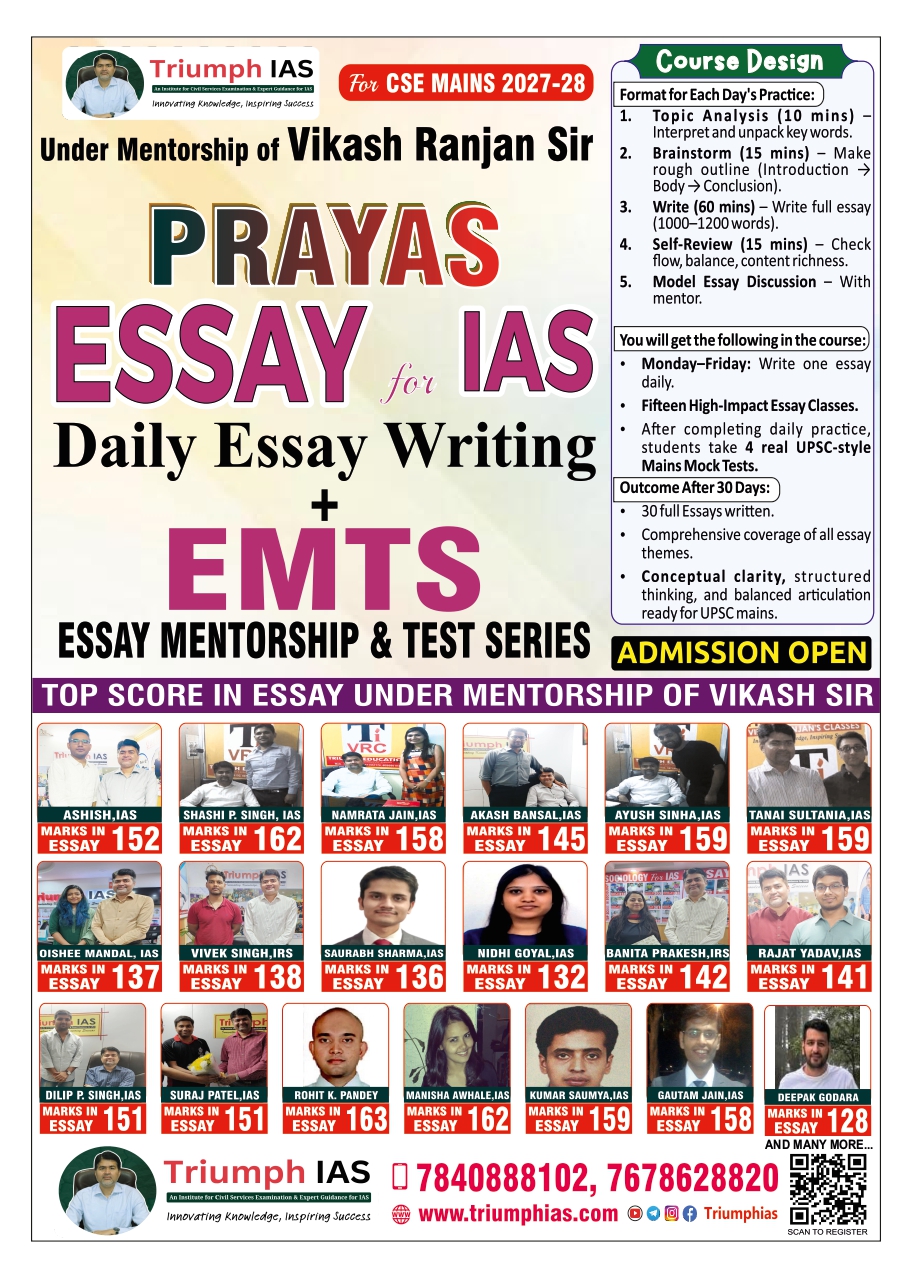
If you’re preparing for the UPSC Civil Services Examination (CSE), one paper that can unlock exceptional scores and a top rank is the Essay Paper. While General Studies and Optional Subjects are structured and syllabus-driven, the Essay writing segment is where individuality, critical thinking, and articulation truly shine.
Among various Essay programs available across India, Triumph IAS, under the expert mentorship of Vikash Ranjan Sir, offers the Best Essay writing Course for UPSC CSE. This comprehensive guide explores what makes this program unparalleled and why it should be part of every serious aspirant’s preparation strategy.







2 comments