Education Inequality and Digital Divide in Contemporary Society | Sociology UPSC Notes

Education Inequality and Digital Divide in Contemporary Society

Relevant for Sociology Optional Paper 1, Paper 2, and GS Paper I (Indian Society)

Introduction

Education has historically been regarded as a powerful instrument of social mobility, human development, and democratic participation. It enables individuals to acquire knowledge, skills, values, and opportunities necessary for improving their social and economic conditions. However, access to quality education remains highly unequal due to disparities based on class, caste, gender, region, and economic status. The rapid expansion of digital technology has further created a new dimension of inequality known as the digital divide, where unequal access to technology influences educational opportunities.

From a sociological perspective, educational inequality and the digital divide are not merely technological or economic problems; they are manifestations of deeper social structures, unequal distribution of resources, and existing patterns of social stratification.

Understanding Educational Inequality

Educational inequality refers to unequal access to quality education, learning resources, and educational outcomes among different social groups. Although modern societies emphasize equal educational opportunities, social backgrounds continue to significantly influence academic achievement.

The functional perspective, associated with Émile Durkheim, views education as an institution that promotes social integration, shared values, and skill development. However, conflict theorists such as Karl Marx argue that educational institutions may reproduce existing inequalities by reflecting the interests of dominant social groups.

Sociologist Pierre Bourdieu’s concept of cultural capital explains how children from privileged backgrounds possess linguistic abilities, cultural knowledge, and social advantages that increase their chances of educational success. Thus, education often reproduces social inequalities rather than eliminating them.

The Digital Divide as a New Form of Social Exclusion

The digital divide refers to unequal access to digital technologies, internet connectivity, digital skills, and the ability to effectively utilize technological resources. In the contemporary knowledge-based society, digital access has become an essential requirement for educational achievement, employment, and social participation.

The shift toward online education, particularly during global crises such as the COVID-19 pandemic, highlighted disparities between students who had access to digital devices and reliable internet and those who did not. Students belonging to rural areas, economically disadvantaged households, and marginalized social groups faced greater challenges in continuing their education.

Therefore, the digital divide represents a new form of social exclusion that can deepen existing educational inequalities.

Education, Technology, and Social Stratification

The relationship between education and technology demonstrates how social inequalities adapt to changing social conditions. Access to digital resources is influenced by income, geographical location, gender relations, language barriers, and institutional infrastructure.

The concept of the knowledge society suggests that information and technological skills have become important sources of social and economic power. Consequently, unequal access to digital knowledge can create new hierarchies within society.

Sociologists argue that technological advancement alone cannot guarantee educational equality. Without inclusive policies, digital transformation may reinforce the advantages of privileged groups while further marginalizing disadvantaged populations.

Towards Inclusive and Equitable Education

Addressing educational inequality and the digital divide requires comprehensive social and policy interventions. Governments and institutions must ensure affordable internet access, digital infrastructure, inclusive educational technologies, teacher training, and equitable distribution of learning resources.

Special attention must be given to marginalized communities, including economically weaker sections, rural populations, women, persons with disabilities, and socially disadvantaged groups. Education should function as an instrument of empowerment rather than a mechanism for reproducing inequality.

Conclusion

Educational inequality and the digital divide represent significant challenges in contemporary societies. While education and technology possess transformative potential, their benefits remain unevenly distributed due to historical and structural inequalities.

A sociological perspective highlights that achieving educational justice requires addressing the broader social conditions that shape access to knowledge and technology. A truly inclusive society must ensure that every individual, irrespective of social background, has equal opportunities to learn, participate, and progress in the digital age.

UPSC Civil Services (Mains) Question

Q. “The digital divide has transformed traditional educational inequalities into new forms of social exclusion in contemporary society.” Critically examine the statement using appropriate sociological perspectives. (250 Words)

To Read more topicsvisit: www.triumphias.com/blogs

Read more Blogs:

Ethnic Conflicts, Communalism, and Identity Politics in Contemporary Society

Cyberspace and Internet: Blessing or curse to the human civilization in the long run – Triumph IAS & Vikash Ranjan Sir


🔥 YOUR FINAL UPSC RANK CAN BE DECIDED BY JUST TWO PAPERS — ESSAY & OPTIONAL!

Most aspirants study hard.
But very few know how to convert knowledge into MARKS.

That’s where Triumph IAS creates the difference. 🚀

✍️ EMTS – Essay Mentorship & Test Series (CSE Mains 2026–27)

Under the mentorship of Vikash Ranjan Sir, master the art of writing structured, philosophical, multidimensional, and topper-level essays.

Scientific Essay Writing Approach
Knowledge Matrix Framework
5 Exclusive Essay Approach Classes
2 Thematic Tests + 4 UPSC Mock Tests
Detailed Model Essay Hints
Flexible Writing & Discussion Sessions
Personal 1-to-1 Mentorship

🏆 Trusted by UPSC Essay Toppers
━━━━━━━━━━━━━━━━━━

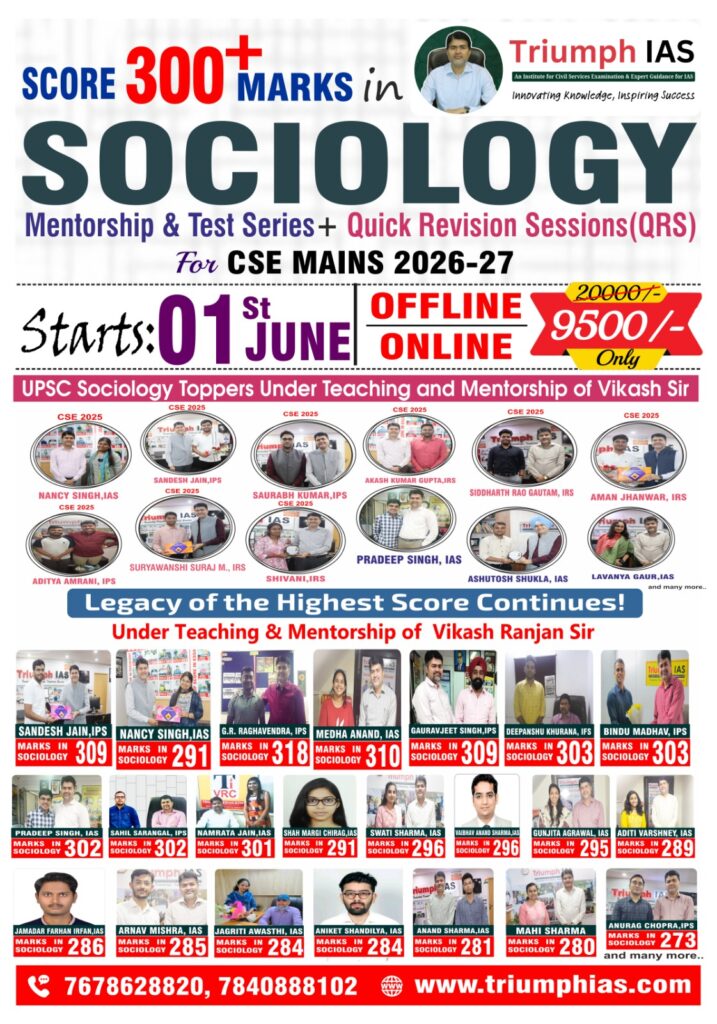
📚 SMTS – Sociology Mentorship & Test Series + Quick Revision Session (QRS)

🎯 SCORE 300+ MARKS IN SOCIOLOGY OPTIONAL

A structured, analytical, and result-oriented mentorship program designed to maximize your Sociology score under the guidance of Vikash Ranjan Sir.

Program Highlights:

26 Full-Length Tests with Detailed Evaluation
PYQ–NYQ Trend Analysis
Quick Revision Sessions on Unconventional Questions
Brainstorming & Concept Enrichment Sessions
1-to-1 Personal Mentorship Discussions
Topic-wise Answer Writing Practice
Current Social Issues Compilation
Home-based Practice Tests with Model Hints
Thinkers Integration & Value Addition Notes
Essay & GS Enrichment through Sociology

  • 🏆 Legacy of High Scores Continues:
  • 🌟 G.R. Raghavendra, IPS – 318
  • 🌟 Medha Anand, IAS – 310
  • 🌟 Sandesh Jain, IPS – 309
  • 🌟 Gauravjeet Singh, IPS – 309
  • 🌟 Deepanshu Khurana, IFS – 303
  • 🌟 Pradeep Singh, IAS – 302
  • 🌟 Swati Sharma, IAS – 296
  • 🌟 Gunjita Agarwal, IAS – 295

…and many more successful aspirants.

━━━━━━━━━━━━━━━━━

Batch Starts: 01 June

  • 📍 Available in OFFLINE & ONLINE Mode
  • 📞 Call/WhatsApp: 7678628820 | 7840888102
  • 🌐 triumphias.com
  • 📍 Triumph IAS
  • 23-B, 3rd Floor, Pusa Road
  • Near Karol Bagh Metro Pillar No. 114, New Delhi
 

Leave a Reply

Your email address will not be published. Required fields are marked *