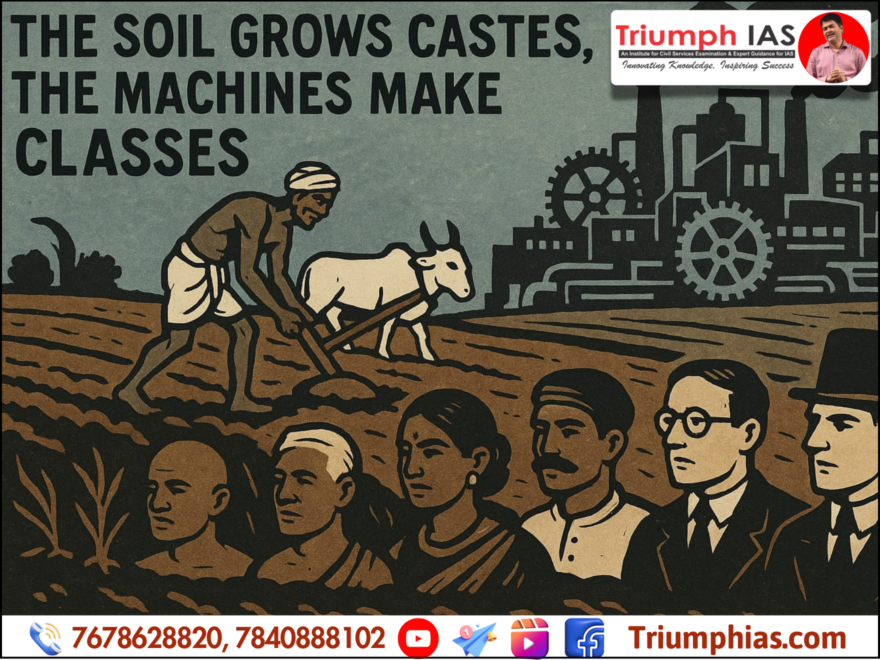
India’s social fabric is deeply entwined with two enduring forms of inequality — caste and class. The phrase “The soil grows castes and the machines make classes” captures a powerful sociological truth: agriculture has historically reinforced caste hierarchies, while industrialization and technology have restructured economic stratification into class-based divisions.
In the age of digital capitalism, gig economy, and agrarian distress, this dual system continues to shape opportunity, identity, and access to resources. This blog explores the relevance of caste and class in contemporary India, backed by sociological analysis and examples from current affairs.
Caste and the Soil:
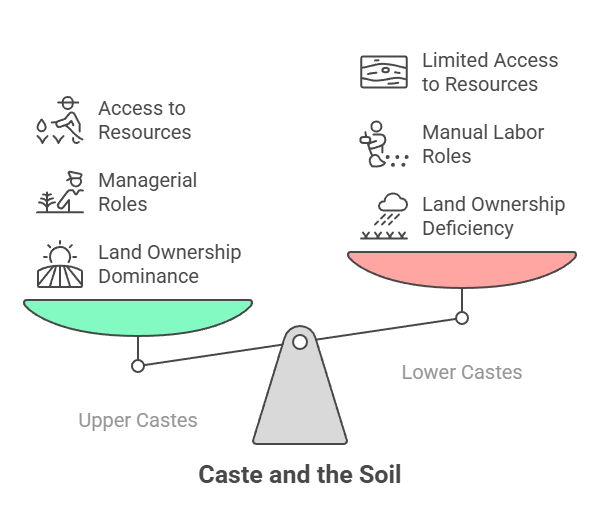
Caste as a Mode of Production: In rural India, caste continues to define access to land and labor. Upper castes largely own agricultural land, while Dalits and other lower castes are often relegated to manual labor. Béteille’s 1969 study of Tanjore village highlights how caste-based occupational roles remain entrenched in agrarian economies, reproducing social hierarchies.
Persistence of Caste in Rural India: The 2018 Rural India Land Inequality Report shows that 95% of Dalit households lack ownership of agricultural land. Caste-based exclusion still manifests through practices like manual scavenging, bonded labor, and unequal access to irrigation and credit, reinforcing social and economic marginalization.
Recent Example – In Tamil Nadu’s Kallakurichi district,Dalit farmers were denied access to irrigation canals by dominant caste groups. This incident reflects how caste-based control over agricultural resources persists, leading to unequal development and social tensions in rural India.
Machines Make Classes:
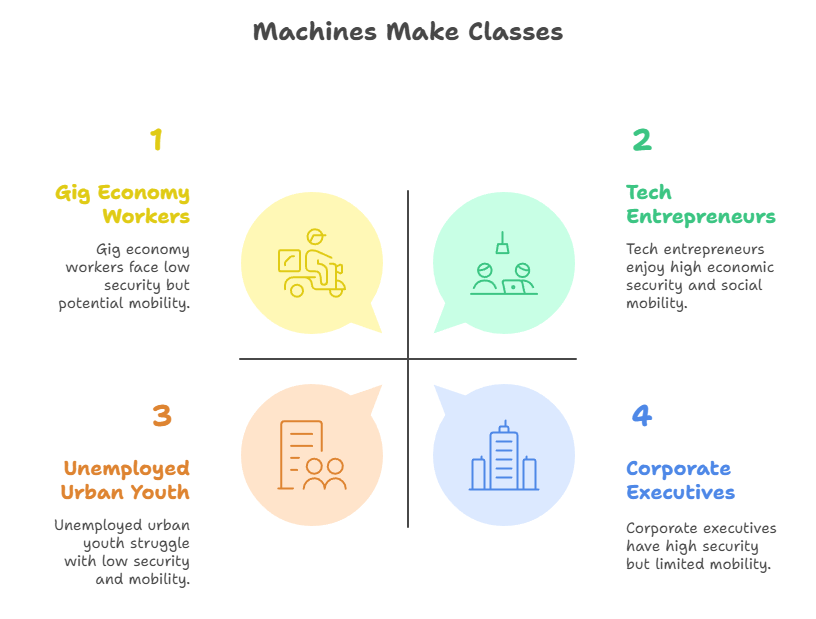
Industrialization and New Class Formations: With the growth of industrialization and the digital gig economy, class has emerged as a new axis of inequality. Platforms like Swiggy, Zomato, and Ola illustrate how occupational roles and income levels now determine social position, moving beyond traditional caste identifiers—aligning with Marxian concepts of class formation.
Technology and the Gig Economy: The gig economy has given rise to a precarious working class. App-based workers often face long hours, lack of job security, and no legal protections. This commodification of labor results in economic insecurity and deepens class divisions in urban India.
Contemporary Inequality: According to CMIE data (2025), urban youth unemployment exceeds 17%, and the richest 10% of Indians control 77% of the nation’s wealth. This growing economic disparity signals a sharp polarization of classes, especially in urban settings dominated by digital and service-based industries.
Sociological Analysis
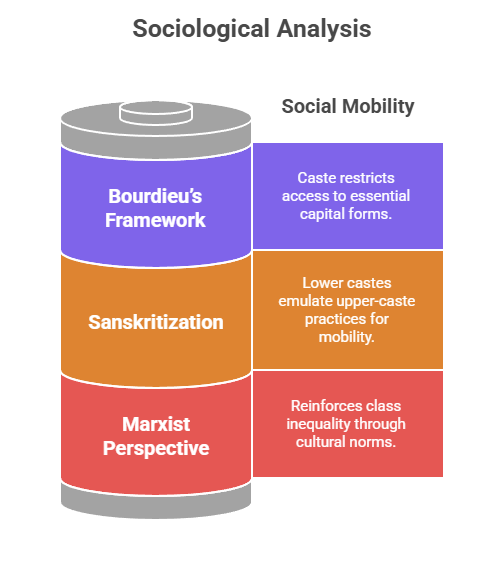
Marxist Perspective: A.R. Desai argues that capitalist development in India perpetuates class inequality. In rural settings, caste operates as a cultural superstructure legitimizing economic exploitation and control over labor.
Caste Mobility: M.N. Srinivas’s concept of Sanskritization shows how lower castes attempt upward mobility by adopting upper-caste practices. However, entrenched structural barriers often prevent these communities from achieving real economic or social advancement.
Social Capital and Habitus: Pierre Bourdieu’s framework reveals that caste limits access to essential forms of capital—social, cultural, and economic—in rural India. Meanwhile, in urban settings, class shapes lifestyle, education, and aspirations, defining individuals’ life chances and social positioning.
Current Affairs Connection
Caste Census Demand (2024–2025): Debates on including caste data in national census underscore its continuing significance.
Labour Codes and Gig Workers: Exclusion of platform workers from legal protection reflects emerging class neglect.
Agrarian Crisis & Farmers’ Protests: Majority of protesting farmers in 2020–21 belonged to marginal caste-based farming communities.
Conclusion
The Indian social structure cannot be understood without examining both caste and class simultaneously. While caste remains deeply entrenched in rural, agrarian life, the urban economy is increasingly divided along class lines, shaped by technology, education, and digital capital. Understanding this intersection of traditional caste and modern class structures is essential to decode India’s development challenges, social justice movements, and policy dilemmas.
PYQs
Paper 1
Distinguish between class and caste as forms of social stratification in India. (2013)
What is the role of caste in contemporary rural economic structure? (2014)
Discuss the changing nature of caste system in modern India. (2015)
Explain how caste and class overlap and diverge in rural India. (2017)
Explain Marxian conception of class conflict. How relevant is it in the context of contemporary India? (2020)
Examine the concept of ‘status group’ as given by Max Weber. How far is it useful in understanding caste system in India? (2021)
How does Bourdieu’s theory of social reproduction explain persistence of inequality in modern society? (2024)
Paper 2
Discuss the agrarian class structure in India and its transformation since independence. (2013)
Write a note on caste-based discrimination in agrarian labour. (2014)
Examine the interplay of caste and class in rural India. (2015)
Explain the sociological significance of farmers’ movements in contemporary India. (2017)
How do caste and land ownership pattern affect agricultural development in India? (2018)
Discuss the impact of globalization on the class structure of Indian society. (2019)
Analyze the role of digital platforms in shaping new forms of class inequality in urban India. (2020)
Critically analyze the issues faced by informal workers in India’s gig economy. (2021)
How do caste and class inequalities manifest in access to rural resources like water, credit and land? (2022)









One comment