


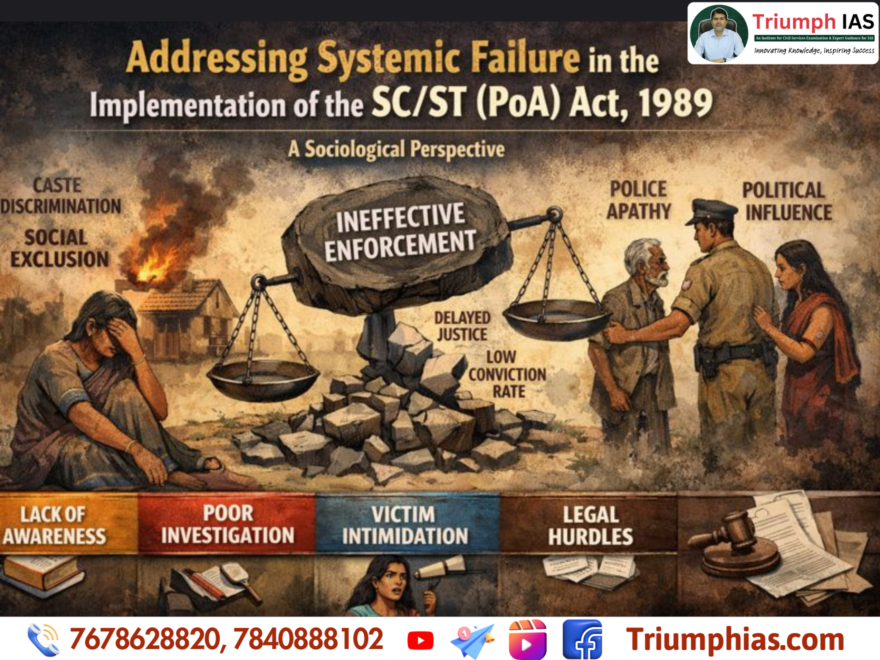
Addressing Systemic Failure in the Implementation of the SC/ST (PoA) Act, 1989: A Sociological Perspective
(Relevant for Sociology Paper 2: Tribal Communities in India and Vision of Social change in India and Politics and Society)
|
The Scheduled Castes and Scheduled Tribes (Prevention of Atrocities) Act, 1989 (PoA Act) was a landmark law aimed at safeguarding the rights and dignity of India’s most marginalized communities—Scheduled Castes (SCs) and Scheduled Tribes (STs)—from caste-based atrocities and discrimination. However, despite its strong legal provisions, a series of recent reports from Tamil Nadu have brought to light disturbing delays and failures in the law’s implementation. These failures have rendered the Act largely ineffective, leaving victims in a state of perpetual fear and injustice. What is the SC/ST (PoA) Act, 1989? A Brief OverviewThe SC/ST (PoA) Act was enacted to protect SC and ST communities from atrocities and discrimination. Some of the key provisions of the Act include:
Despite these provisions, the implementation of the law has been lackluster, often thwarted by systemic failures at multiple levels, including the police, judiciary, and administration. Systemic Failures in the Implementation of the SC/ST (PoA) Act
A fundamental flaw in the implementation of the SC/ST (PoA) Act is the routine neglect of its procedural safeguards. According to reports from Tamil Nadu, FIRs (First Information Reports) are not filed immediately in cases of atrocities. In many instances, chargesheets are not filed within the stipulated 60 days, a violation of the Act’s mandate for swift justice. This delay results in a backlog of cases, further exacerbating the trauma and vulnerability of victims. From a sociological perspective, this neglect reveals a systemic caste bias within law enforcement and the judiciary. In many cases, law enforcement personnel and judicial officers, who are not from the marginalized communities, may subconsciously internalize caste prejudices, leading to delays or non-compliance with the legal provisions of the Act.
One of the most troubling aspects of the implementation of the SC/ST (PoA) Act is the tendency of authorities to bypass formal legal procedures. Instead of pursuing justice through the courts, informal peace meetings or extra-legal settlements are often arranged. These meetings typically fail to protect the interests of the victims and are often biased in favor of the perpetrators, particularly when they belong to higher castes. This practice, rooted in caste-based discrimination, reveals the social stratification at play within legal institutions, where those in power are more inclined to side with the dominant caste. This social norm of informal settlements undermines the very foundations of the law and violates the rights of the victims. By prioritizing social harmony over legal justice, this approach perpetuates caste-based oppression and discourages victims from seeking formal justice.
While monetary relief is sometimes provided to victims, the socio-economic rehabilitation mandated by the Act—such as land, employment, and educational support—is often delayed or never provided. This failure to deliver on the rehabilitation provisions of the Act reflects the broader inequality within Indian society, where marginalized communities continue to face structural obstacles to social mobility. The lack of comprehensive rehabilitation leaves victims trapped in a cycle of poverty and social exclusion, reinforcing the caste-based inequalities the Act was designed to dismantle. This systemic neglect of rehabilitation underscores the failure of the state to address the broader socio-economic needs of SC/ST communities.
Despite the provisions under Section 4 of the SC/ST (PoA) Act, which calls for the punishment of public servants who neglect their duties under the Act, this section has seldom been invoked. This lack of accountability creates a culture of impunity among law enforcement officers, judicial officials, and administrative authorities. When public servants fail to act on atrocities against SC/ST individuals, the perpetrators often continue to commit crimes with little fear of consequences. From a sociological perspective, this lack of accountability is deeply tied to the caste system in India, which has historically protected the interests of dominant castes while oppressing marginalized communities. The systemic failures in holding officials accountable are a reflection of entrenched caste biases within India’s bureaucratic and legal systems.
In many cases, the accused in atrocities against SC/ST individuals remain free, often asserting their dominance over the same communities they have victimized. The perpetrators are rarely subjected to any form of deterrence, and the fear of reprisals often forces victims and witnesses to withdraw complaints or change their testimony. The intimidation faced by SC/ST victims, combined with a lack of victim protection, perpetuates a climate of fear and social exclusion. This situation illustrates a critical failure in the implementation of protective measures, which are vital for victims to access justice and for the law to serve as a deterrent against caste-based violence. When protection is weak or absent, the cycle of abuse continues, reinforcing caste terror within communities. Sociological Consequences of Systemic FailuresErosion of Deterrence The failure to effectively implement the SC/ST (PoA) Act has undermined its deterrent effect. High-profile cases, such as the Melavalavu massacre (1997), in which 6 SC men were killed, and subsequent leniency toward perpetrators—such as the release of convicts for “good behavior”—have emboldened perpetrators and discouraged victims from seeking justice. This erosion of deterrence weakens the law’s ability to prevent future atrocities and allows caste-based violence to continue with impunity. Psychological Toll on Victims Beyond the physical and economic harm, the delayed justice and bureaucratic indifference faced by victims take a significant psychological toll. Victims of caste-based violence often find themselves not just fighting for justice but also enduring psychological trauma, as they battle against intimidation, delays, and institutional apathy. The long process of legal recourse, coupled with the persistent threats of caste-based retribution, can lead to victim fatigue—a loss of faith in the justice system and, by extension, in the promises of social justice enshrined in the Constitution. Reinforcement of Caste Hierarchies By failing to implement the SC/ST (PoA) Act effectively, the state inadvertently reinforces existing caste hierarchies. The inability to deliver justice reinforces the message that marginalized communities are less deserving of protection and dignity, thus perpetuating the social stratification that the Act sought to dismantle. This erodes social harmony and perpetuates inter-caste tensions, creating a cycle of social inequality. Steps for Effective ImplementationTo address the systemic failures in the implementation of the SC/ST (PoA) Act, 1989, the following measures must be taken:
A high-level committee should be established to actively monitor the progress of cases from FIR registration to rehabilitation. This will ensure that no steps are overlooked or neglected and that accountability is maintained at all levels.
The government must ensure that the Special Courts are fully functional, with dedicated judges and prosecutors. Vacancies in these courts must be filled promptly, and delays in trials should be addressed.
Section 4 of the Act must be strictly enforced. Public servants who fail to act on atrocities must be held accountable, ensuring that there is no impunity in the system.
Victims and witnesses must be provided credible and visible protection, including police escorts and legal support, to build confidence in the justice system.
Alongside legal measures, there is a need for social reformation to challenge deeply ingrained caste prejudices. Educational programs focused on social democracy and fraternity can help dismantle caste biases at the grassroots level. ConclusionWhile the SC/ST (PoA) Act is a powerful tool for addressing caste-based atrocities, its systemic failures in implementation undermine its potential to protect vulnerable communities. To ensure social justice, the law needs robust enforcement, swift trials, effective victim protection, and greater accountability within the justice system. Furthermore, long-term solutions require social reformation to dismantle the entrenched caste system, creating a more just and inclusive society for all. |
To Read more topics, visit: www.triumphias.com/blogs
Read more Blogs:
Human Rights Day: A Global Commitment to Equality, Dignity, and Freedom
One comment