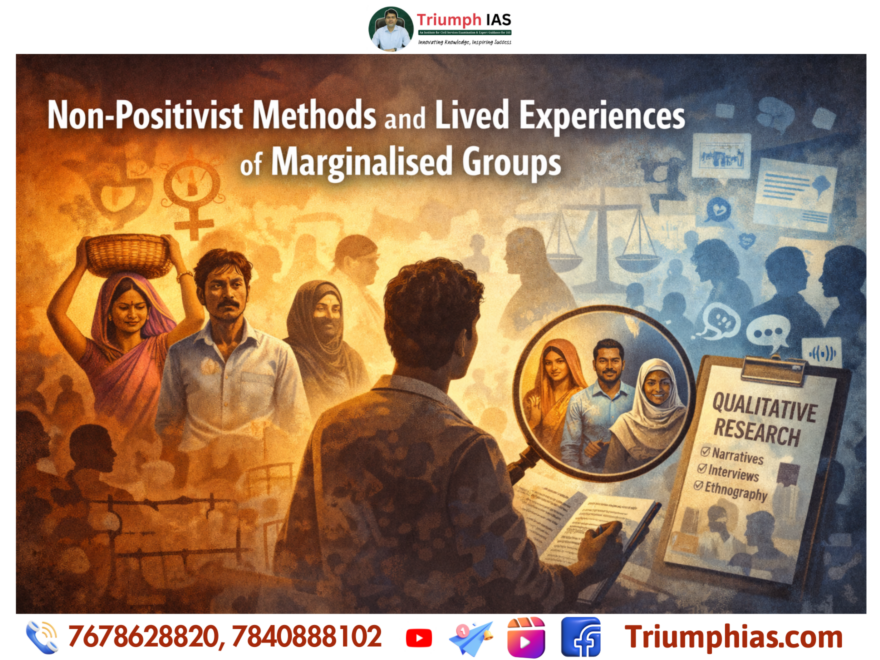
Classical sociology was deeply influenced by positivism, which sought to study society using methods similar to the natural sciences—emphasising objectivity, quantification, and general laws. However, such approaches often failed to capture the subjective meanings, emotions, and everyday struggles of marginalised groups such as Dalits, women, tribal communities, sexual minorities, and informal workers. To address these limitations, sociology increasingly turned towards non-positivist methods, which prioritise lived experiences, meanings, and voices from below. These approaches are crucial for understanding social inequality, exclusion, and resistance in a nuanced manner.
Dimension:
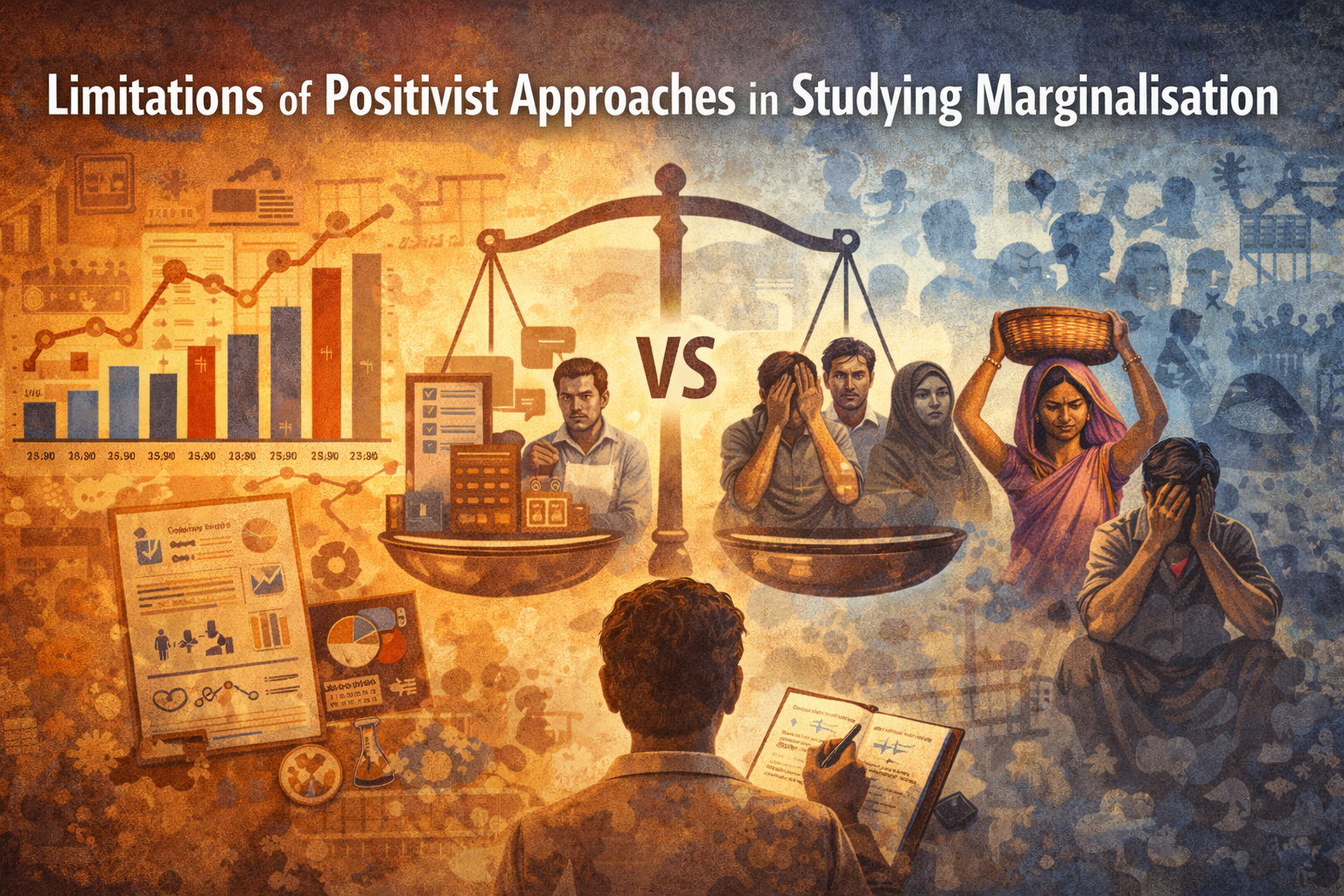
Limitations of Positivist Approaches in Studying Marginalisation
Positivist methods rely heavily on surveys, statistics, and large-scale generalisations. While useful for identifying broad patterns, they often silence individual experiences and overlook structural violence embedded in everyday life. Marginalised groups are frequently reduced to variables—income, literacy, caste category—without attention to humiliation, stigma, fear, or resilience.
For example:- caste discrimination cannot be fully understood merely through occupational data or poverty indices. The everyday experience of untouchability, social exclusion, and symbolic violence requires methods that go beyond numerical representation. Positivism thus risks reproducing dominant perspectives while marginal voices remain unheard.
Non-Positivist Methods: An Alternative Framework
Non-positivist methods emphasise interpretation, subjectivity, and context. Influenced by interpretivism and phenomenology, these approaches seek to understand society from the standpoint of social actors themselves.
Max Weber argued that sociology must focus on Verstehen—interpretive understanding of social action. This laid the foundation for qualitative methods such as:
In-depth interviews
Participant observation
Life histories
Ethnography
Narrative and discourse analysis
These methods allow sociologists to grasp how marginalised individuals interpret their social worlds, negotiate power relations, and construct meaning under conditions of inequality.
Lived Experience as Sociological Evidence
The concept of lived experience highlights how oppression is felt, embodied, and reproduced in daily life. Feminist sociology, Dalit studies, and subaltern perspectives have strongly advocated this approach.
Dorothy Smith developed standpoint theory, arguing that knowledge produced from the standpoint of marginalised groups offers a more complete and critical understanding of society. Similarly, Dalit autobiographies and oral histories reveal forms of caste oppression that remain invisible in official records.
In India, the use of life narratives of manual scavengers, migrant workers, or tribal communities has exposed the gap between constitutional ideals and social reality. These accounts challenge dominant narratives and question whose knowledge is considered legitimate.
Power, Voice, and Ethical Responsibility
Non-positivist research is not merely methodological; it is also ethical and political. It seeks to democratise knowledge production by recognising marginalised groups as knowers, not just subjects.
Michel Foucault highlighted how knowledge and power are intertwined. From this perspective, positivist “objective” knowledge often aligns with institutional power, while experiential knowledge disrupts dominant discourses.
However, non-positivist methods also demand reflexivity. Researchers must remain aware of their own social position and avoid appropriating or romanticising marginal voices. Ethical fieldwork requires informed consent, trust-building, and sensitivity to vulnerability.
Relevance in Contemporary Society
In an era of identity politics, social movements, and claims for recognition, non-positivist methods are increasingly relevant. Movements related to gender justice, tribal rights, disability, and LGBTQIA+ issues rely heavily on personal testimonies and narratives to challenge exclusionary policies and social norms.
For policymakers and administrators, understanding lived experiences enables more inclusive and effective governance, making sociology directly relevant to public administration and social justice.
Conclusion
Non-positivist methods enrich sociology by foregrounding the lived experiences of marginalised groups, revealing dimensions of social reality that remain hidden in positivist frameworks. By privileging voice, meaning, and context, these approaches not only deepen sociological understanding but also contribute to social justice and democratic knowledge production. In a diverse and unequal society like India, sociology cannot afford to ignore the experiential realities of those at the margins.
UPSC CSE Mains – Practice Question
“Non-positivist methods are crucial for understanding the lived experiences of marginalised groups.” Discuss. (10/15 marks)






3 comments