


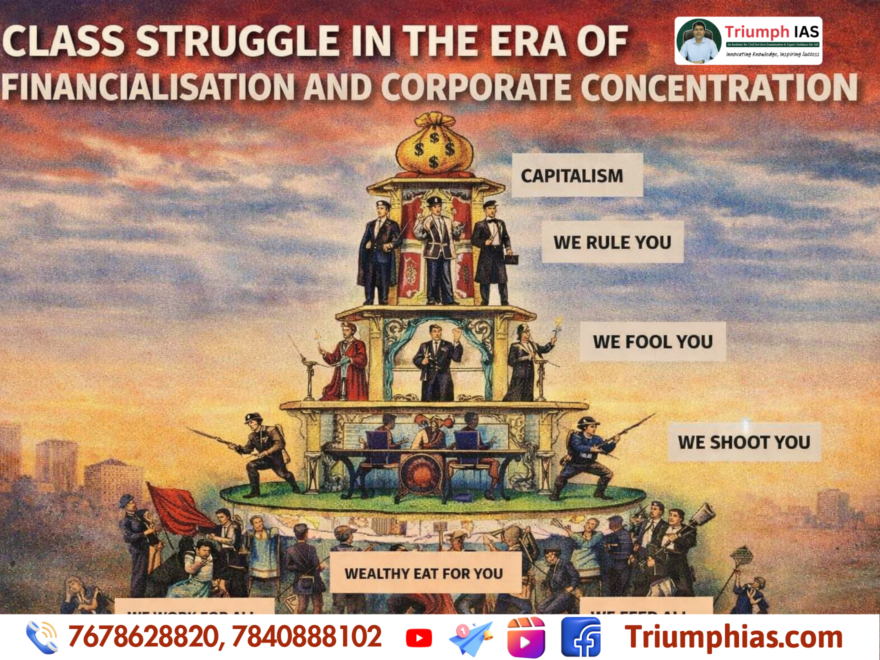
Class Struggle in the Era of Financialisation and Corporate Concentration
(Relevant for Sociology Paper 1, Paper 2 , GS Society )
IntroductionThe concept of class struggle, most systematically articulated by Karl Marx, remains central to sociological analysis even in the twenty-first century. While classical capitalism revolved around industrial production and factory-based labour exploitation, contemporary capitalism is increasingly defined by financialisation and corporate concentration. The terrain of conflict has shifted—but the structural antagonism between capital and labour persists.
Dimension:From Industrial Capitalism to Financial CapitalismFinancialisation refers to the growing dominance of financial markets, institutions, and speculative logic in shaping economic life. Profits increasingly flow from financial instruments—stocks, derivatives, asset trading—rather than from the production of goods and services. Corporations prioritize “shareholder value,” often through cost-cutting, downsizing, contractualization, and automation. In classical Marxian terms, surplus value was extracted primarily at the point of production. Today, surplus extraction also occurs through debt regimes, credit systems, and asset inflation. Workers are not only exploited as labourers but also disciplined as borrowers, consumers, and precarious investors. This transformation diffuses class struggle into everyday financial life—housing loans, student debt, gig contracts, and pension insecurities. Corporate Concentration and Monopoly PowerParallel to financialisation is the concentration of corporate power. A handful of transnational corporations dominate sectors such as technology, energy, pharmaceuticals, and digital platforms. This reflects what Marx described as the “centralization of capital,” where competition ultimately leads to monopoly or oligopoly structures. Sociologically, corporate concentration produces:
The result is not merely economic disparity but structural power imbalance embedded within political and cultural institutions. Precarity and the Fragmentation of Labour
Unlike the relatively unified industrial proletariat of the nineteenth century, today’s working class is fragmented. Gig workers, informal labourers, platform-based service providers, and contractual employees constitute a dispersed workforce. Trade unions face structural challenges in organizing digitally mediated labour. However, fragmentation does not eliminate class struggle; it reconfigures it. Platform worker strikes, campaigns for living wages, demands for social security, and movements against privatization reflect emerging forms of resistance. Class struggle increasingly intersects with gender, caste, race, and ecological concerns—producing layered solidarities rather than singular class blocs. Ideology and the Invisibilisation of ConflictOne of the distinctive features of financial capitalism is the ideological masking of exploitation. When inequality is framed as a consequence of “market forces” or individual merit, structural contradictions are depoliticized. Financial literacy campaigns and entrepreneurial rhetoric shift responsibility from systemic inequality to individual competence. Sociologists argue that contemporary class struggle is as much ideological as material. The contestation occurs in media spaces, academic discourse, and digital activism. Control over information and narratives becomes a crucial dimension of power. Global DimensionsFinancialisation operates within a global political economy. Capital mobility enables corporations to relocate production, evade taxes, and discipline labour across borders. This global restructuring intensifies inequality between the Global North and South while also deepening internal disparities within nations. Dependency and world-systems perspectives remain relevant in understanding how peripheral economies experience intensified exploitation under financial capitalism. ConclusionClass struggle in the era of financialisation and corporate concentration is less visible but no less real. It has shifted from factory floors to stock exchanges, from industrial strikes to digital mobilizations, from overt exploitation to structural indebtedness. Contemporary sociology must therefore refine its analytical tools to capture these transformed dynamics of power, inequality, and resistance. The antagonism between capital and labour endures—reshaped by finance, technology, and global corporate dominance. |




UPSC Civil Services Mains – Sociology Optional Question
“In the context of financialisation and corporate concentration, examine whether class struggle has diminished or merely transformed in contemporary society.” (250 words)
To Read more topics, visit: www.triumphias.com/blogs
Read more Blogs:
Platform Capitalism, Gig Workers, and New Forms of Alienation
2 comments